Dear Readers,
Good evening and welcome back to Capital Letter.
We continue this week with our string of great guest contributors but before we get into that – if you do enjoy this mail out, please keep sharing it around and consider the paid subscription, which is the absolute backbone of this offering. Thank you to everyone who does contribute, it allows us to get some of the great writers whose thoughts, tips and know-how you are about to indulge in.
And we do hope you enjoyed last fortnight’s as much as we did. Sofia Hallström’s piece with Jeremy King on the fear of the full moon of course has had Warren Zevon’s Werewolves of London running round our head all week. Even better though is its nearly eponymous twin, Werewolf of London (1935) a series piece of silly old-timey horror/thriller work, whose trailer is too good not to share with you here.
https://www.youtube.com/watch?v=swDiECXLX8o
With our heebies now jeebied we can delve into the capital’s mystery and intrigue, or at least some truly excellent recommendations. We’ve got some really great stuff for you this time as G’s Selections continues to let us know the best places to dance and we get rude about crap Irish pubs. But first, a real treat, as the author of Traveling Around The World Without Leaving London tells us how to get to North Africa and south-west Asia down the Edgeware Road.
SWANA Summer
Sama Ansari Pour talks going around the world without leaving London.
The best thing about London is how you don’t need a plane to experience every country in the world – you just need your Oyster card. I started travelling around the world without leaving London a year ago, and one of my favourite regions has been SWANA (Southwest Asia and North Africa. So here it is: my ultimate SWANA guide for the perfect London summer:
Morocco
You can try street food, see the iconic tilework and shop in a souk without leaving Golborne Road, which, in my opinion, is the most Moroccan place in London. First, head to Hamid’s Kitchen Cuisine for a £7 Moroccan sandwich. It’s basically a hotdog stuffed with chips, veggies and the most incredible merguez made by the butcher in front of the stall. Cross the road and head to Fez, a Moroccan artisan store – anything you’d find in a Moroccan market, there’s a high chance you’d find it here too. There’s also a Moroccan garden a few minutes’ walk away, as well as Hassan Morocco Fish if you fancy seafood.
Algeria
There are two Algerian enclaves in the city – Finsbury Park and Shepherd’s Bush. La Princesse on Blackstock Road is an Algerian cafe selling the best Algerian pastries, but if you get anything but the baklava, it would be a disservice. In Shepherd’s Bush, Sam’s Sandwiches serves fresh Algerian merguez sandwiches. Bring cash and an empty belly. Finish your day at Rostomia, perhaps one of the best value-for-money spots in London. I spent £13 on a meal of chicken and couscous – the portion was so big, it fed me for three days.
Egypt
For food, perhaps the most authentic is Koshary, a chain in Cairo that’s opened up shop in London. It’s cheap street food: rice, macaroni, brown lentils, and chickpeas all mixed together. I promise, it works. Food aside, Egypt to me is all about history. You can find plenty on the Edgware Road, which has had an Egyptian presence since the ‘50s. Carry on to Sotheby’s on Bond Street, and if you look up, you’ll see one of London’s oldest statues: the goddess Sekhmet from 1320 BC.
Lebanon and Syria
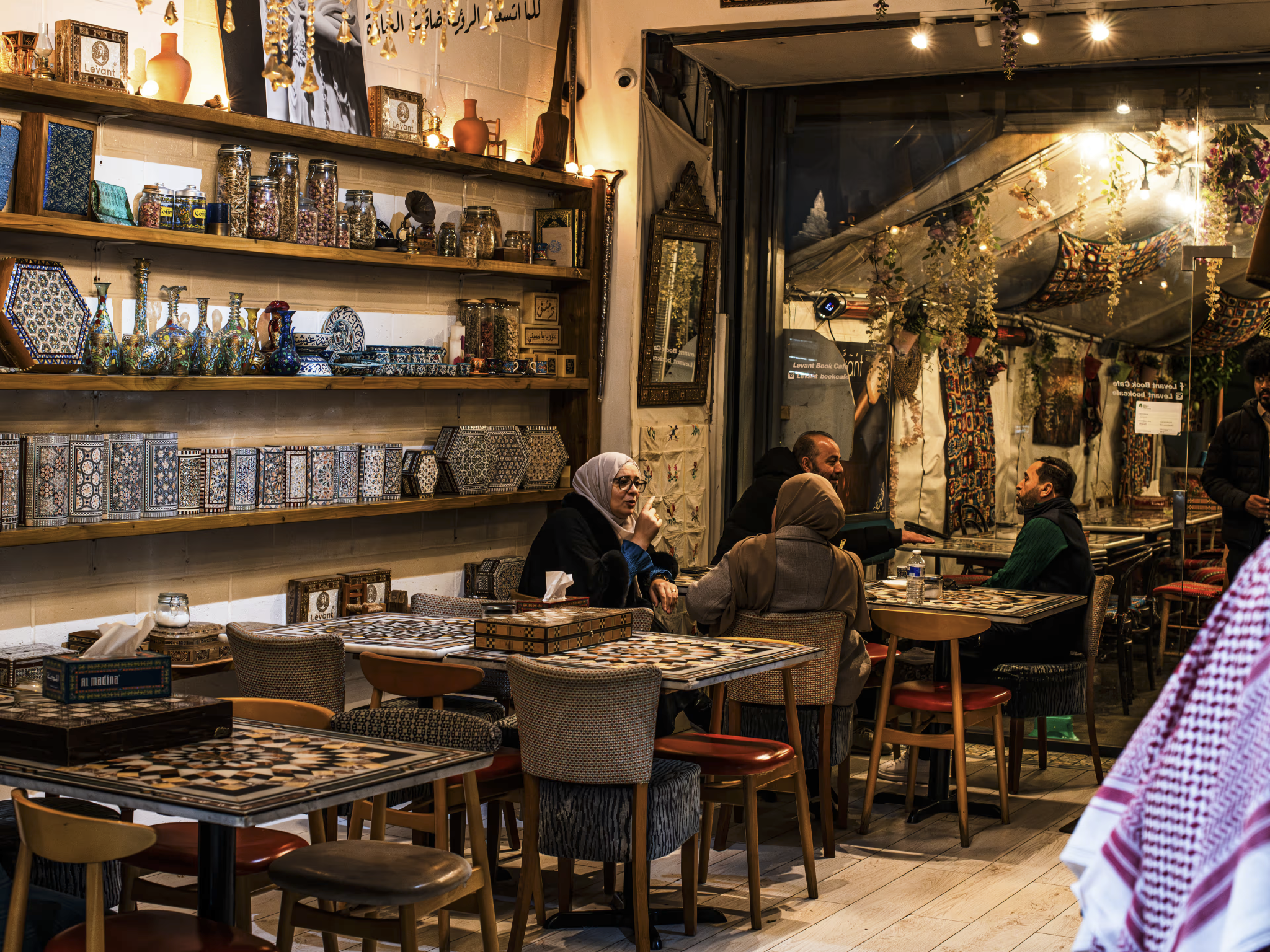
The only reason I’m bumping these two countries together is because Park Royal is like the Levant. In my top three cafes in London is Levant Book Café. You’re instantly transported to Syria – the decoration, architecture, windows, colours, fountains. Plus, Syrian coffee culture isn’t like the British one. You’re invited to stay as long as you like – they close at midnight every day. For Lebanon, go to Kamil Bakery for a shawarma pizza. Fresh, cheap pizza topped with shawarma, sauces, veggies and pickles.
Iran
Iran is a day out in Finchley Central. As a Persian-Londoner, anytime I’m homesick, I go here. First is my mum’s favourite nut store, Zandiyeh. Saffron pistachios and fresh almonds. Next are the bakeries – head a few stores away to Tavazo and get noon khamei (like profiteroles’ better sister.) Finish the day at Caspian Lounge – get an Iranian hotdog (thank me later) and bastani ab haveej (saffron ice cream in fresh carrot juice.) Super refreshing with notes of rosewater, pistachio, and of course, every Iranians favourite: saffron.
Turkey
To me, the Turkish motherland has to be Harringay. There are streets of Turkish businesses – from the furniture store (Istikbal) to the limitless supermarkets (perfect for your sucuk fix.) One must-visit is Gozleme House. A grandma is making fresh stuffed flatbreads in the window in front of you – if that’s not a good sign, I don’t know what is. Another spot I love is Çiğköftem for çiğ köfte. The name literally means ‘raw meatball’ but it’s vegetarian – it’s made of bulgur, tomato paste, and spices. Make a wrap with lettuce and pickles and you’ll be in heaven.
Kurdistan
There’s no one specific place for this – I spent the day in north, south and east but here are two of my favourites: at number one, Erbil in Edgeware Road. A lot of the Iraqi restaurants are actually run by Kurdish people from the community, and at Erbil, 80% of your meal is free. With every main, they serve multiple free starters. Next, Ranya in Kilburn. It’s the coolest Kurdish supermarket and sells fresh flatbreads for £1.
Rounding Off
If you’re still wanting more, try these last few recommendations. See the beautiful architecture of Palestine House which takes me back to my childhood, and have arguably the best coffee of your life. The Petrie Museum in UCL houses ancient Egyptian and Sudanese archaeology and is free entry. And try your best to spend £5 at the Sudanese Blue Nile Bakery – it’s hard. I got six pastries and a tea and still spent less than a fiver.
There are still so many countries I have yet to explore: Oman, Tunisia, Jordan, Kuwait, Yemen and more. I’m on the job: once I’ve completed my travels, I’ll report back to you. In the meantime, you can find me at Dance Around the World Without Leaving London – my day party on 20 June where we travel to five regions of the world in five hours through music and dance, and SWANA is there every time.
The Jig Is Up
When Brendan the Navigator opened in 2021 on a steep incline of Highgate Hill, it was something of a novelty, a new-school Irish pub serving Guinness and live folk sessions, but also padrón peppers and agreeably priced New World wines. It’s now shuttered, but it was a prototype for a certain genre of ersatz boozers looking to cater to the capital’s burgeoning class of Hibernophiles: Molly Mcs in Vauxhall, The Horsemen and Fitzgerald’s in the City and, of course, the mothership itself: The Devonshire, a pub majority-owned by an Englishman serving British cuisine in the heart of our capital that is still, somehow, Irish at the same time.
Of course, this particular model is nothing new in London town – The Cow in Notting Hill, owned by a privately educated furniture scion and managed by a team of Albanians, has effected – successfully effected – an Oirish identity since the 1990s for the badly behaved bohemians who make up their clientele.
In a city with so many great historic Irish boozers – Skehan’s, Blythe Hill Tavern, The Sheephaven Bay for starters – it’s no wonder that people want to update and possibly elevate traditions. And, of course, Englishness, at least to a metropolitan crowd with disposable income, has flag-adjacent connotations in these extreme times.
But we would like to see this change. There are so many exciting things happening in English food and drink and folk music. The question is how you would market it to an audience of Londoners, and who would be brave enough to try it.
The Great Dane
If you follow the art press, you’ll know that there’s no coherent story to be told about the state of the market today – beyond the fact that it’s in fairly awful shape. For every commentator lauding the baby galleries as the industry’s saving grace, there’s another arguing that the rarefied top end of the market – the Pollocks and Brancusis – is the only reliable area.
Ever the contrarians, London Gallery Weekend – a yearly event that sees local dealers pay £500 to put stickers on their doors – took an unusual tack. The artists presented are neither spunky upstarts nor market stars. Most have been chugging along, loved by some and ignored by many, since sometime in the 20th century. If you want to see some interesting art this month, we recommend avoiding the overly glitzy or esoteric, and getting amongst the following three in Mayfair:
Prunella Clough (on show at Thomas Dane until 25 July) applied the drab palette of Modern British painting to a set of semi-abstracted forms and networks that she ‘collected’ from her everyday life. That’s what Jenni Lomax, the curator of this exhibition, says. Lomax’s accompanying text illuminates Clough – who has, since her death in 1999, become a favourite artist of contemporary painters and critics – as an artist who found significance in the quotidian and managed, sometimes, to translate some of it into her relic-like canvases. This concise exhibition of her late work is no more lofty in its positioning than Clough herself was as a painter. But to truly animate the flotsam and jetsam of daily life as she did – to make it momentarily vibrate with potential – is no small miracle.
Stephen Shearer (on show at David Zwirner until 31 July) is less satisfied by what’s in front of him. His paintings, whose imagery sits somewhere between Old Master portraiture and 80s punk zines – are at once vivid, hallucinatory and mythical. This show is replete with characters whose coiffured hair doesn’t quite match their pallid, translucent skin and sunken eyes. Most of these figures have precedents in art history – Shearer’s haunting contribution is to put them into a pair of jeans and send them somewhere that looks a lot like hell.
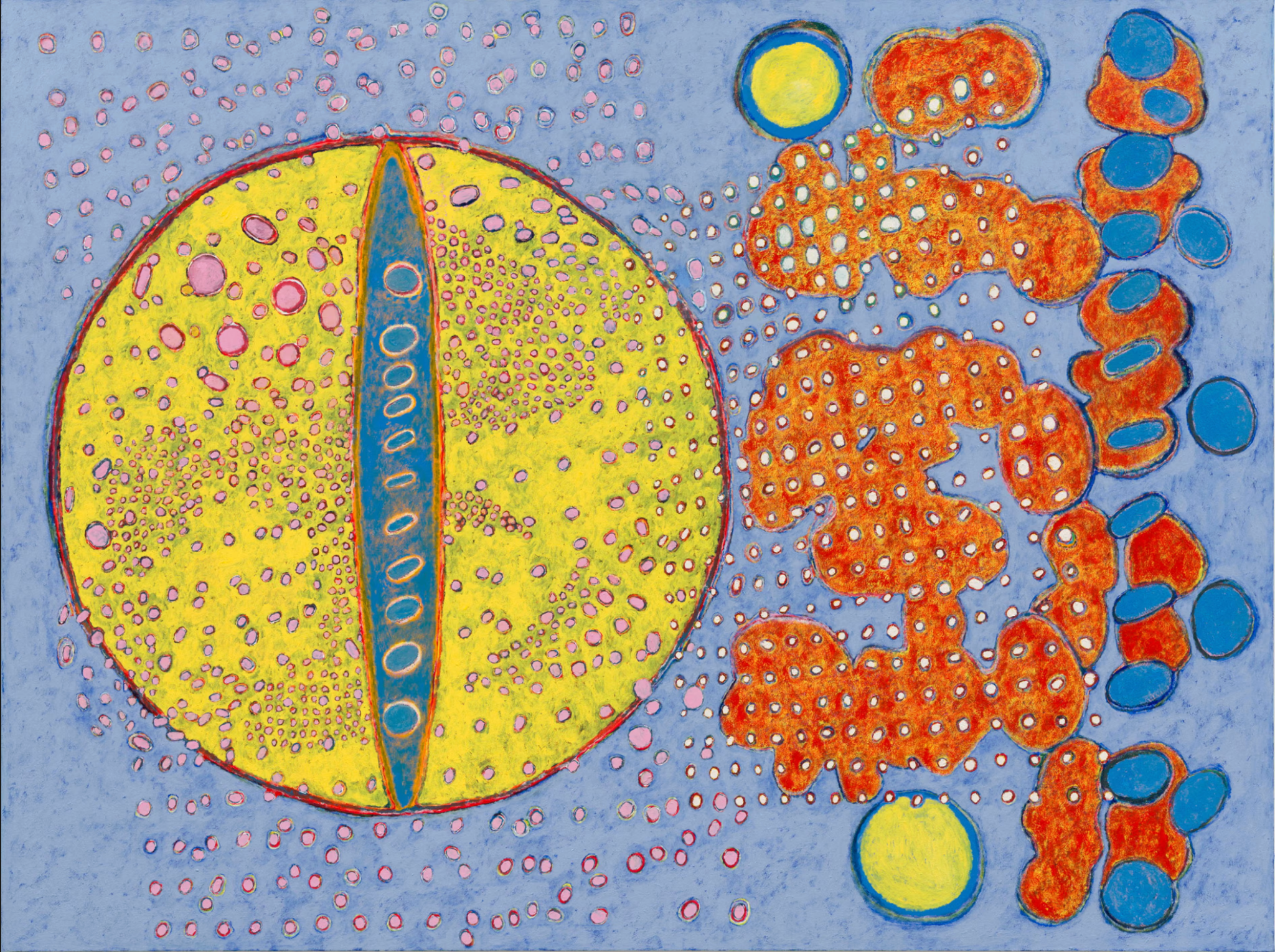
Terry Winters (on show at Modern Art until 11 July) might be painting Clough’s daily detritus or Shearer’s cursed punks, only very close up. Like, very close up – microscopically so. In his abstractions, cell-like forms mutate, multiply, morph and migrate. They fall into loose constellations and then deviate from them; colliding, overlapping and subsuming in a way that makes you wonder whether there’s some greater plan at play here. There’s something distinctly biological about them. Like our bodies, they are rhythmic and imprecise – and, if you look at and think about them for long enough, strange and miraculous.
On the Tiles
We’re back with G’s selections, who selects even more incredible nights out.
Founded by Lex Blondin, the original venue and studio space on Foulden Road became the unlikely home of some of the most boundary-pushing sounds coming out of the UK. A breeding ground for artists like Sons of Kemet, Shabaka and many more. And you feel that history when you walk in. Colourful, unpolished, lived in. The basement venue space may technically be gone but the studio and smaller event space are as alive as ever. Also, there’s free sweets. Love.
I’ve witnessed a jazz legend’s birthday jam, a listening night curated by the most beautiful vocalist, and that time they transformed the basement into a late-night samba party with Aleh Ferreira’s Roda de Samba. Thank you Lex! Sidenote: Aleh runs an incredible samba day party in Notting Hill called Samba de Raiz on every last Sunday of the month.
And I have to include Lex’s gig project The Church of Sound. About twice a month, Church of Sound takes over St James the Great Church in Clapton for 24 hours and turns it into somewhere between a gig and collective workshop. I’d pretty much go to any Church of Sound event without checking who’s playing.
And it’s in the round. There’s something about being on the same level as the musicians and then looking across and seeing people completely lost in it, fully entranced. And you’re in a church! A religious experience! Also, we’ve got to talk about the Caribbean Food. Huge portions for like a tenner with all proceeds go to charity. Scrumptious.
With any event Charlie hosts, you know you’re going to leave with a completely new perspective and at least one new friend. Whether it’s a dance, a listening session, a festival set or his run club Run Dem Crew, it’s always a masterclass in building community in a single event. If all this sounds appealing, Charlie’s listening sessions at Devon Turnbull’s Listening Room at 180 Studios is one to check out.
But I want to talk about Charlie’s dances, they are transcendental. 8 hours. Open to close. No filler. The stamina. The dedication. A proper magical selector, he simply knows when to play the right tunes at the right time to make the crowd completely lose it. The group photo at the end says everything.
Shai Space is not somewhere you stumble upon, it’s very much a destination. A cosy listening room hidden in an old warehouse in Peckham’s backstreets, and for me, a bloody trek to get to. But that’s part of what makes it so good, the sacrifice, remember? Once you’re there it feels like a second home. You’re fed and blanketed by both sounds and actual blankets. There’s complimentary tea, delicious vegan Caribbean food and the city’s best DJs playing 90-minute sets, mixing and layering sounds you’ve never heard into incredibly unique sonic journeys.
BMX Shakespeare Strikes Again
We’ve been scouting away in the theatre to try and find some real good stuff to send you to and have, as per, been somewhat disappointed. CARE at the Young Vic had some promising moments – Hayley Carmichael and Linda Basset are phenomenal – but as per his other work (The Other Place at the ‘Nash) writer/director Alexander Zeldin ruins it all with unbelievably heavy-handed touches and some of the worst-written characters we’ve seen all year.
We had higher hopes for Mother Courage and Her Children, a rare appearance of Brecht at Shakespeare’s Globe. The performance we watched was a little different. Michelle Terry – the Globe’s Artistic Director – is starring as Courage, but she did not appear. Instead she was covered – the Globe doesn’t have understudies so it was covered (quite impressively) which did damage the show somewhat. But frankly, what we saw didn’t look like something one performer could solve. There were messy and rather dull bits of staging (at one point ushers gathered on the balcony to drop confetti on us…) and the stakes of the play never felt very high. A bright spot was Ferdy Roberts as Minister, who was the only actor who seemed to really rise to the quality of the play, whose text and songs were quite tepidly rendered for the English stage.
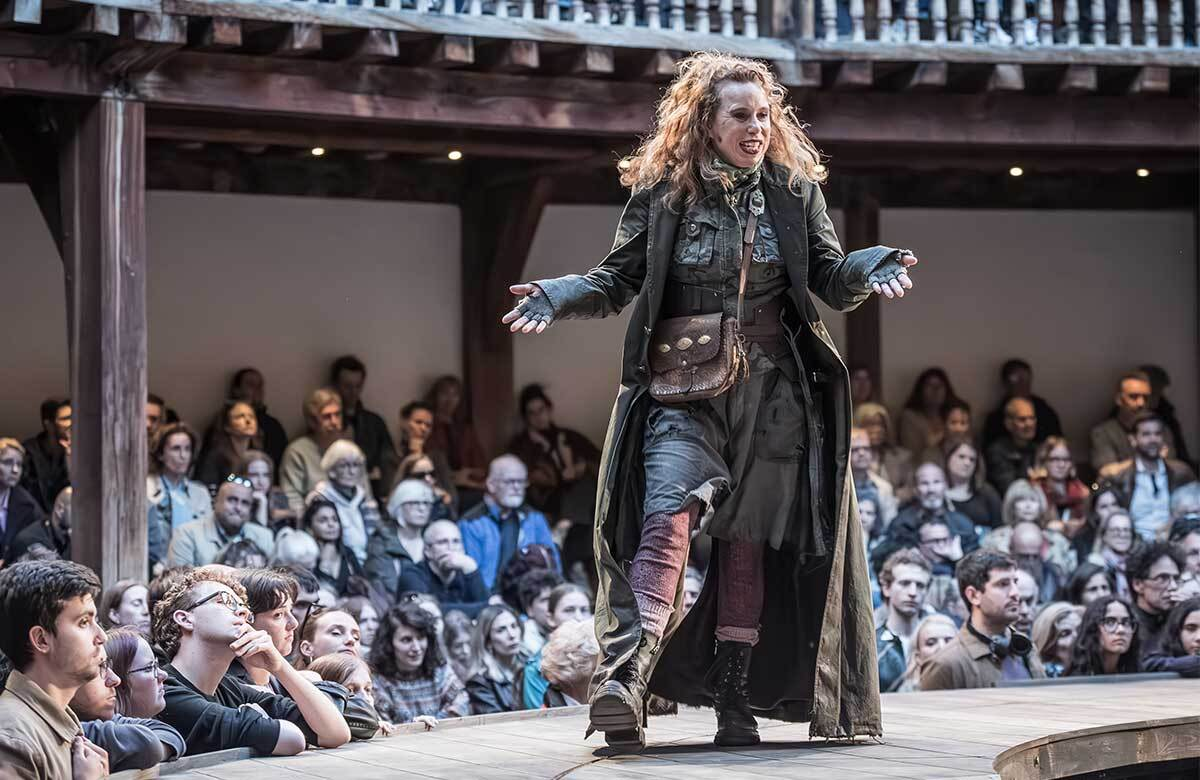
Thankfully, we had the good fortune of heading to the opening night of White Rabbit Red Rabbit, which is beginning a residency at the Duchess Theatre. A truly unique play written by Nassim Suleimanpour back in 2010 when he was unable to leave his home in Iran. It is designed to be performed by an actor who has never seen it, nor even read the script before they appear on stage. We saw the great Lucian Msamati do it – upcoming are such names as David Tennant, Kathryn Hunter, David Harewood and Jodie Whittaker – and it was spectacular, mostly because it actively plays with what live theatre can do, something our other visits this last fortnight fell well short on.
Daubs & Dashes
It’s funny how fashions wax and wane. These days, very few of the boldface names in British art are based in London. Damian Hirst and Jake Chapman are in the Cotswolds. Tracey Emin on the Kentish coast. David Hockney looks set to die in France.
Despite the guttural German accent he maintained till his death at the age of 88, Lucian Freud spent the overwhelming majority of his life in London: flitting between Paddington studios and Soho fish restaurants, shimmying up Chelsea drainpipes for encounters with his titled lovers and dining, infamously, at The Wolseley on Piccadilly.
The house he stayed in for the longest holds a number of secrets. 138 Kensington Church Street is, as some of you will know, three minutes’ stroll from Notting Hill Gate, on a particularly antique block of W8 where everything is done in the best possible taste.
Freud used it as his studio and his house, and then left the property to his long-time assistant David Dawson. Worth millions as a piece of real estate, its paint-splashed walls have stayed untouched since Freud’s passing, and as such, stand as a vital piece of national heritage.
Will the public ever be allowed in? We hear conflicting and fascinating reports as to who exactly holds the keys to the house right now. Of an evening, you can see where Freud waved goodbye to Kate Moss after she sat nude for him at the pomp of her beauty. Picture that scene, and then retire across the road for a pint at The Blue Stoops.
We do hope you enjoyed that particularly globetrotting caper. Do subscribe to Capital Letter to keep this offering growing, it really does mean a lot to us to see so many of you coming back regularly! As ever we are open to pitches, thoughts and tips at editorial@the-fence.com. Our full treasure chest map is available here.
All the best,
TF