Dear Readers,
Good morning and welcome back to Capital Letter.
It is a pleasure to be with you once more. We note with pride and joy that this is the fastest-growing part of everything we do here at The Fence. If you like what you see here, do consider a subscription to the full print magazine or buying the latest issue.
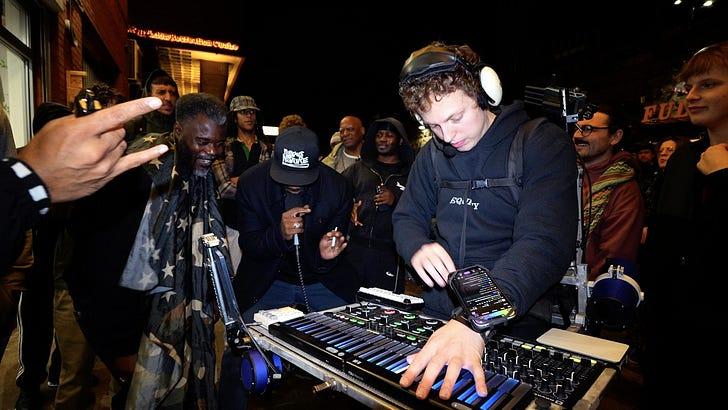
Our capital has suffused our thoughts and minds this last fortnight, but one particularly enjoyable piece of London content came courtesy of an American this week, Ari Miller, a man who wanders around city streets (usually in New York) making live music for people to rap or sing over. He made the trip over to Brixton and took a video.
The full stream features several great cameos from Inspeckta Veg – an MC and health food influencer – who we had the pleasure of encountering on a bus in north London. He was carrying an enormous bag of sarsaparilla root and explained its benefits to us (unprompted). When he got off the bus, he stopped to turn round to the closing bus doors and spit a quick eight-bar, most of which he finished as the bus was mostly pulled away. Anyhow, it’s a great showing for the overly maligned Brixton – we jump you in as a bloke who’s been having a roadside haircut jumps on the mic.
https://www.youtube.com/watch?v=4l8mNN-qLC4
We have much that showcases other parts of the capital in similarly excellent lights for you this time round. There’s a big dosing of history but we begin with some choice thoughts on one of the capital’s most prominent foodstuffs.
A Pizz-a Our Minds
As it is with Guinneses, pizzas are either bad or good. There is no sliding scale of quality. Only morons or small children say otherwise. There is no nuance to it. It does not matter if you have let your dough rise at 38 or 39 degrees, nor if you slightly alter its hydration levels. No one can taste the difference.
Indeed, one of the best pizzas we’ve ever had was stumbling home from a disgusting nightclub in Prague. It involved no art and we’re pretty sure it had an entire hot dog on it and we would take it over a slight of slow-risen organically sourced wood-fired nonsense you might otherwise find for £20 in the city.
And yet London seems awash with the stuff. We even had to witness it getting a BBC slot when Naples on the Road, a UK-based restaurant, won ‘best pizzeria in the world’, an award that after the 400th slice, is an absurd act in splitting hairs. We are reliably informed that getting a seat there on a weekday lunchtime can involve an hour to an hour and a half wait.
Is there any need for the fuss? We’ve had some good pizzas such as Breadstall (although their interior vibes are horrific), Lunablu (a small place up north that loads the things with toppings) and the now sadly defunct Oscar’s Lockdown Pizza out near Walthamstow. We’ve also had many that are bad – Franco Manca being the leading offender.
So what do we advise with regards to pizza in London? Simple: never travel for a pizza, never queue for a pizza and never pay more than you should for a pizza (£15). And, preferably, eat something else.
Serving North London Realness
Jamie Lennon lowers the net.
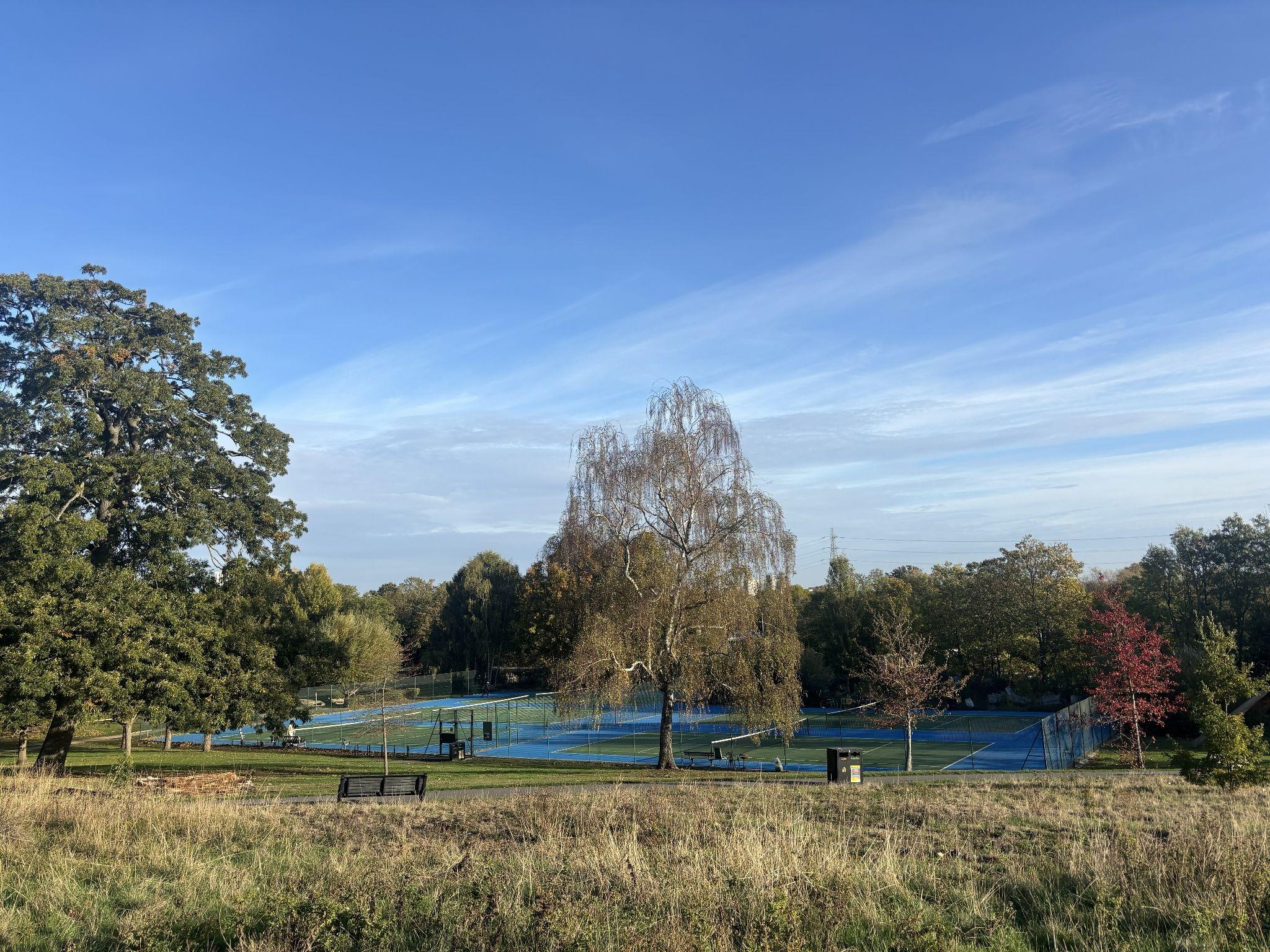
London’s north-eastern residents surrounding Springfield Park will know three things: that the park’s sloping eastern aspect and wild parkland mark it as one of the loveliest spots in zone three, that the Anchor and Hope down the River Lea is as crusty as it is charming and that the group of men playing tennis on court four are never to be trifled with. Tucked under the bowed willows lining the river, surrounded by rich meadowland that turns golden as the sun sets, the courts are almost bucolic in their loveliness.
But the same players are, without fail, always there. They are a decidedly eclectic composition. Viz, a fired-up eastern European, serves rockets to an elderly Caribbean man. A shirtless American slices cross-court to a Hasidic Jew, sitting back of the service line in his full garb. A sloping Italian in a Legionnaire’s hat returns up the line with a deft backhand.
A fluctuating yet unremitting fixture of court four, they stay long beyond daylight’s permission to see the ball, and in eternal defiance of the one-hour fair use limit marked on the signage. Each weekend, indignant newcomers will approach the group and question their flouting of the rules. Little more than a grunt is ever offered back. Many have tried to overthrow them, many have failed. Their resistance is too strong, their foundations too firm.
Visitors might have reason to resent this group. But they should be giving rapturous thanks. In August of last summer, the gates were locked, the nets came down and a sign went up: courts closed for refurbishment. The news ripped through east London tennis group chats. A statement soon appeared on the council site: Springfield’s courts were undergoing their upgrade, and once complete would reopen on a bookable basis.
Winter came and went and, as the frost melted, punters were out on the crisply coated courts. The new gate sat leering at visitors, though curiously had not yet been activated. Many months and matches came and went, yet the blow never came. The court’s saviours were none other than the old faithfuls. Around the time of the refurb administrators, the council sent down an in-person representative to bring the severe news that they’d soon have to cough up for their favourite old court. This was not received well. Roughly seven paid a personal visit to the offices of the council and addressed the matter directly, making the case for a little reconsideration. The courts have remained free since, and these men go unthanked.
It’s time all visitors knew how lucky they are to have them there, those men on court four.
In the Best Possible Taste
In the latest edition of Noble Rot magazine, there is an inaugural ‘50 Best Restaurants in the UK’ list and we have to say it really is bang-on. Obviously, most of the restaurants are in London, and it’s great to see so much love for exciting, risk-taking neighbours of ours like Mountain and Osteria Vibrato. Truth be told, we were slightly surprised not to see A. Wong on the list, and The Yellow Bittern take up a slot at 14. Hugh Corcoran’s food is decent and the wine list is excellent, but it is not one of the best restaurants in the country. Still it’s good to see initiative and imagination being recognised as London’s culinary scene becomes dominated by ‘elevated pub classics’ from private equity barons and unexciting celebrities.
Digging, Digging, Digging
Does everyone remember Crossrail? No, us either – we now call it the Elizabeth Line and it no longer menaces headlines with news of careering delays or costs. Instead, it’s what you name-drop if you want people to be jealous of your commute. In contrast to its decade-long construction shambles, it now is a part of London life that fosters a kind of acceptable patriotism (please get in touch if you have an opening day foam finger), in its two-and-a-half years surpassing all TFL forecasts with over 500 million passenger journeys. Perhaps a lesser-known aspect of the whole debacle is that its construction was piggybacked into serving as the biggest archaeological dig in London in a generation.
Leading archaeologist Jay Carver and his team from MOLA (Museum of London Archaeology) uncovered over 10,000 artefacts spanning 8,000 years of the capital’s history in the excavation of the twin-bore tunnels. Some of the largest finds were two massive plague pits – the Bedlam Burial Ground in Liverpool Street, housing 3,000 skeletons from the Great Plague, and an estimated tens of thousands more from the Black Death sitting under Charterhouse Square. Workers also found 20 Roman skulls in the Walbrook River sediment, one of London’s subterranean rivers, as well as the remnants of one of the capital’s last commercial shipyards. And we could continue to bang on about the wolf-ravaged reindeer bones, the Tudor bowling ball or the sizable chunk of a Roman road, but all we really want to talk about is our favourite find, the 68,000-year-old bison winched out at Royal Oak. You can go and see a selection of these artefacts, which have been variously scattered into museums and research centres around London (including said bison), but of course, a lot were left in place. So as well as getting you from central to east London in just over ten minutes, we can also now enjoy the Elizabeth Line for the fact that we are aware of staggering layers of ancient London life sitting dormant underneath Prets and parks. Or, to be specific, a small town’s worth of Black Death skeletons who have found their final resting place below TikTok’s UK headquarters.
Sliding Doors
Walking around London, it is easy to get flashes of foreign capitals among the architectural jumble, Bloomsbury is Dublin, the Barbican is Berlin – we could go on.
Mostly, however, the city is indisputably distinct, whether from its Portland stone, stucco terraces, chimney pots or indeed the jumble itself, largely serving as a reminder of the Blitz and the baffling decisions of 60s urban planners. London’s remarkably preserved visual history almost didn’t come to be, and it even got quite close to resembling certain foreign capitals in its entirety.
After the Great Fire flattened the medieval city, initial official responses involved undertaking a mass rebuilding project, informed by a comprehensive plan that was to outline the entire city. Planners who vied to lead redesign included Sir Christopher Wren, draughtsman Richard Newcourt and army officer Valentine Knight. Wren’s plans predictably set out to rebuild London with a Baroque grandeur, complete with wide boulevards leading to large plazas that, if carried out, would have London looking far more like what would become 19th-century Paris. Submitted just six days after the fire was extinguished, Charles II was so keen on the plans that he appointed Wren as one of six commissioners to oversee the rebuild.
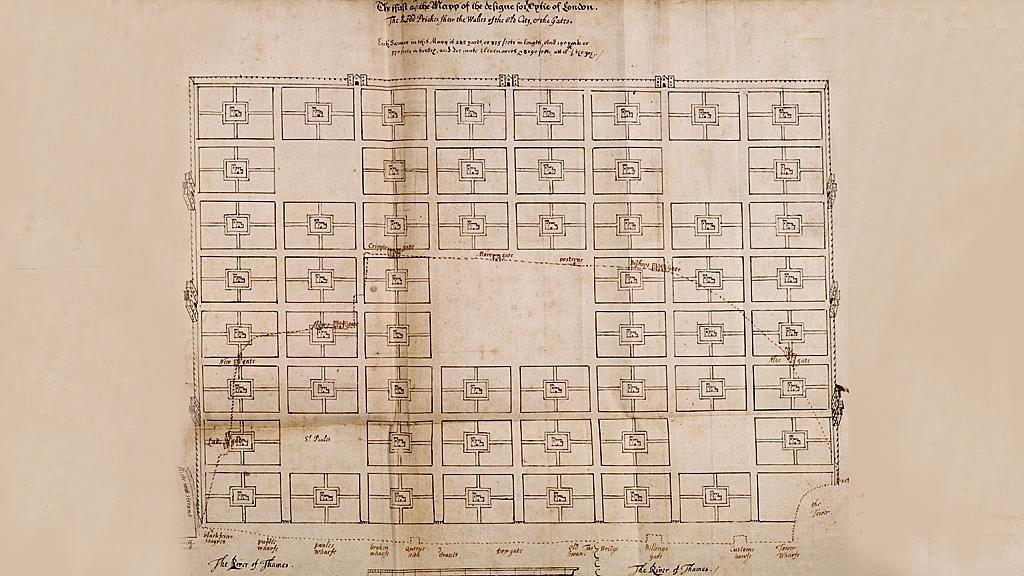
Newcourt’s blueprints took on a different tack, proposing an eerie grid system with a church placed at the centre of each identical block. Knight too opted for monotony with rows and rows of east/west streets, interrupted occasionally by long north/south cross intersections. His plan was rejected, and he was even thrown in jail for suggesting raising money from the public for the project through a canal toll, which the king found reprehensible. In the end, none of these even came close to fruition as property owners ignored the whole affair and simply returned to their plots to rebuild what was there before – scuppering the king’s plans with a diligent indifference.
Instead of ‘a much more beautiful city than is at this time consumed’ as Charles II promised, London reemerged as a remarkably faithful recreation of what it once was, save for a few building regulations, including a ban on timber facades, obviously. The plans live on only in RIBA’s collections (a worthwhile visit when it reopens in its entirety) – apart from Newcourt’s, which had a respectable second wind, directly influencing William Penn and Thomas Holme in designing the 1682 gridiron layout of Philadelphia.
Take Me (Back) to Church
And let us carry this trip down memory (or more accurately history) lane one stop further. Long-time followers of Capital Letter will know that a great slew of wonderful London churches used to await weary travellers at the end of many of these mail-outs. Well, their relative absence of late can now be remedied by the presence of St Margaret Lothbury, whose current form is deeply linked to the post-fire rebuilds that nearly turned us French.
The building as it is now is mostly a rebuild by the Wren’s Office (for whom a double CL mention is surely his greatest achievement), but in the process it gathered in a huge amount from other, similarly damaged, churches, making it something of a Frankenchurch, suitable for this end of October edition.
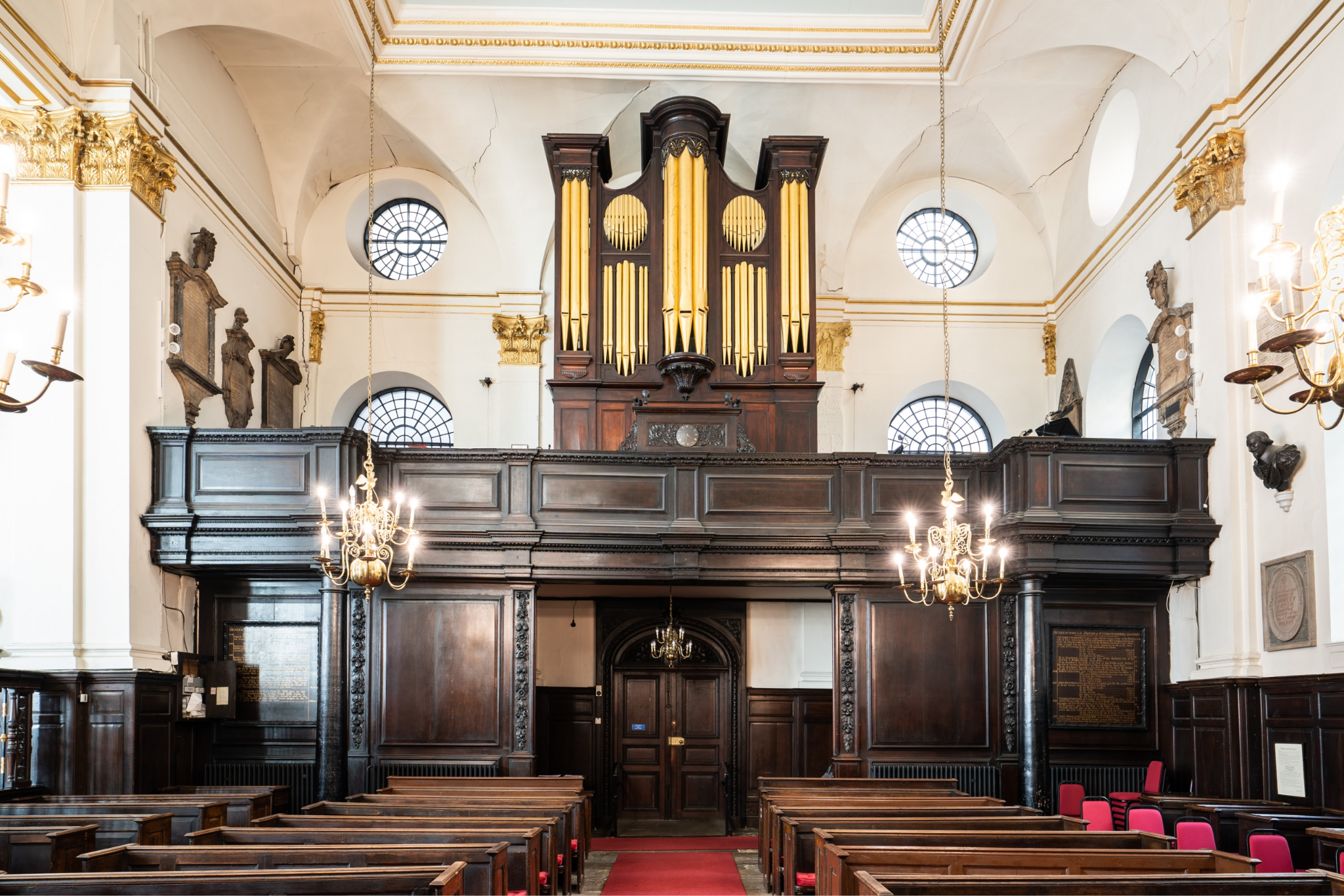
The reredos and baptismal font are from St Olave, Old Jewry and are believed to be done by Grinling Gibbons, whose legacy is still present at Windsor Castle and Hampton Court Palace, as well as Grinling Gibbons Primary School in Deptford. The sounding board and rood screen are from another church that bit the fiery dust in 1666, All-Hallows-the-Great. It also features two paintings of Moses and Aaron that came from St Christopher le Stocks (demolished 1781) and the organ, pictured below, is an 1801 design, still with its original casing, and most of its original pipework.
But its roots as a dedication to Margaret of Antioch are even older, with a church in her name occupying the site since 1185. Pretty good going for a church that houses the remnants of so many of its peers who fell around it.
Right, we won’t keep you any longer. We do hope you enjoyed this week’s gallivant round these historic streets. Do be in touch to let us know what things you want to hear more (or less of), whether you want to be the one doing the telling or not. Our hearing trumpet is tuned to editorial@the-fence.com. Otherwise, we remind those with access to get onto that tasty map which has been updated for use, and encourage those without access to purchase it hither. Otherwise, we leave you in peace with our urban, and urbane, blessing.
All the best,
TF