Dear Readers,
Good morning, and welcome back to Capital Letter. This week we’ve got some great dispatches and items for you this week that will take you all round the capital – down to Broadway Market, into the bowels of the Houses of Parliament and onto Cock Lane in Spitalfields.
This fleet-footed edition got us thinking about the bus driver’s prayer, a take on the Lord’s version vastly improved by a full use of this city’s place names. It’s one of those bits of text that is hard to know the origin of, probably because it developed as a good joke among those who used it. There are many versions – different areas, one of bus drivers, one for policemen – but we like the version Ian Dury recorded the best:
‘Our Father
Who art in Hendon
Harrow Road be Thy name
Thy Kingston come
Thy Wimbledon
In Erith as it is in Hendon
Give us this day our Berkhampstead
And forgive us our Westminsters
As we forgive those who Westminster against us
Lead us not into Temple Station
And deliver us from Ealin
For thine is the Kingston
The Purley and the Crawley
For Iver and Iver
Crouch End.’
Do keep getting in touch with us on editorial@the-fence.com. Both of the bylined pieces came to us on that exact grapevine, so if you’d like to have your writing here and pick up a small fee along with it, do send us your pitches. You can check a rough pitch guide here.
With our prayers said and ear extended, we can begin the fortnight’s glimpse into the many faces of this great city. But we kick off with a dispatch from the centre of government, from Rich Bunn.
Rat Race
‘After the Queen,’ says Stuart, ‘came the black wave.’ Stuart is the pest controller for the Houses of Parliament. A quiet, unassuming man, he stands in front of me expectantly, a bag of bait boxes in hand. We first met when I worked as the Health and Safety Manager for the House of Commons. I was brought in to keep safety hazards within acceptable levels until a larger decision on restoration and renewal landed, and it was in that period that Stuart and I got to know each other. Years later, I meet him three floors beneath the dignified opulence of the committee corridor, in a damp basement choked with internet cables, gas pipes and retrofit air conditioning. ‘The black wave?’ I repeat. He nods, rattling the box. He is referring to the increase in the rodent population at Westminster Hall that followed Elizabeth II’s lying-in-state in 2022.
That Parliament is in a state of disrepair is well known, but Stuart’s own battle within that war is less common knowledge. He goes on, ‘Rats and mice, huge ones, they’ve been here so long that they’re mostly immune to poison as well. But it’s not just them, we’ve got pigeons, seagulls, a huge problem with moths, silverfish in the library, beetles in the flour.’ The building is apparently teeming, and if anyone can attest to the population, it is Stuart. He is an expert on vermin of all varieties: ‘Liz Truss used to say Boris Johnson’s dog had fleas.’ We are walking through the back passages of Parliament, setting traps for the rodents, Stuart pointing out the ideal niches in which to place the snares.
But not every creature is unwelcome. ‘Service dogs are very well cared for,’ he says. The latter fall into a more official menagerie. There are ‘sniffer dogs, patrol dogs, guide dogs, horses for weddings, falcons on the roof for the pigeons.’ And, ‘the Speaker of the House of Commons has two cats, two dogs, a parrot and a tortoise.’ When I look surprised at the mention of a tortoise, he explains simply: ‘It’s only allowed in the Speaker’s garden.’ There is no true solution to the problem while Parliament remains in its current state, so the infestation problem looks set to continue. But Stuart is sanguine. When I leave him, I leave him to the black wave. There is some comfort in that.
Open City Documentary Festival
A number of screens across London are opening their programmes over April for the Open City Documentary Festival. We’ve had a scan through the offerings, and there are some very good things to peruse. For our purposes here, two stand out especially. One is a screening of William Raban’s Thames Film (1986), which is simply a journey from Tower Bridge to the Thames estuary and back. The images shot in the 80s are mixed with archive footage from 1937, as well as travel writings of the same route in 1787, read by John Hurt.
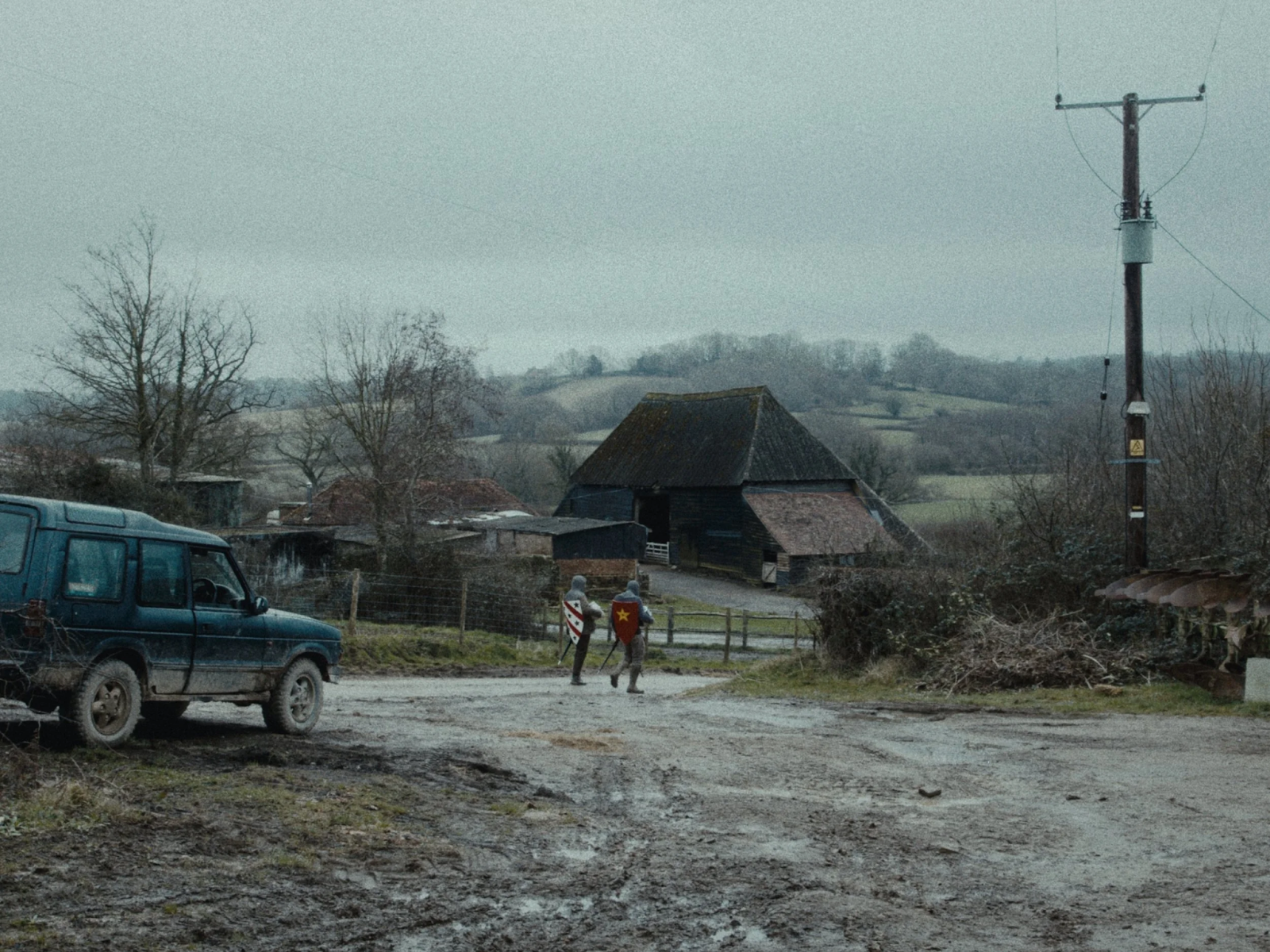
The other is called Matter of Britain, made in East Sussex, Mayfield to be precise, taking its name from the body of medieval literature about the legendary world of British and Breton kings. The idea of the picture is to mix traditional documentary about contemporary life there, with a focus on environmental degradation, with something a little more daring: a full-costume reenactment of the Arthurian legend of the holy grail. Made with the participation of 300 Mayfieldians, it looks to be a fascinating and unique way to approach filming the UK, full of slow, ponderous takes shot on gorgeous 16mm.
There’s some good programming on Palestine and Gaza, with Sven Augustijnen’s film about Hassan al Balawi, a Palestinian diplomat, and the boldly titled TERRORRISM the TERRORISM land TERRORISM of TERRORISM common TERRORISM disgrace. The latter is a series of staged police interviews and trials, involving pro-Palestinian activists who have re-imagined the events that happened to them. On top of this, the film will be screened silently, the audio provided by a forensic lipreader and ‘the participatory role of the attendees’. Not one to bring popcorn to.
The Green Fairy
As you know, we have made big statements about hating ‘gatekeeping’, that is, hoarding the choicest recommendations about London life for ourselves. If nothing else, Capital Letter exists to slam down the drawbridge. You will of course be familiar with Gerry’s, the legendary liquor store on Old Compton Street. It has the most comprehensive stock and also the fairest prices, with some excellent wines too. But what is less well-known is that they sell beers from split cases at slashed costs, so you can pick up, say, four bottles of a delicious continental lager like KEO for £5, which really is good going these days. They also do tastings most afternoons during the week, if you ever want a daytime shot of absinthe (for free). One of the pearls of Soho.
Off-Broadway
Sophie Clark made a trip down the famous Hackney market.
It’s 7.50 am when Matt and I arrive at the bridge where Broadway Market begins. The only people on the frozen street are vendors and stern runners/ I am here to follow Matt on a typical day at the market, and it begins when he opens the boot of a clown car. He grabs wooden slabs, propane and a full grill. Then lettuce, chicken, tofu, mushrooms, rubber gloves, knives, chopping boards, more wooden slabs, more rubber gloves. With screws, wrenches and zip-ties, he transforms the empty wooden bench that he pays £70 a week for, and makes it into his stall, Tokyo Kebab. Like many of the vendors, he has Stephen Selby to thank for his current position.
For a long time, Selby was the heart of Broadway Market, credited with reforming it 20 years ago after becoming chairman of the Broadway Market Traders’ Association. It’s a position he was perfectly suited for; as far back as the 1980s, he had been devoted to the market’s preservation, working with tabloid photographer Stuart Goodman to oppose redevelopment plans by the Greater London Council. He then worked as a seller in the intervening period before pushing for the market’s reopening in 2004.
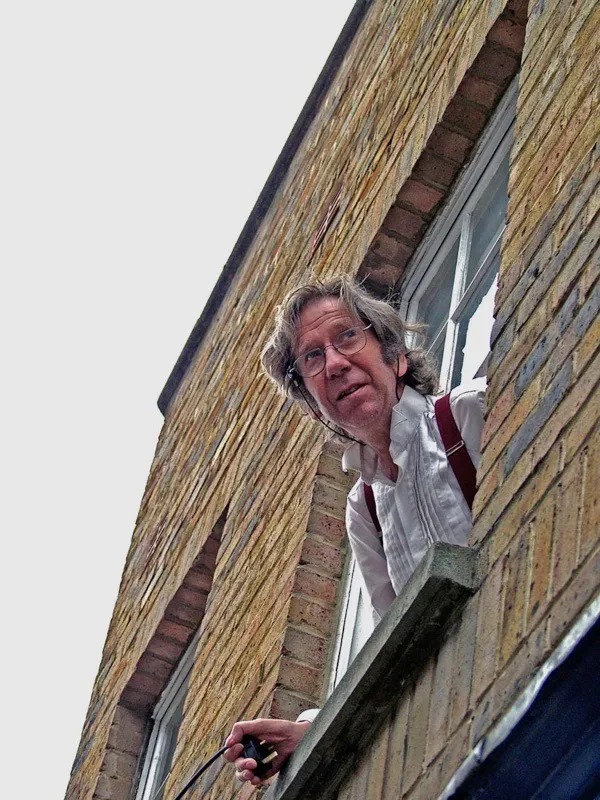
Selby was known throughout the street for his trademark red suspenders and his extraordinary generosity, providing electricity from his flat above the market to vendors in need. Fastidiously polite, he had somewhat incongruously worked in advertising in New York in the 1960s. He passed away this year, and today, most shoppers on Saturday obliviously pass a stall dedicated to him, although some stop to leave a message to the heavens in a red leather-bound memory book. Selby’s absolute goal was the preservation of a market that Matt continues to serve.
The first challenge of the day comes when we notice Matt’s orange propane canister is leaking. He points me to a blue building that turns out to be the backbone of the market, storing hundreds of propane cans, which are used for the cooker. But in spite of the flames, it is cold. I notice that Matt and the other sellers are standing on cardboard. ‘It’s to stop our feet from freezing,’ Matt explains. I naively believed proximity to the grill would warm me up, and I realise that the most valuable item in this market is a broken-down box. On the market, Selby said that he wanted to ‘create a high quality market, and not in conflict with anyone’. Sharing a scrap of wet cardboard feels in keeping with that vision.
Matt is expecting a rush at noon, but it’s barely past 10 when the first queue starts forming for his miso chicken wraps. I use my notebook to mark down orders, and get brutally reminded of my failures working behind a bar at 18. Matt starts to go non-verbal as the orders stream in. It hits 12 pm, and Matt’s friend Alex arrives to serve as a ‘firefighter’ as the demand shows no sign of stopping. It’s barely midday, and we’ve already bulldozed through 10 kilos of chicken. Between 1 and 2 pm, it’s nearly a wrap a minute. Matt hasn’t said a word in over an hour.
By 3.38 pm, everything from Matt’s stall has been devoured. As he finishes boxing up his grill and bin-bags, I notice that after 4 pm the market demographic changes dramatically. The fashionistas and ‘creatives’ are replaced with mostly older unhoused people asking around for leftovers. Food that was a weekend treat an hour ago is suddenly a necessity. The stall owners seem willing and able to give a box or two to those in need. Nearby, Selby’s stall looks on.
Fanny’s Your Aunt
If we told you that there was a London ghost known as Scratching Fanny, and that she was reported to haunt a building on Cock Lane, you’d think we’d been possessed by the spirit of Kenneth Williams. Not so. The Cock Lane Ghost took Georgian London by storm, one of the first big stories to really obsess the whole capital. William Kent, an illegal loan merchant from Norfolk, a sort of one-man Wonga of his time, moved into a property on Cock Lane with a woman – called Fanny Hynes – whom he claimed was his wife. In fact, she was the sister of his recently deceased wife, Elizabeth, whose marriage was illegal under canon law.
The man who had offered them this place in Cock Lane, Richard Parsons, was hardly a byword for morality either. Though outwardly respectable – Parsons was the parish clerk, a layman tasked with assisting the Vicar at St Sepulchre without Newgate – he was known as a soak and a permanent debtor. Indeed, it was in exchange for a large personal loan that Parsons found the couple a room. Things went south when Fanny, who was pregnant, fell ill with smallpox. In her illness, she and Parsons’s daughter both reported mysterious knocking. Not long after, Fanny died.
Kent left Cock Lane and tried to sue Parsons for the inevitably unpaid debt. It was at this point that Parsons’s daughter Elizabeth began to report scratching and knocking in a room in the house. It was reported that while the previous ghost had been the spirit of Kent’s first wife, this was the ghost of Fanny, determined to share the real story of her death. Parsons brought in several clergy, including the then rector of St Bartholomew the Great, who was notorious for his Methodist sympathies. Early Methodism had an obsession with ghosts, and it is quite possible that Parsons chose his cleric carefully.
The rector reported a series of scratches and knockings and came away convinced of the ghost’s authenticity. Several seances were arranged during which ‘Fanny’ began to accuse her ex-not-husband of murder with arsenic. The Georgian press – based in Grub Street not far from the site of the haunting – had a field day. In the end, the ecclesiastical authorities intervened, with the vicar of Clerkenwell putting together a committee to investigate the claims, which featured, among others, Dr Johnson. The committee pretty soon discovered that ‘Scratching Fanny’ was in fact the work of Elizabeth Parsons, who had hidden in the bed with a small block of wood and produced the required sound.
Kent was acquitted at the Old Bailey, the senior Parsons was fined and condemned to the pillory, but the legend of the Cock Lane ghost lingered long in London’s memory. It was depicted by Hogarth, derided by Johnson and mentioned by Dickens. Cock Lane now is a rather sad collection of offices round the back of Smithfield (otherwise one of the City’s most interesting areas), but it is certainly worth a wander down en route to Trattoria Brutto or St. JOHN. As you do so, listen out for Scratching Fanny.
*
So concludes another edition of Capital Letter. We do hope you’re enjoying these outings. As our newest newsletter, we’re keen to keep trying things and experimenting here – we promise there’s lots of fun stuff to come – so do please let us know what you like, what you don’t and what you want to see. You can drop us a line at editorial@the-fence.com or just comment down below. We always love to hear from our fellow Londoners and London appreciators alike.
Until the next fortnight beckons, tread well.
All the best,
TF