Dear Readers,
Good morning, and welcome to Capital Letter, and what a glorious morning it is. The sun is shining and London is feeling lithe and limber, the streets full of possibility. We are here with a tipsheet, written in the best possible taste, and delivered via email.
Brief note of housekeeping: if you’ve been enjoying what we do here, please do tell your friends, and if you would like to write for us, do send us an email to editorial@the-fence.com, and we will attend to you promptly there.
Paid subscribers are able to feast on the tipster’s treasure map, and we do encourage you to join their number so we can keep this mail-out’s expansion ticking over.
This week, we have something of a history special, but we start with a trip to Mayfair.
Revolt into Style
People talk with increasing fervour as to what is the ‘best’ restaurant in London, but really, we should be asking: what is the coolest restaurant in London?
Some mainstays are still, somehow, cool, like the River Café, despite its ludicrous prices and Sloane Ranger staffers. Some old standbys are getting cooler with age – like Andrew Edmunds, where the clientele seems to be getting younger and hipper with each passing year, drawn by the hand-cut flowers and the promise of Soho. St. JOHN’s original site is one of the great pieces of interior design of the last 50 years, and even an egg mayonnaise sandwich by the bar can feel, to use a hoary cliché, like ‘an experience.’
Then there’s the new guard, where the diner is thrust into the white heat of 2026: Ikoyi, Planque, Goodbye Horses, Mountain, Dalla. All deeply stylish and exciting places to eat out.
These days, when restaurateurs are increasingly drawn by the ‘pub model’ epitomised by the runaway success of The Devonshire, we should prize those who look to spend budget on designer staff smocks, starchitect visions and mid-century Italian furniture.
So it stands to reason that Dover Street Counter – a restaurant that promises thrusting Manhattan energy in the heart of Mayfair and which has been raved about by every critic in the land – should be squarely on our list.
On our visit, what we can definitely say is that the food was really very good, and at prices reasonable for this part of town. If you like eating cheeseburgers, then you’re in for a treat.
But the dining house experience was not particularly agreeable. There’s deep house music played at just too high a volume. The crowd is comprised of people who like the idea of coming to Mayfair for the day, rather than regarding it as their birthright. The whole thing seems contrived, and in quite a boring way, just a little too ‘Soho House’ – and, inevitably, the Dover Street Counter’s owner, Martin Kuczmarski, is the former COO of the private club megalodon.
If you want to pretend to be richer than you are for the day, we do recommend a visit.
The Cave of the Golden Calf
Readers of our sister newsletter Off The Fence might recall that we published a dispatch from the first club night at ‘lost’, and that we struck a somewhat sarky tone. Since then, it’s scored quite a bit of coverage, a lot of it ecstatic. It’s undoubtedly great to see a new nightclub – especially one in central London – thrive in such a punishing nightlife economy, and to succeed while having such experimental programming. There are complaints of expensive drinks, door fees and ‘sceney’ behaviour, but these are eternal fixtures of the clubbing scene.
On our street – Archer Street – there is, for much of the day, a long snaking line of up to 45 minutes for Spud Bros, an eatery which sells potatoes with baked beans. In the immediate environs, there are people queuing for noodles and cheeseburgers and nylon hoodies.
What this all goes to say is that we are pleased that people are queuing for nightclubs in central London again. Waiting in line for boring food items is one of the great delusions of our age, and we will be pleased when it is no longer a thing.
On the Street Where You Live
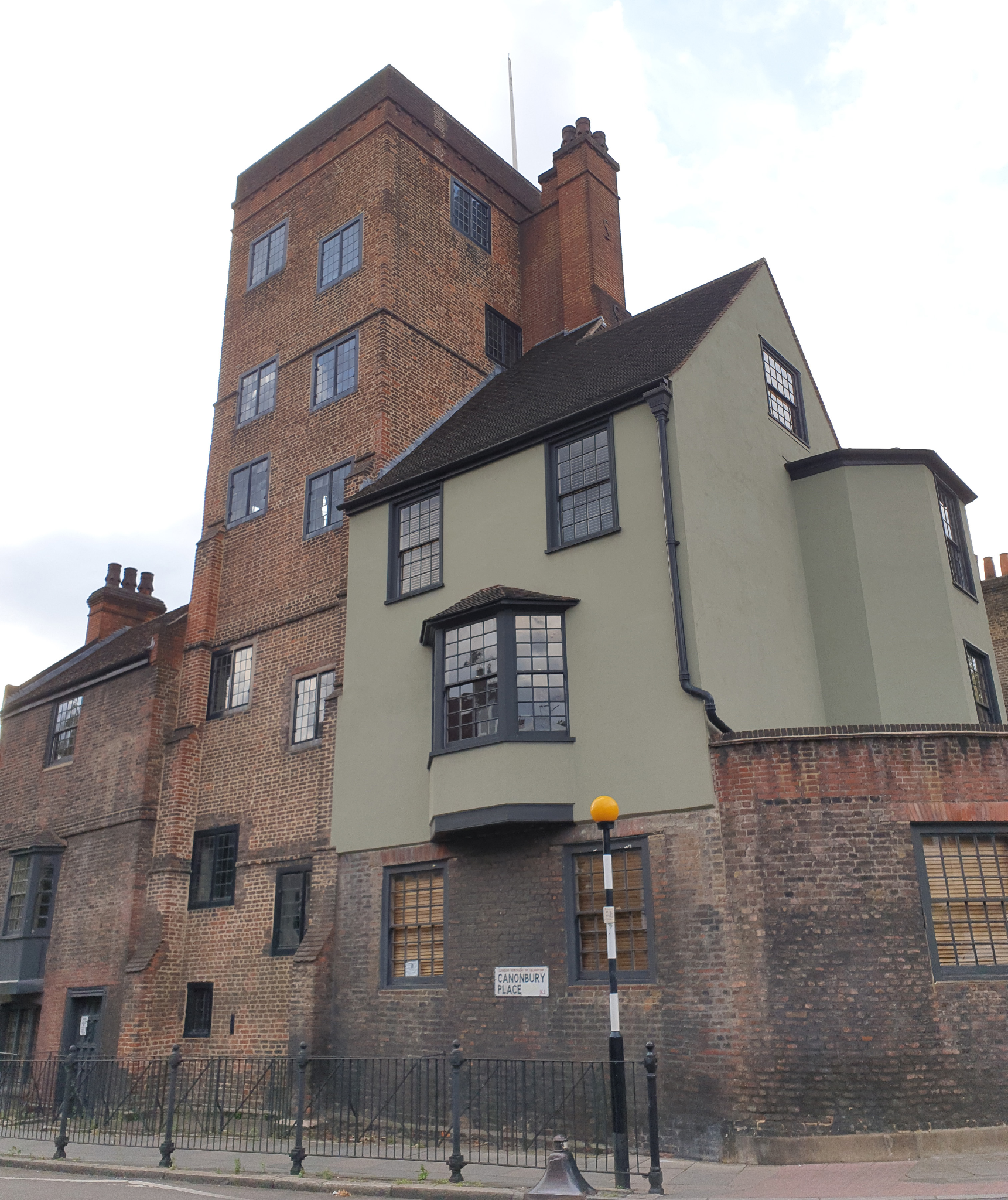
Where does London feel at its oldest? Where do you feel the centuries course through your veins? The tourist overspill at the Abbey and the Tower will dampen any reverie (unless you’re invited on a private tour). The narrow alley of Cloth Fair probably takes the title, where the 12th-century church of St Bartholomew’s juts out into the road across from some of the few houses in the City that survived the Great Fire. In second place, though, is the complex around Canonbury Tower in Islington, with a particularly beautiful row of Georgian houses on Canonbury Close lit by one of the few remaining gas lamps. It’s a scene so agreeably historique that it was used as the streetscape for the 1968 film of David Copperfield. And who does the only blue plaque belong to – none other than the brutalist seer, Sir Basil Spence, who lived and operated out of the grandest place on the street. How’s that for an irony of history?
The Duke of Kent
We had a brief word with one of the capital’s most important theatre directors and former artistic director of the Tricycle (now Kiln), Nicholas Kent, about his new show Ukraine Unbroken at the Arcola.
Ukraine Unbroken is a collection of five one-act plays that draw on stories from Ukraine’s recent history. Why this form?
The value is you can get some very interesting playwrights to address several topics. Playwrights sometimes envy journalists for not having to invent the stories.
That’s a slightly optimistic view of journalism.
The idea was to go back 12 years to 2014, because a lot of people had forgotten what 2014 was about and how this all started. There were lots of stories that most people don’t know about, like the stolen children who’ve been abducted to Russia, which are now over 20,000. Gradually we collected these kinds of stories together to make the show.
What separates a well-run theatre from a middling one?
I inherited the theatre from Ken Chubb, and he understood what a theatre in the community should be. He laid out four planks of policy and that made it so easy: we had to do new work; work for and and with children; work by and with women; and work that reflected the ethnic community around us. If the work didn’t meet those policies, it was out the window.
It also meant our programming moved with the community that we served. When I started, Kilburn was predominantly Irish. Then it moved to being Afro-Caribbean, and then it became Asian. And so, through these transitions, the writers and work that we programmed changed too.
Say a bit more about people who’ve been involved in the theatre.
I was lucky to see the famous debate [between James Baldwin and William F. Buckley] in Cambridge and I then met Jimmy many years afterward at a play reading at Willesden Library. At the interval, I walked along the stacks, and there was James Baldwin! I went up to him and said, ‘I saw you at the debate, you were amazing.’ He just turned to me with a smile and said, ‘Yeah, I was on song that night!’
Another Country
It turns out that James Baldwin spent a surprising amount of time in London. Though he hailed from New York City and spent much of his adult life in Paris, Baldwin returned repeatedly after his first visit in 1949. His time spent here really started in 1955 with his meeting and subsequent collaboration with Michael Joseph, one of the founders of Penguin, who would eventually buy the publisher in 1985. And all because Baldwin apparently loved Dickens.
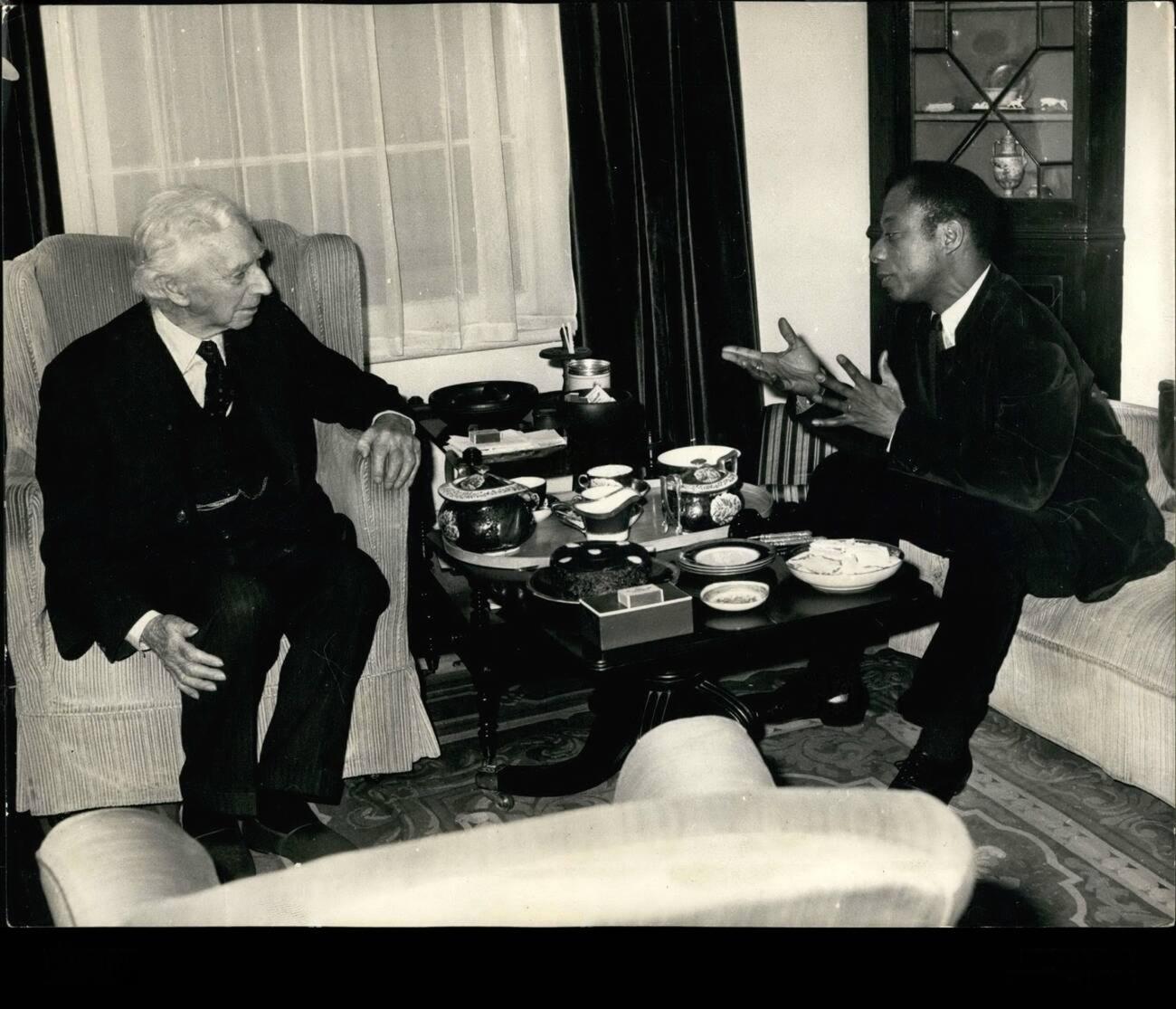
But that’s not all. In 1965 he visited Bertrand Russel, who had written to Baldwin two years prior to praise The Fire Next Time and Note of a Native Son. They had tea at Russell’s flat in 43 Hasker Street, between South Kensington and Belgravia (Russell moved there because his old flat was torn down to make way for the Millbank Tower). The meeting led to this wonderful photo and Baldwin’s brief involvement with Russell’s efforts to investigate potential American war crimes in Vietnam, along with Jean-Paul Sartre.
Baldwin came back in October 1967 to work on a stage adaptation of a book on Malcom X, and left just four months later. His editor, Raleigh Trevelyan, said: ‘The London experience didn’t suit him’, and many of Baldwin’s writings reveal a complex history with the capital. When talking to Paul Gilroy in 1985 for City Limits, Baldwin explained that staying in London would have been ‘misleading, maybe fatal, for my writing’ as the apparently helpful similarities with the states felt like traps; ‘we only seem to speak the same language.’
Perhaps the most interesting trail Baldwin’s time in London left was a network of small community centres and libraries which Baldwin frequented. One, of course, was the Willesden Library where he met Nicholas Kent, but the appearance of one of America’s foremost novelists at a local library was far from an aberration. He made speeches at the former GLC Brixton Recreation Centre and spent a lot of time at the CLR James Library in Dalston. This is where you can find Baldwin’s blue plaque.
Similar occasions took Baldwin to places such as The Africa Centre, which used to be housed in 38 King Street, sadly sold to a property developer in 2012 despite the efforts of some of its illustrious patrons. It’s now the site of a french tea shop, Mariage Frères. Other buildings frequented by Baldwin have fared slightly better. He spent time at the West Indian Students Centre in Earl’s Court, which you can see in a clip of him speaking here, and which now houses the embassies of Dominica and St Lucia. The large Quaker meeting house on Euston Road is one of the few that survives in both place and purpose. Baldwin spoke there to promote the campaign to free Ngũgĩ Wa Thiong’o, a Kenyan author imprisoned for his Marxist and Fanon-inspired writings.
One of James Baldwin’s final visits to London brought him to the Tricycle Theatre for the 1987 staging of his play The Amen Corner. That same year, he died, and the premiere marked one of his last walks through the city he had so often passed through.
Port Overboard, Starboard Home
If you trace the course of the River Thames through central London, you will notice the comparative smoothness of its banks. The docks are long gone, and the tributaries have been forced underground; almost nothing, beyond its natural bends, interrupts the Thames’s journey to the sea. However, if you look closely – just to the west of Southwark Bridge and on the north bank, opposite the Globe – you will see that there is a strange square of blue that bites into the City of London. This is Queenhithe Dock, the oldest bit of infrastructure that survives in all of London. It was almost certainly first used by the Romans, before being enlarged and restored by Alfred the Great and continued in use as a dock until the 1970s.
Queenhithe was so-called because the duties and taxes from goods unloaded there were awarded to several queens, beginning with Matilda, the wife of Henry I in the early 12th century. The dock was always small compared to others in the capital, being the wrong side of London Bridge for larger, ocean-going vessels. Yet it became critical to London’s economy and subsistence, being the place where, for many centuries, grain was unloaded to feed the populace. As the city grew, the dock became too small for its needs, and so moved to unloading luxury goods like wine and furs. It managed to survive the great departure of the city’s sea trade eastwards and its subsequent collapse. Its smallness and the relative poverty of the surrounding area meant that, presumably, nobody ever thought it was worth filling in or redeveloping.
It is reached by a small side street found just off the dual-carriaged hell-road that is Upper Thames Street. The ward to which the dock gives its name is one of the most residential of the City of London – and also one of the smallest. It feels different – quieter and calmer – than the rest of the City. There are almost no pubs – the Samuel Pepys on the other side of the dock has river views to commend it, but little else, ditto the Mercer Terrace has sensational vistas of rarely seen corners of town, but a sterile feel. Still, the memorial mosaic to Alfred the Great is nice.
Take from all that what you will. And if you find yourself taking rather a lot, you might consider becoming a paid subscriber – not least for access to our rather splendid, ever-evolving map of recommendations, updated weekly for your viewing and reading pleasure. It’s only right.
All the best,
TF