Dear Readers,
Good evening and welcome back to Capital Letter.
We woke up the other morning to a London shrouded in a kind of hopeful fog and gentle sunshine finally beginning to fall over us. It’s March and we are in that strange limbo between the winter and the spring. So perhaps it was only natural that Lord Kitchiner’s London Is The Place For Mewas the tune playing in our heads, its mournful enchanting opening giving way to an upbeat ode to the city, tinged with the understanding that the reality is often something very different. The video of Kitchener (real name Aldwyn Roberts) singing it, having just stepped off the HMS Windrush, is still a striking piece of this city’s history.
Behind the scenes, we’ve been hard at work on our lovely Issue 27 – which we are looking forward to sharing with you all – but not so hard at work that development plans are still well underway for this publication, which truly is our doted-on youngest offspring. We can promise you a shiny (more beautiful) new platform for Capital Letter, which is currently under construction. We’re very excited, and we hope you are too.
This week, like many before it, also has a lovely guest spot, which allows us to remind you all that Capital Letter is always interested in hearing from you with tips and pitches. You can check the guide here and drop us a line at editorial@the-fence.com. If you’re feeling especially helpful, you can even put ‘Capital Letter’ in the subject line.
A reminder, as well, that our map remains a valuable resource to our paid subscribers. It has (almost) every recommendation we’ve included up to now and is pending a nice juicy update. Do make sure to subscribe to CL and select that fully paid-up option.
With that, we turn to this fortnight’s selection. We’ve got some exciting theatrical offerings and tales of the Tyburn Tree. But we begin with Phoebe Pascoe, who has been on a revealing hunt around London nightclub’s lost property bins.
Return to Sender
The true walk of shame after a night out is not heading back to your own home from another’s. Rather, it is schlepping back to the venue from the night before, and explaining to the manager the intricacies which make your black Zara jacket ever so slightly different from the five others behind the bar. Lost property is never a place you want to be. But it is a place of hope, and offers a rare glimpse into the state of the city’s clubs, and the state of their patrons. We went investigating.
Some might claim that they themselves are lost if they end up in the Clapham behemoth – and cog in the Wuthering Heights press machine – Infernos. But the items in the club’s lost property speak to a certain Gen Z preparedness which treats a night out as yet another half-marathon. We heard of fuel (sandwiches and half a loaf of bread), grooming essentials (a couple of electric toothbrushes, an electric shaver, full make-up bags, the odd tanning mitt) and the lost possessions of Infernos’ hopeless romantics, presumably discarded once they had been successfully used in the art of seduction (books of chat-up lines and a gift pack of Lynx Africa.)
North of the river, what winds up in lost property has less obvious utility in a night-life setting. At the Colour Factory, by Hackney Wick, staff were confounded at the end of a long night by a bag of miniature Dungeons & Dragons figurines. At The Lexington, someone recently left behind an IV stand, replete with bags of unlabelled liquids. It was assumed to be a fancy dress prop, but St Pancras Hospital is only five minutes away on a Lime bike.
Some of the more expected, seedy items certainly did crop up. Cleaning up at The Jago, staff have found men’s briefs in the smoking area, and bras on top of speakers. But the most numerous items came at locations where the dancing is more serious. There, wigs have been known to crowd lost property. Both Dalston Superstore and eartH Hackney report ‘hundreds’ of things. EartH’s stash of items more generally resembles the lost and found of a pageant: many single shoes, one Miss Trans Uganda sash and two mannequins. These are mixed in with a plastic shark, a miniature figure of Alex Ferguson, three whips and a buttplug. The final item, I am assured, was ‘not used.’ How eartH’s proprietors were able to confirm this remains unclear.
We ended our treasure hunt at a Thatcher-themed nightclub on the Fulham Road. We weren’t expecting sentimentality, but the lost property at Maggie’s is a shrine to an entirely different lady. Tony Cela, the general manager, was behind the bar one night when he noticed a man place a small pot down beside him. ‘Another guest nearby, trying to place an order, almost knocked it over and the man got very upset,’ Cela says, so he stepped in to see what was awry. ‘The man explained that the pot was actually an urn containing his mother’s ashes. Naturally, we offered to store it safely in the cloakroom, which he accepted.’ The story quickly spread among the staff. ‘To this day,’ Cela says, ‘We still have a picture of the customer’s mother in our cloakroom as a mark of respect.’
An Honest Boozer
Last time out, we identified The Spaniards Inn in Hampstead as offering the most expensive pints in the capital, though one of you did point out that the Nag’s Head in Knightsbridge does also pour Guinness at £8.50 (and refuses to take card transactions for less than £15).
Few people come to this newsletter to learn that you can buy exorbitant beverages in SW7 and NW3; it’s not a particularly vivid insight. But one thing that will surprise you is that The Tarmon on the Caledonian Road is probably the cheapest central-ish pub in London. It’s in Barnsbury – Tony Blair Country – and on our visit last week, we enjoyed a pint of plain for £4 only. Why so cheap? Well, that’s a story in of itself, but do have a look at this episode ofSecret History of Our Streetsand see if you can work it out. Regardless of ownership, it’s an absolutely cracking pub.
Let’s Talk About the Globalists
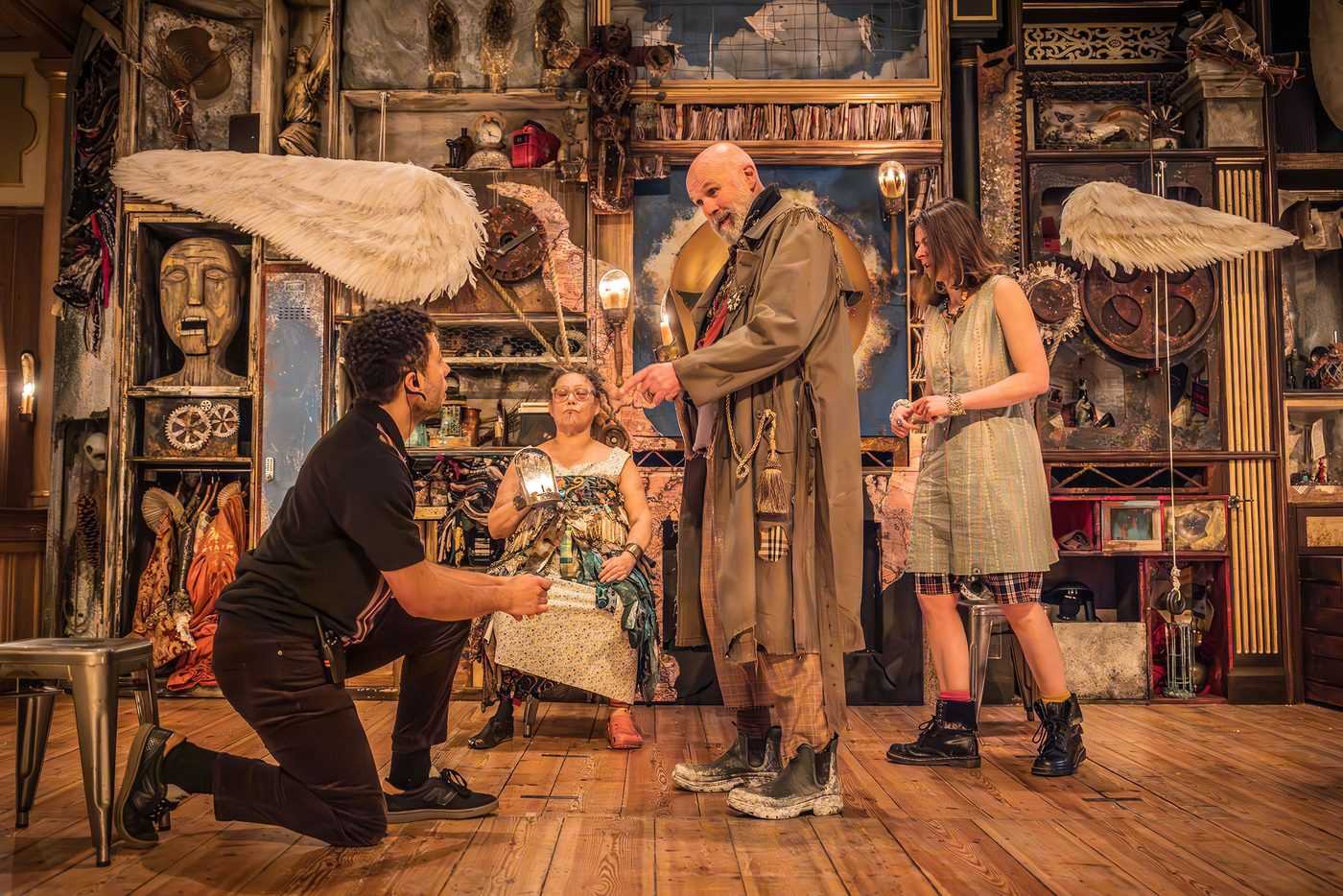
Recently, we have been greatly enjoying going to the Sam Wanamaker Playhouse, and we recommend you do so soon. Despite being in the same complex as London’s most famous theatre, the Globe’s second space is often overlooked. It is, for our money, easily the better of the two stages there. It is a beautiful wooden theatre, lit largely (sometimes exclusively) by candlelight, which gives it a wonderful intimacy. Currently, it’s playing both The Tempest and Deep Azure, the latter a play written by the late Chadwick Boseman.
The first of these we recommend highly. It’s a production by a stalwart of experimental British Theatre, Tim Crouch, who both directs and stars as Prospero. As with all of Crouch’s productions, the act of theatre is just as important as the story on stage. For this reason, Shagspar purists wanting to see someone ‘give’ their Prospero might be disappointed. For our money, Crouch achieves something much more interesting, and in its own way, something Shakespearean, in that the production is uproarious and encourages the crowd to be active participants.
For example, the visitors to Prospero’s island are stationed throughout the audience. Instead of using this as a one-off gimmick, Crouch pursues this idea doggedly. When these characters leave the stage, they don’t go to the wings, but back to their seats, clambering over the audience in the process. When the absolutely hammered Stephano enters, clambering all over the beautiful surroundings, the audience are in fits. At the interval, all the actors are there in the foyer, still in character. Trinculo and Stephano were trying to get a party going; Antonia and Sebastian were immersed in their own conversation on a balcony; we spotted Gonzalo heading off for a piss. Cleverly, none of the island’s inhabitants was to be found. Neatly, and with total commitment, the theatre has been cemented as Prospero’s island and as an active, living space.
It is this kind of approach, along with a beautiful set design from Rachana Jadhav and an excellent cast (especially good are Naomi Wirther’s Ariel, Tyron Huggins’ Gonzalo and Faizal Abdullah’s Caliban) that makes this a unique production of Shakespeare’s final play, which we recommend highly.
The other play on offer is Deep Azure which is a more uneven affair. It’s Chadwick Boseman’s narrative of the aftermath of a police killing of a young black boy, Deep. It’s hard to know what to make of it. At its best, it has some truly striking moments and Selina Jones’ performance as Azure is phenomenal.
Other moments are less convincing. The production’s chorus are dressed like an Andre 3000 fever dream (sparkling leotards with red and blue patches) and Tristan Fynn-Aiduenu’s direction adopts a storytelling style (narration as direct address, using physical theatre to create props and settings) which is hard to nail. It has its moments, but when it’s done right, this style should never make us think, ‘I’m watching an actor move a box’ or, ‘He’s been pretending to be a car door for a while’. Unfortunately, this kind of thing does occur and it slows down the pace of this unusual, knotty drama. All the same, the Sam Wanamaker is such a good space that we never feel like we’ve had a wasted trip. Stop overlooking this gem of a theatre.
Dalston, Via Kharkiv
Nicolas Kent’s new show Ukraine Unbroken is at the Arcola. A collection of five short plays beginning in 2014 amid the revolution of dignity in Kyiv’s Maidan Square, accompanied by music and words from bandura player Mariia Petrovska. It’s a series of fascinating vignettes. David Edgar’s Five Day War, is the best of the first half, and imagines the secretive planning for a puppet provisional government to replace Zelensky (based on a possibly true story.) It was a sharper turn than the opener, which unfortunately, never quite got going, though some critics have been overly harsh on it and have (classically) misidentified the flaws it did have.
What is indisputable is the quality of the final three plays. Natalka Vorozhbit’s Three Mates (translated from the Ukrainian by Sasha Dugdale) is a fantastic monologue about a Ukrainian man dodging conscription. It’s followed by an intense snapshot of frontline fighting and morality, and ends with Cat Goscovitch’s play Taken, which focuses on the plight of one of the roughly 20,000 children who have been abducted by Russia. It is, predictably, a gut punch, but it avoids the main trap of becoming obvious.
The opener aside, then, Ukraine Unbroken is a collection of highly accomplished short plays, and if you don’t fancy the trip to the Globe, we point you in its direction. Edward Bond was known for advising young writers that all he really wanted from theatre was to be surprised, to be educated and to be moved. We found success on all three fronts.
Vivat Tyburnia!
Where the Edgware Road emerges into the chaos of Marble Arch, there is an atoll of traffic islands. It is a good place to go and watch bemused tourists nearly get run over, but there is otherwise not a great deal which would draw the Londoner to this corner of the capital in the current day and age. Not so in the past, for this was one of the most popular destinations for Londoners to spend their leisure time. The traffic island at the end of the Edgware Road itself, shaped like a hammerhead shark, with a broad head and long tail that extends back up towards the Paddington basin, bears witness to this. Placed in the paving stones, between three ugly striplings and barely noticed by those who walk over it, is a plaque which bears these words: THE SITE OF TYBURN TREE.
Between 1196 and 1783, it was here that almost all of London’s public executions took place. Crowds would throng the route up Oxford Street and spill out onto this little patch of land at the north of Hyde Park, where previously a grubby stream- the Tyburn Brook- ran, in order to watch the final moments of those convicted of serious crimes. Those executed here included the Pretender Perkin Warbeck, the Holy Maid of Kent, St Edmund Campion, James Maclaine, the Gentleman Highwayman and, posthumously, Oliver Cromwell. The ‘Tyburn Tree’ as the gallows were known gave their name to the entire district of Tyburnia, which lies to the immediate northwest of the traffic island. It remains a strange part of town even today- a mix of massage parlours, empty townhouses and boutique shops. Appropriately, it is also home to Tony Blair, who has a house on Connaught Square just a stone’s throw from the location of the gallows.
It is worth a little walk around this eerie bit of London, which, despite its proximity to both, feels like it is miles from both the bustle of the Edgware Road and the rus in urbeof Hyde Park. The Victoria, however, is a good pub, and the Shahjahan opposite is an old school curry house holdout. Go for a beer and the special lamb and try not to mind the ghosts.
That’s it for this week. We look forward to speaking to you at editorial@the-fence.com, it really is a pleasure to have so many of you along for the ride. Do celebrate the newsletter on social media, if you’re feeling fancy. We’ll join you a fortnight hence.
All the best,
TF