Dear Readers,
Good afternoon and welcome back to Capital Letter. While this newsletter strives to be original, we will say that these leaden skies are getting to us, which is why we’re leading with a nightlife dispatch with this particular outing.
We are redesigning how this mail-out looks: the design will match the sparse beauty of the prose when everything is completed in late March, which is when we will go weekly.
Thank you to everyone who has sent through ideas for this ‘vertical’. There have been some excellent ones of late, so please do have a read of the pitch guide here and send your best and brightest thoughts to editorial@the-fence.com, and we will attend to you promptly.
Do remember that our piratical map of London’s treasures is available here, but can only be accessed by paid subscribers. It has built up quite magnificently, if we say so ourselves.
Now, let us head into the night.
Underground, Overground, Partying Free
If the names Ledbyher, EsDeeKid and SINN6R mean nothing to you, draw closer. Asha Birdi lets us in on the burgeoning underground clubbing scene springing up across the capital.
As so-called pundits lament the death of London’s party fever, an emerging cultural scene serves to prove otherwise. Gen-Z are becoming the tastemakers of a new ‘underground’. Everything, of course, is circular.
On a rainy Thursday evening in Kennington, I’m queuing with my friend Noah for a documentary screening inside Manor Place, an indoor skatepark-slash-football cage-slash-artist residency space funded by fashion brands Nike and Palace. He shares his thoughts on how the UK went underground. ‘Techno culture, grime, drill, 2016-18 SoundCloud rap, it’s taking all these things and making something new’, says Noah.
Noah was the first of several male film students I would speak to that evening, all of whom were equipped with seemingly mandatory pairs of baggy jeans.
When I asked him if he had any other events on his radar, there were murmurs of the ‘highly secretive’, phone-free night out Lost, which recently took over the former Odeon cinema on Shaftesbury Avenue. ‘Someone told me they went two weeks ago, like bro, you’re not niche!’, he quipped.
Two more students told me, of their own volition, that they had met Norfolk-bred ‘bedroom drill’ rapper Ledbyher, otherwise known as ‘Baby Rachy’. One bumped into her at Elephant & Castle station while another managed to say hello backstage when the artist took part in a Yori Sport runway show at warehouse club Egg London last year. ‘If you see her, please tell her to follow me back,’ he requests.
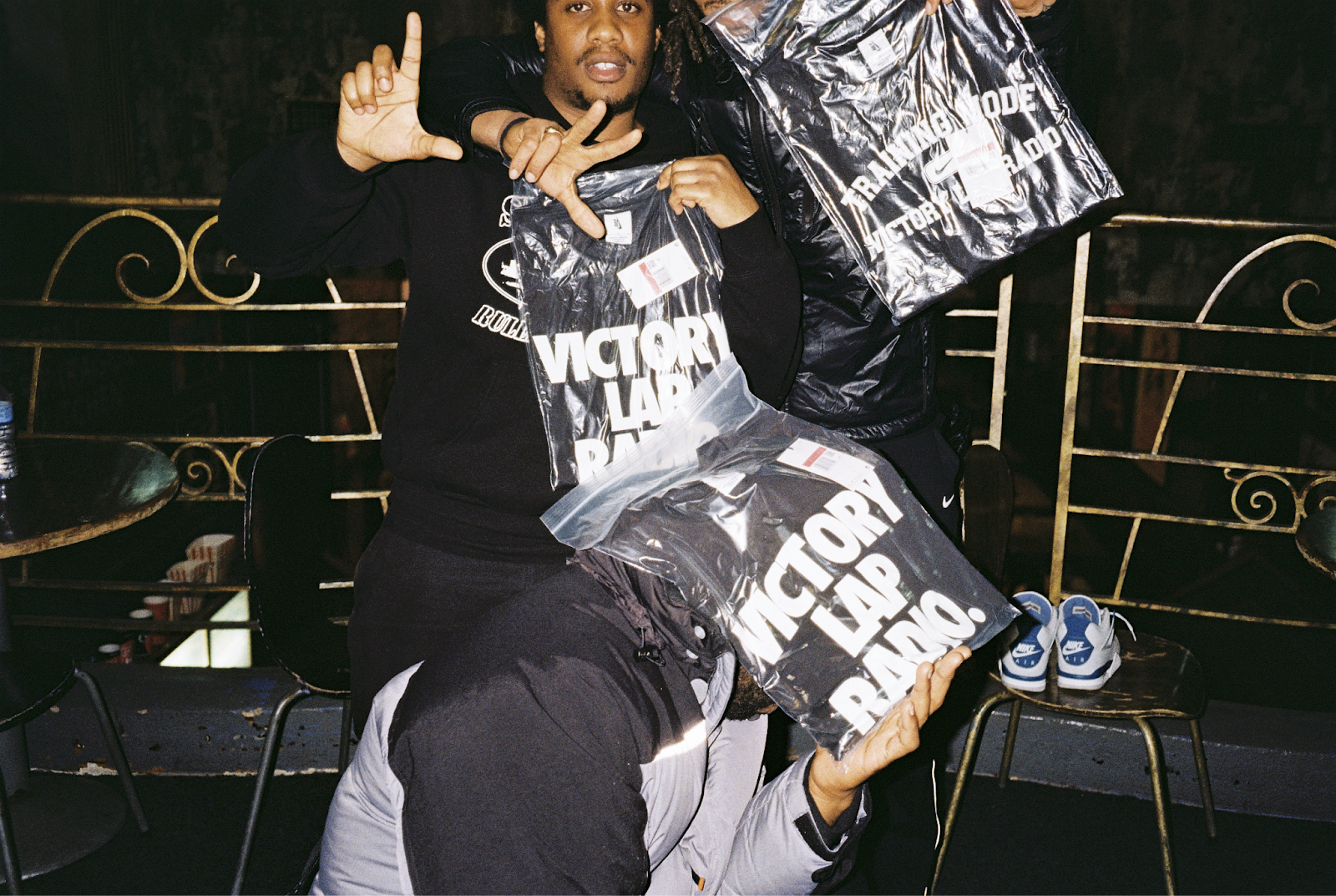
At the front of Manor Place, you are confronted with a bronze Statue of Liberty replica, shed of her traditional robes and instead sporting a black Nike t-shirt with the words ‘Victory Lap Radio’. With its viral rap cyphers, the London-based grassroots music platform, Victory Lap is at the very heart of the scene. Bass, distortion and undeniably British vocals filled the room.
The audience was undoubtedly young but in all other aspects, as mixed as London is. Moses Ideka, an indie musician friendly with the likes of Jim Legxacy, YT and PinkPantheress, noted: ‘You’ve got people here who do editing, illustration, music, all kinds of mediums.’ His statement was proven right when a girl told me she could play the tracks of Scouse rapper EsDeeKid on the harp.
Two young women, giggling with red eyes, told me that the underground never stays still. One said: ‘I’ve hardly been to the same venue multiple times’. South London was their regular haunt, with spaces like Venue MOT Unit 18 and ORMSIDE Projects in Bermondsey, and Jumbi in Peckham, offering their kind of thrills.
If you fancy exploring the scene, consider the fashion advice shared with me by Matrix, an online rap culture commentator. ‘In terms of the staples, you’re wearing Corteiz, you’re wearing a Peak Television hat, you’re wearing some Palace jeans, and [Nike] 110s or Timbs for the shoes.’ He added: ‘If you’re a girl, consider some fluffy boots.’
Once those boots are on, you might want to head to Practice Hours Vol 1.5, a night-out promising cyphers from an array of underground artists and DJs, hosted by Pretty Twisted Live and Black British Hall Party on 26 Feb at The Orange Room. If gigs are more your style, consider the debut show of British MC Afrosurrealist on March 29 at The Lower Third or fall into the recesses of a mosh at SINN6R’s headline on 23 April in Hackney’s EartH. Stay locked in, chiefs.
Floating Down the River
If you are looking for a more relaxed evening of live music, we nudge you in the direction of VOYAGE, an ambitious-looking programme of live electronics, straight-ahead jazz, experimental works and world dance music. As the name suggests, it will be one for those interested in a bit of new music, but we’ve scoped out some of the acts and can promise there will be good stuff to hear. In particular, Gan Gemi’s electronic/jazz orchestrations and Allexa Nava’s phenomenal saxophone playing are to be looked forward to, and one of the DJ’s ending the night, Talulah, is a brilliant DJ and musician we’ve had the pleasure of hearing a few times before.
What’s more, the whole event is supporting Thames Reach, a charity providing supported housing, mental health support and employment advice to people facing homelessness. For this and the quality of the music, we recommend it, even if it will involve trekking to Deptford.
Spools of the Black Stuff
Where can you find the most expensive pub-served pint of Guinness in London? We’ve left out hotels and smart restaurants for obvious reasons, but from our research, it seems that The Spaniards Inn in Hampstead is the worst offender in the capital.
A pint of Diageo’s prize offering costs, at the time of writing, £8.50 only. Do you know of a tavern pouring it out for a princelier sum? Do let us know in the comments or via email.
Lumber Support
Maazin Buhari takes us around the best vintage furniture options in the capital. You can read more of his work at his Substack, The Goodies.
The world of modern design can appear a little intimidating. How does one separate the good from the bad, the overpriced from the bargain? Is it necessary to become a modern design aficionado who has notes on the Frank Lloyd Wright-designed Kauffman office exhibit at the V&A Storehouse? In this busy world, you cannot be expected to know that early Brazilian rosewood is the most collectable version of an Eames lounger, or that the black leather chairs to reference in conversation for maximum clout are Barcelona, Corbusier and Wassily. But if you’re the kind of person who just about pictures a Noguchi table, or simply wants to steadily build up a stylish living room, you needn’t turn to Facebook marketplace for that new coffee table. The world of London vintage furniture awaits.
Chase & Sorensen is an unintimidating and easily navigable store in Hackney Downs, and should be first on your list. They specialise in midcentury Scandinavian furniture; think well-made sofas, tables and chairs. The day I moved into my flat, I found a green Yngve Ekstrom lounge chair, so its track record is good. It’s worth keeping an eye on their website, as such is the popularity of Nordic midcentury design that Chase & Sorensen sells items on pre-order, with some of their best offerings snapped up before they even reach the store.
Next, you could go to the enormous Aelfred in Hackney Wick to see London’s largest mid-century homeware-house. There you can buy some lovely Royal Copenhagen mugs and French copper cookware. Just on the other side of Fish Isl and is the Peanut Vendor (esoteric names are a requirement for these shops), which is a shop specialising in one-off weird pieces in Brutalist, Bauhaus and Art Deco styles. Very expensive, but worthwhile for a good gander at things that can not be found anywhere else.
Next door to the famous Irish-Indian pub Shankeys on Well Street is an outdated storefront which reads ‘The Charity Shop’. In actuality, it currently houses ‘Shoreditch Junk’, one of the most eclectic collections around featuring graffiti artworks, Herman Miller Aerons (the gold standard of all WFH chairs), Eames animals, and humanscales. Tony, the proprietor, is an anarchist, former womenswear specialist, and now jaded dealer that rotates through crates of Swiss modern design pieces, desks ‘borrowed’ from local sixth forms, vintage espresso machines and other objets d’art. Here is a great collection of photos from the store when it was still in Shoreditch.
And here’s a date for your diary. Modern Shows congregates nearly 100 of London’s best modern furniture dealers. Their next show is on 22 March. Expect to find refurbished vintage radios, design-significant lamps and chairs, art prints, British paintings and sculptures, ranging from the ‘that’s not too bad’ to the downright outrageous. Modern Shows runs a great online directory of repurposed, restored, midcentury, and modern dealers across the country as well. Sometime in June, they’ll be doing a second London pop-up inside a design-led hotel and creative living space in Westbourne Park, which has previously hosted design behemoths including Paul Smith and Margaret Howell. Once you’re done with all this, you might be halfway to looking like a Modern House listing, though hopefully you will have got there with a bit more joy and a bit less judgement.
Oh Man, Oh Man! Oh Boy, Oh Boy!
It’s been a while, but we have something really good to recommend to you on the stage: Terrance Rattigan’s Man and Boy at the Nash is phenomenal, and Ben Daniels’ lead performance will be the standard bearer for best performance of the year going forward.
The play sets us in the basement New York apartment of Basil Anthony, a drinker, gigging pianist and budding socialist. Through conversation with his girlfriend, Caroline Penn, we learn he is a reserved man. When Gregor Antonescu – one of the world’s foremost financiers in the midst of a massive crisis – appears at his door, we soon learn why. Gregor is Basil’s estranged father, and he needs help. Soon, the pair are embroiled in a complex game of exploitation, power and denied love, as Gregor seeks to pull off a financial miracle by whatever means he can. It’s a hell of a text.
Rattigan is a legendary figure in playwriting, but one who has often been seen as slightly stale. This was true even when Man and Boy first appeared in 1963, and looking at his work, we can see why. His plays always bear the mark of excellent craftsmanship, but are often judged to be ossified by their upper-middle-class environs, naturalistic stagings and overreliance on subtext and neat quips. It’s not an unfair assessment, but it’s a shame because the quality of his writing and the tensions he creates have an immense capacity to entertain and move.
And it is in realising this potential that this production deserves immense credit. Rather than stick old ‘Ratters’ (as we call him) in another drawing room set, the creative team trusts the quality of his writing and goes for a dynamic staging, borrowing clever tricks from storytelling forms.
This begins with Georgia Lowe’s set, which is kept very simple. The Dorfman is set in the round, which is always a pleasure, and the stage’s green felt holds only a few props: an upright piano, a radio, a telephone, a clothes rail and some drinkware. Otherwise, the space is dominated by three large, rectangular tables with grey wooden legs and pale wooden tops; the kind strewn around classrooms and offices across the country. It is a perfect choice. It’s anachronism declares the production’s intent, and their ability to split apart, come together and vary the space serves the action perfectly. Like all good sets, it also contains a few secrets, but we’ll leave those to your discovery.
The lighting is equally good. Elliot Griggs creates a square grid of lights –almost the size of the whole stage – which are suspended on ropes. They begin the play very low, before rising with a period piece of music to create an old-school overture atmosphere. For much of the play, they hang up above, being correctly unobtrusive. At the end, when Gregor Antonescu faces his fate, you realise they have subtly descended, hemming him in and creating a sharp angle in the space. It’s a supremely effective piece of design.
At the heart of this production’s success is Ben Daniels’ performance as Antonescu. He is nothing like a traditional Rattigan character, with shaved back and sides, a Romanian accent and a tense, brutish physicality. It’s this latter aspect that is most stunning. Daniels’ movements are hypercontrolled and hugely engaging – at times Daniels looks hardly human, more animal or even insect. But it is much more than an imposed style, as some have argued. Gregor Antonescu is a kind of financial genius and confidence trickster; he can remember any figure he reads, knows all his rivals’ pressure points and yet when we meet him, he hasn’t slept in three days, and his mind, body and empire are failing him. All of this is captured in Daniels’ form, and in doing so, we are able to enjoy the subtext and the language in the negative space created by his immense physical presence. The rest of the cast are no slouches, particularly Laurie Kynaston and Gregor’s son and Nick Fletcher as Sven Johnson. The lead, however, is the lead for a reason.
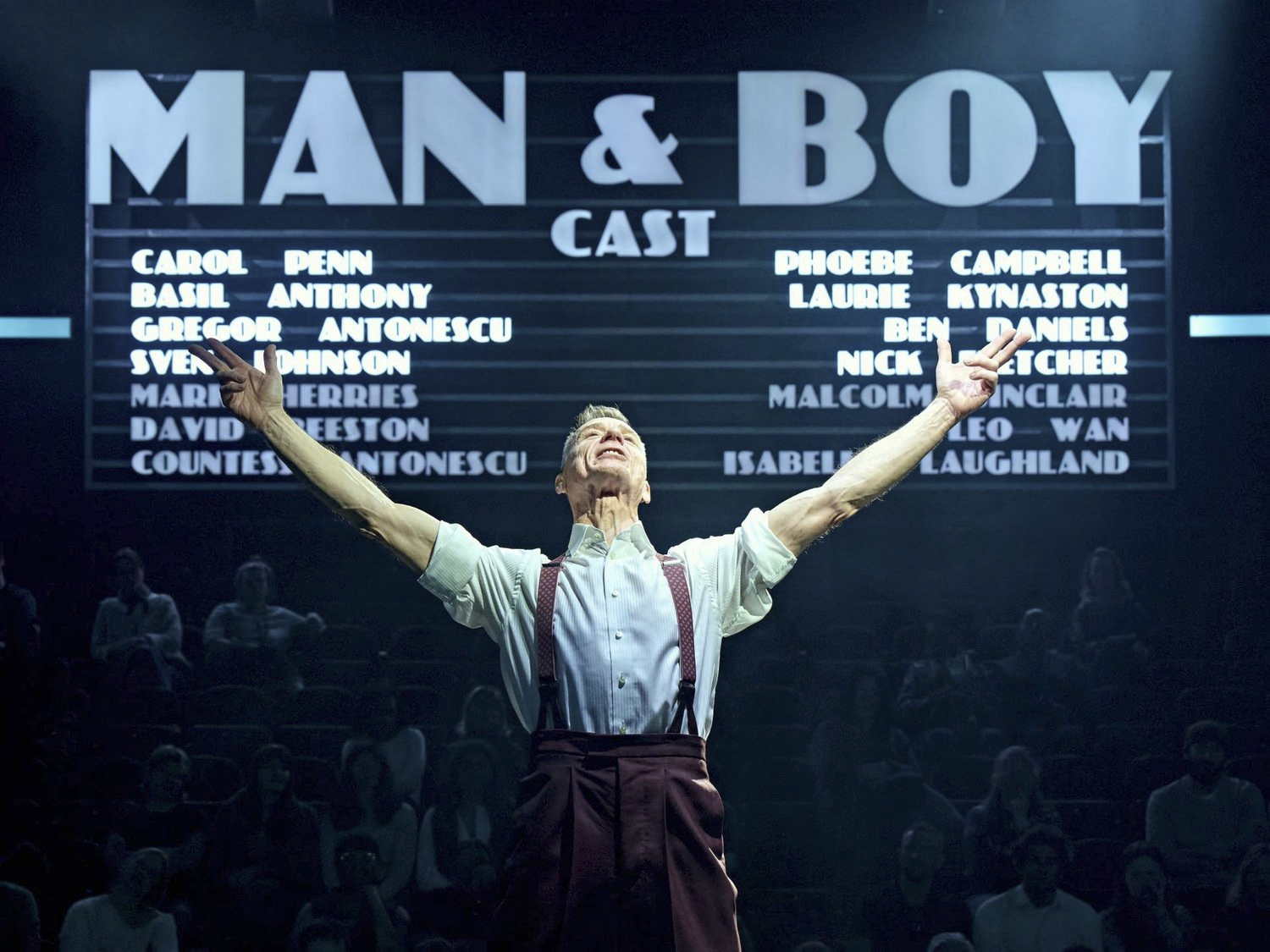
Is it perfect? Well, no, but what is? At times, the relentless energy created on stage can start to topple over itself, becoming a little farcical. For example, a moment when Gregor feels he’s pulled off yet another trick is followed by wolf-like howling by him and Sven, or a moment of Basil’s personal anguish is slightly overwrought on one of the table tops in a moment of silent writhing. Rattigan’s interest in the protagonist also comes at the cost of exploring his other characters. But these feel like prices easily worth paying for a production willing to rip up the floorboards; it’s a £1 entry to the fountain of youth. You would have to be a cynical and misguided theatre critic to lean away, rather than in, when watching the raw energy on stage. Do make the journey to the National Theatre while tickets are still available.
Holy Bread and Circuses
We finish with a dispatch from E9, courtesy of Atticus Evans-Lombe
A thoroughly sodden crowd shuffles into Hackney’s All Saints Church, but they are not here for anything like a regular service. The first reading is going to be given by a man in an enormous clown costume, known simply as ‘Frosty’. As the reverend begins the act of confession, silence descends. Seconds later, the familiar high-pitched squeak of a clown horn erupts. Before long, chaos has descended. ‘Tweedy’ begins to ride his six-inch high miniature bicycle down the aisle, and ‘Eek’ Cooper soon leads the congregation in a ukulele sing-along. This is the 80th Annual Grimaldi Service.
If one were wandering the streets of London’s West End at the beginning of the 19th century, there’s a good chance they were there to catch a glimpse of Joseph Grimaldi. Known as the father of the British clown, he was a dominant figure on the stage of the day, particularly at Drury Lane and Sadler’s Wells until his retirement in 1823. So influential was Grimaldi that his costume design, the classic clown garb, and catchphrases, such as ‘Here we go again!’ feature to this day in modern clowning. The Grimaldi Service is a genuine church service organised by Clowns International to commemorate the life of Grimaldi and, in the words of the event’s organiser Mattie Faint, ‘praise the gift of laughter’.
The event’s popularity means there is a queue waiting for me. The man next to me had come down from Barnet and was holding a space for his friend, who was trekking all the way from Hampshire. This was his second Grimaldi service, he explained. Just ahead of us, an old man known as ‘Conk’ appeared in a huge rainbow-striped suit, with a tiny parasol attached to his red top hat and that familiar face paint. As he began to play a tune on a tiny plastic saxophone, I began to see what he meant.
Inside was a carnival atmosphere. Cakes and cups of tea were provided, and children scurried about between the clowns. Just in time, I made my way to a standing spot in the church’s upper gallery – nearly 700 people had crowded in, and there wasn’t a spare seat to be seen.
The church organ rang out to signify the service’s opening. Three priests in traditional white robes shuffled in bearing the cross. Then, in came the clowns. Carrying a huge banner with the image of Grimaldi and the words ‘Here We Are Fools for Christ’, they cavorted in, waving scarves and skipping along. Like cheeky schoolchildren, they tipped each other’s hats and honked their horns under the watchful eye of the reverend.
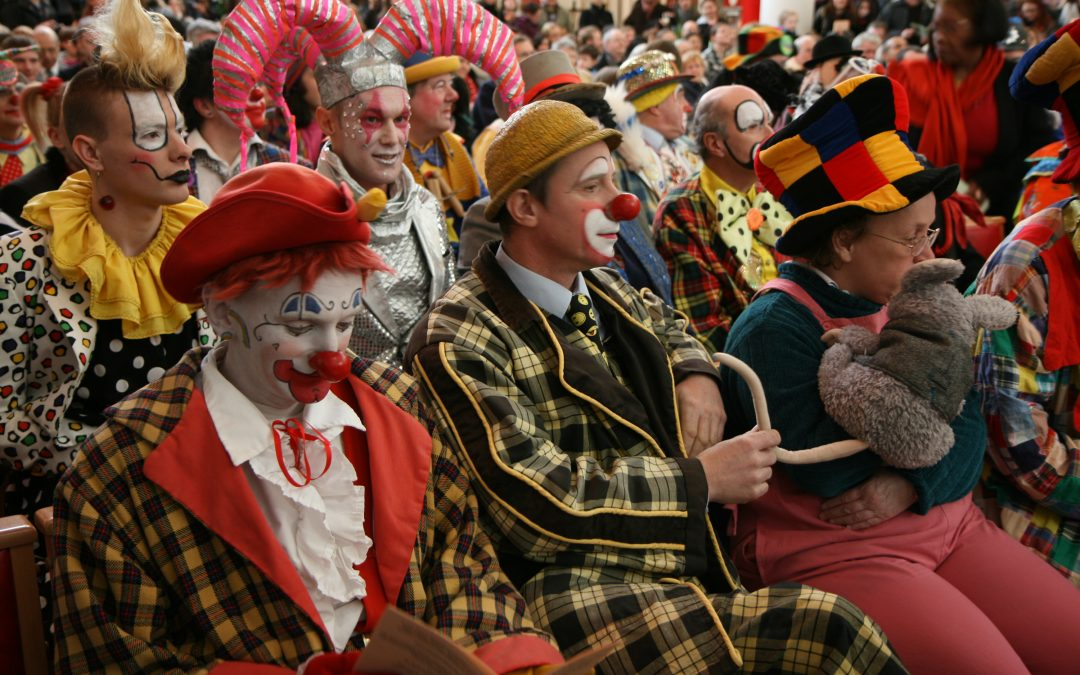
‘To be able to laugh about the joys and the sorrows of life is something we all appreciate,’ Reverend Laura Luz said, and this message reverberated throughout the service. As the crowd sang along to When You’re Smilin’ under the careful guidance of ‘Eek’ and a unicycle clown show proceeded before us, it was impossible not to laugh and enjoy this genuine expression of happiness shared between hundreds of complete strangers. The event was, however, no mere farce. It was a genuine service, with prayers and respects paid to clowns who had passed in the last year.
As the final hymns were sung and the service came to a close, I slipped away past more impromptu clown shows which were delighting the massed kids. Seeing such a genuine celebration of joy felt like a real pleasure, and I was left with the words of Sam, an amateur clown in the crowd next to me. I’d asked her if this service might compel her fully into clowning, or into religion. Neither, she’d said, but that didn’t matter. She’d come all the way down from Yorkshire on this miserable day to have a laugh – for after all, ‘laughter is the best religion’.
That’s it all for this week. If you enjoyed this outing, please do celebrate us in ‘like’ form below, or even better, spread the word about what we’re doing here, either on social media or in real-life conversation: both formats work wonderfully for us. We trust you’ll have a lovely weekend.
All the best,
TF