Dear Readers,
Good afternoon and welcome back to Capital Letter. The weather stations inform us that things should be gently warming over the coming days in a kind of pathetic fallacy that London always seems quite good at; the long first month of the year is over, things feel better, a little bit of light and heat return to our streets.
As ever, we have a full gamut for you to guide you through the coming fortnight, with lots to say about film, theatre and galleries. And the future for this ‘vertical’ is looking bright indeed. The time of weekly distribution is drawing near, we promise, and there’s a lot more to come by way of dispatches from life around the capital. There are even rumours of an exciting Capital Letter contest, but let’s not get ahead of ourselves.
All there remains to say is to encourage you to subscribe to the newsletter and upgrade yourself to a paid member (at only £3 a month) to support the work we do here and get access to our beautiful curated Google map of the city, so you need never be without a handily locatable recommendation. Do also keep the tips and pitches coming. We’ve had some great stuff drifting into our inbox since the last edition, and it always excites us to bring new voices in to talk about this city that we love. The hotline is editorial@the-fence.com. With that said, let’s begin our journey at the cinema.
Avant-Garde A Clue
Cici Peng – a frequent FT writer who has programmed films at the BFI, ICA and the Barbican – clues us in on the best screenings you likely haven’t heard about.
Coming up at the ICA there will be the first expansive Werner Schroeter retrospective. A 20th-century – distinctly post-1968 – German filmmaker who can’t exactly be classified within the ‘New German Cinema’ movement alongside Rainer Fassbinder or Wim Wenders, Schroeter stands out as a highly theatrical, irreverent, avant-garde filmmaker who has been long overlooked. Schoreter’s literary adaptations are seasoned with his wildly camp flair – his productions of Oscar Wilde’s Salome, Shakespeare’s Macbeth and Austrian novelist Ingeborg Bachmann’s Malina (with a powerhouse performance by Isabelle Huppert) draw from opera, pop music, melodrama and contemporary dance to create a dizzyingly amalgamated cinematic collage. Many of his films attempt to re-interpret history through forms of cultural pastiche that undercut the delusions of grandeur at the heart of a nation’s myth-making.
Speaking of pastiche, the BFI is running a season of French New Wave top hits to accompany the release of Richard Linklater’s Nouvelle Vague (2025), a pandering romanticisation of the filming of Jean-Luc Godard’s Breathless (1960). Clearly, the American meant to appeal to those who feel smug enough to understand its Easter eggs, yet foolish enough to ignore its shallow idolatry. Sidestep this season, which feels particularly juice-less (Pickpocket, again?), to a much more prescient programme with, ‘Constructed, Told, Spoken: A Counter-History of Britain on TV’ that brings together restorations and rare screenings of works by collectives of Black and Asian filmmakers and media workers in the 1970s and 1980s who were formalised by broadcasting institutions (Channel 4, BBC, ITV) to offer a counter history to British life through a multicultural lens.
Shows like Open Doors on Channel 4 reimagined public television as a participatory democracy, with grassroots collectives taking over public broadcast with fierce and often wry critiques of state policy. It’s interesting to study what vibrant leftist energy there was in 1970s British television, such as Thames Television’s programming of Stuart Hall’s Karl Marx: The Spectre of Marxism among midnight screenings of avant-garde films by Derek Jarman. Though, fascinatingly enough, one of the lynchpins of that era – Tariq Ali – is not best pleased at having been part of the programme.
In the spirit of community filmmaking, don’t miss the Barbican’s screening at the end of February featuring the London Community Video Archive’s programme that brings together never-seen-before work from the late 1970s with avant-garde experimental filmmakers including Mexican filmmaker Chick Strand (on 16mm!) and Japanese filmmaker Utako Koguchi to highlight feminist perspectives that inhabit the space between private autobiography and the grander telos of history.
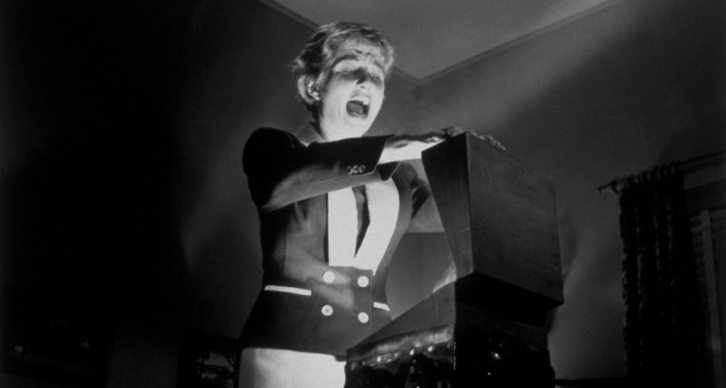
Other great seasons include gems of pre-revolutionary Iranian cinema at the Barbican, curated by Ehsan Khoshbakht. ‘Not By Lynch’, a season dedicated to the Lynchian and its inexpressible horrors will host a special screening of horror film Carnival of Souls (1962) by Herk Harvey in March at the Cinema Museum. It’s not so much an action-horror film, but a brilliantly haunting re-mediation of how images themselves can be signifiers of horror. Other highlights can be found, not within the darkened screening room, but in the gallery: photographer Nat Faulkner experiments with analogue darkroom techniques that play with the idea of waste and the process of decomposition in his first solo show at the Camden Arts Centre.
Ray of Light
More than a month since our last dispatch from our capital’s art world, we can report that January passed largely as expected, as most commercial galleries, too lethargic to put something new on the walls, extended their December shows. Of course, those that did rehang outsourced the task to international galleries for Condo, the graphic-designmaxxing worldwide gallery-swapping initiative.
In its closing month, Mark Godfrey’s Kerry James Marshall retrospective reeled in two of its biggest and baldest star-visitors yet in Stormzy and Cynthia Erivo. (Madonna’s storied trip to Margate last month can only be understood as a brazen challenge to Godfrey’s status as the art world’s top starfucker from the baby-talking seaside gallerist-podcaster Robert Diament. We hope that Godfrey’s response will be swift and proportional.)
If you’re wondering why Soho seems barren of preteens in iridescent puffa coats and candy-coloured trainers, it may be because they’re all visiting the artist Slawn’s new studio, which is inside Saatchi Yates’ 10,000-square-foot gallery in St James’s. He’ll be there until mid-February, knocking out clownish George Condo rip-offs in front of a crowd of gawping children.
But it’s not all bad news. Late last year, the ever-shapeshifting Sadie Coles HQ opened its tenth West End space, on Savile Row. (With almost as many having closed, this new edition is Coles’ third operational gallery). Its second exhibition, Lord Arthur Savile’s Crime, named after an Oscar Wilde short story, is a barnstorming group show that harkens back to the building’s history as a late-Victorian arts club.
Across the gallery’s two floors, the walls – draped in flesh-pink curtains – bear the work of almost 50 artists, joining to convey a flicker of the ecstasy, excess, drama and deviance of the life of a bygone London social scene. Highlights include Nicole Wermers’ pinched-clay sculpture of four toffs getting pissed atop an 18-tape VHS box set of the 1970s ITV drama Upstairs, Downstairs and Paulina Olowska’s monumental, blue-hued painting of a gowned woman sitting on the edge of a bed with a post-bacchanalian hangover.
Alongside a few glassy-eyed renderings of Wilde himself, a few portraits of characters of modern-day London icons like Princess Julia and Fergus Henderson suggest that some version of the author’s freewheeling and louche London might still exist today. For most visitors, the show’s boozy and base world will feel escapist – but could it be gesturing towards something real? In the dying days of a bleaker-than-usual winter, here’s a reminder that London can still provide a pretty good time. You just need to have the right numbers to call.
Panto’s Over, Baby
In recent years, the theatre has been increasingly dominated by what we call ‘issue plays’. These certainly have their theatre antecedent. Brecht, Littlewood, Fo and many others have used stories on stage to tackle a topic, rather than simply create a resonant tale. These recent versions have a different focus, however, focusing much more closely on the personal, rather than the societal.
Cultural speculators will have their theories for this, but one reason given little attention is the Arts Council’s laser-sharp focus on the ‘social impact’ of its funds. As one professional grant writer put it to us recently, their goal is always to reach so-called ‘dark areas’ in arts coverage, anyone who they feel is not reached by the theatre at the moment. This is an effort one wants to get behind, but can be behind the production of some rather stifling drama. So what are we to make of this dominant brand of theatre and its varying grades of quality, from the bombshells to the duds.
Most recently, this kind of show has appeared in Guess How Much I Love You?which has opened this year’s season at the Royal Court. The subject matter is dark, dealing with a couple’s complicated pregnancy. They are forced to decide whether to have the child or get an abortion.
Norris’ text is full of excellent stuff. In particular, the play’s third scene is especially strong, placing us in the hospital room after the baby has been delivered. It’s a tense moment, and Norris’ lays careful surprises that turn a setting we know very well both in life and in drama on its head. Scenes like these, along with an incredibly strong performance from Rosie Sheehy mean that we have a very slick, successful production on our hands.
And yet, the production’s ‘issue play’ nature means it is only really interested in one question: will this couple terminate their pregnancy? As a result, the territory it can explore is restricted. With two actors on stage, every scene is, fundamentally, about The Baby. Great drama tends to operate on three levels: internal, inter-personal and extra-personal. Guess How Much I Love You? is brilliant on the second of these, but lacks in the others.
These limits are visible, for example, in the dialogue games Norris needs to play in order to get his characters talking about something other than the issue at hand. These can be funny, but are inherently artificial, and are full of on-the-nose bits of resonance, such as a rogue discussion about badgers which quickly leads to talking about culling. And there are lots of loose ends: the show’s third character struggles to find any space on stage and vague allusions to the couples’ differing family lives go nowhere.
The production attempts to lean into this with a kind of bleak intensity, best embodied in Grace Smart’s sets, which gradually narrow in on the actors. But bleakness can easily develop into inertia and so the show just hits you with both barrels, which gradually becomes a little obvious and alienating. The couple’s song of choice (used twice) is The Velvet Underground’s Pale Blue Eyes,and the play itself is named after a kids’ book which are both used to create ‘powerful’ moments of Sad.
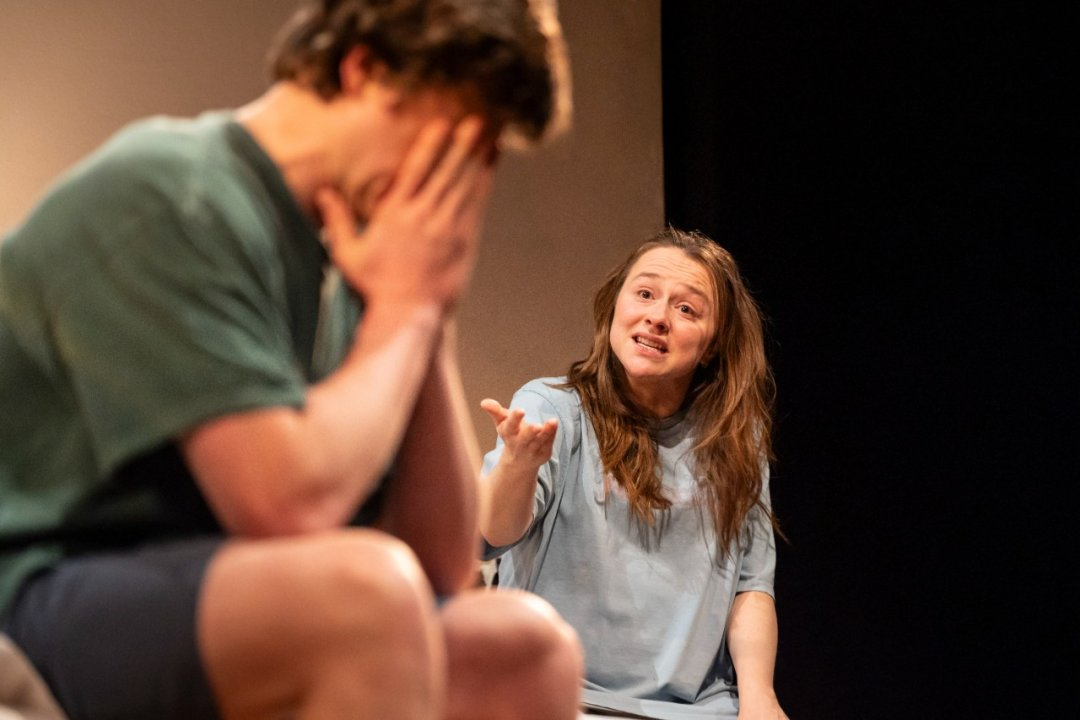
Elsewhere, the Arcola has ventured into these waters with A Grain of Sand which has now gone on tour. This was, if anything, an even more ambivalent watch, because the subject matter was not only more harrowing but real. The play uses real testimonies from children in Gaza whose words are interwoven with a monologue written by Elias Matar from the perspective of an 11-year-old girl. The verbatim words of these children are some of the hardest things we have had to hear in a theatre in recent times. Likewise, a moment comes when the names of children killed in Gaza, some with the phrase ‘0 years old’ bracketed after them, are projected onto the screen. This is a horrific reminder of what has happened over the last few years.
How does an audience member square this with the fact that the rest of the text is really rather poor? It lacks a strong propulsive structure that storytelling needs and fails to capture the essence of its main character; children are much smarter and weirder than the text allows. Instead, the writing and actor (Sarah Agha) give us a character much closer to a children’s entertainer than a child.
Bottom of the tier of this kind of show is something on at the Finborough at the moment titled Darkie Armo Girl. Somehow ostensibly related to the Armenian genocide, it is, in fact, an excuse for its writer and (inevitably) performer Karine Bedrossian to complain about everything bad that has happened to her. She tells us about careers in modelling, singing, bartending, stripping and reception work alongside tales of rehab, childhood trauma, holidays, a violent footballing brother and sexual assault. Many of these things are indeed pretty horrible, but none is given a moment to land with the audience and we run from one thing to the next. It becomes a kind of perverse act of vanity and is, unfortunately, one of the worst things we have seen recently. As a kind of countermeasure, we strongly recommend Debate: Baldwin v Buckley, which is running at Wilton’s Music Hall at the moment. Quite simply it is a restaging of the famous 1965 debate without any pretense, and is a fascinating experience because of it.
Monk-eying Around in the City
Finding Medieval London is notoriously difficult courtesy of Henry VIII, a drunken baker, the Victorians, the Luftwaffe and the post-war planning system. There are obvious bits – St Bartholomew the Great, Westminster Hall, The Abbey and, of course, the Tower. The latter two are London’s two star attractions that everyone should visit at least once every two years.
But what if you like your medieval remains a bit more, shall we say, deconstructed? You don’t have to be a rabid Thomas Cromwell enthusiast to prefer a bit of melancholic stone to the slight ‘exit through gift shop’ vibe from which the more established Medieval survivors suffer. Well, fear not, 21st-century sadboi/girl, the remains of London’s Middle Ages are still there and we can show you where. Crucial to the economy, politics, religion and geography of Medieval London were monks. The great monasteries define road names to this day. Here are a few places where you can see – or in some cases, not see – their remains.
Let’s start in the west and with one of the most considerable monasteries of the period. The Whitefriars were a Carthusian order with a large church and famously ill-disciplined ‘liberty’ just south of Fleet Street. If you peer down into the basement of Ashentree Court in Magpie Alley – a sort of nondescript 90s alleyway of fake marble – between Whitefriars and Bouverie Street you will see the remains of what was almost certainly the latrine block at the western edge of the monastery.
Also nearby were the Blackfriars, although almost nothing remains of their monastery except street names: Church Entry and Friar Street. The church which survived the Reformation was lost to the Great Fire and scant bits of grave and masonry remain. Part of the wall along Ireland Lane itself is made of some masonry from the church. There are apparently some more substantial remnants if you can get into the courtyard of Apothecaries Hall.
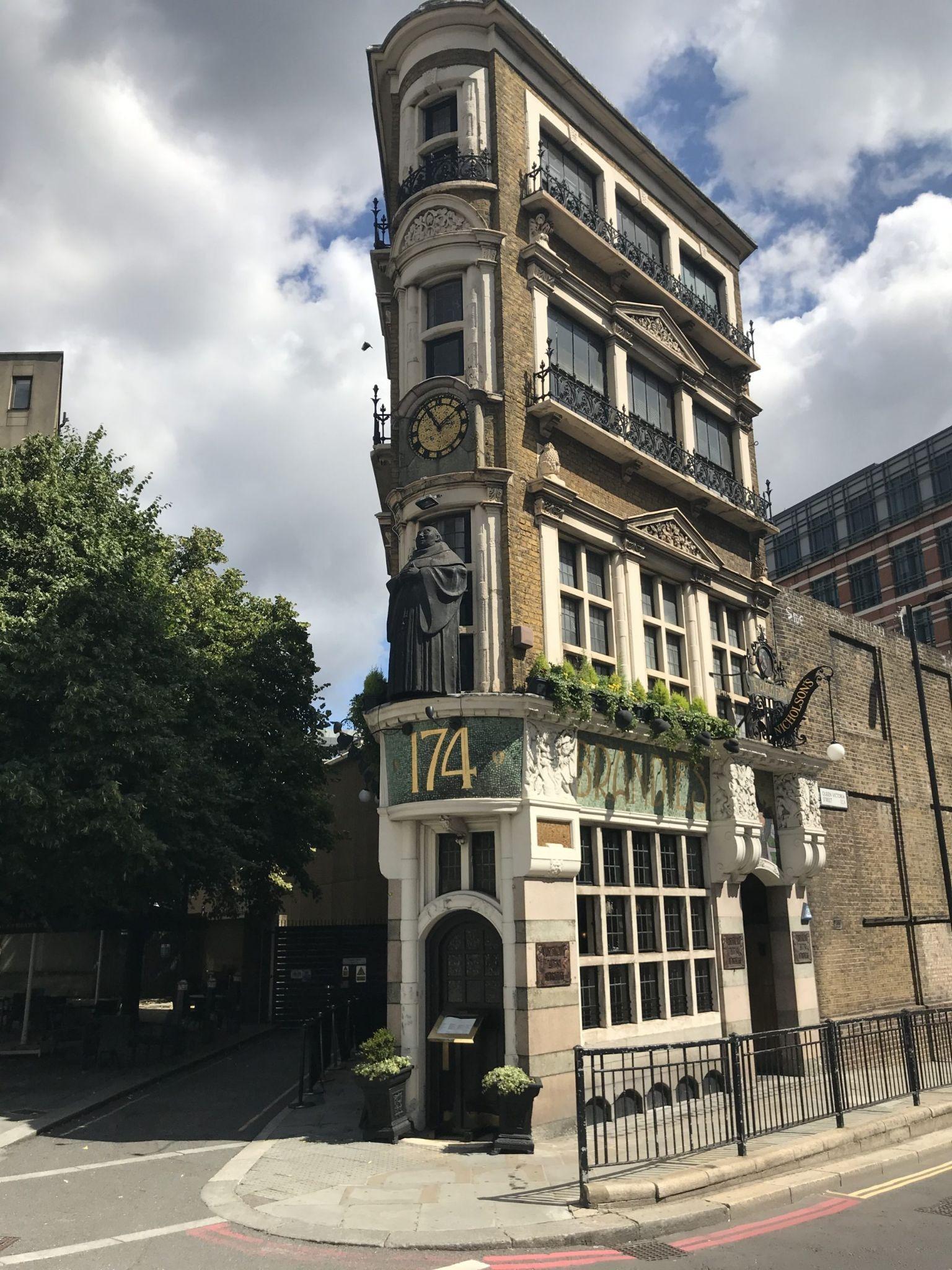
Again not far but not very considerable are the remains of the Greyfriars, the Franciscan Priory in London. There is some medieval masonry in the gardens which now occupy the shell of Christchurch Greyfriars. This site had the rare privilege of being destroyed in the Reformation, the Great Fire and, latterly, the Blitz.
Perhaps the most significant actual ruin available to the London sightseer is of the Augustinian – the same order as the current Pope – Priory of the Holy Trinity. It is a sizeable arch and now resides in the basement of 77 Leadenhall Street, which is currently a WeWork. It is just about visible from the street so you don’t have to risk sexual harassment or ‘fun Friday beers’ in order to go and see it.
Finally we have the Carthusian order’s largest priory in London, St Mary Graces, which is now the site of the proposed Chinese mega-embassy. Isn’t it fun when history rhymes? The remains in the basement of what was the Royal Mint building are actually quite considerable; however, access is, as you can imagine, not easy even if you’re a member of the British secret services. Walk the square route of East Smithfield, Cartwright Street and Royal Mint Street and keep your eyes peeled for masonry. Photos from eager hunters are always welcome in response to this email, though if you end up in a detention camp in Guangdong, then we want to be clear that we accept no responsibility whatsoever.
That’s all for this week! As foretold, next week will involve a couple of dispatches from around the city and some interesting recommendations in fields we have yet to broach. If you have any thoughts, tips or things we should know regarding the Capital, we’re always reachable on editorial@the-fence.com.
All the best,
TF