Dear Readers,
Good afternoon, and welcome back to Capital Letter, our fortnightly guide to living large in London. Before June hits and your schedule gets weighed down with Zone 2 BBQs, dirge-like children’s parties and jubilant nights out with old friends, there’s a chance to have some quality, clear-headed communing with the city and its possibilities.
We hate to do it, but we are moving the paywall higher up the spine this time around, so do sign up to get the increasingly exclusive insights we have on offer; there’s only going to be more coming the way of the generous. There is, however, still much to offer those of you who’d rather buy two extra meal deals a month.
Today, we have a rich offering. We got London’s hottest ticket and the insider knowledge behind the production and we anoint London’s most vulgar restaurant, alongside a paean to Christopher Wren and some tips on which police station to get yourself booked into, but first, we’re back in Galleryland.
Wide-eyed & Perceptive
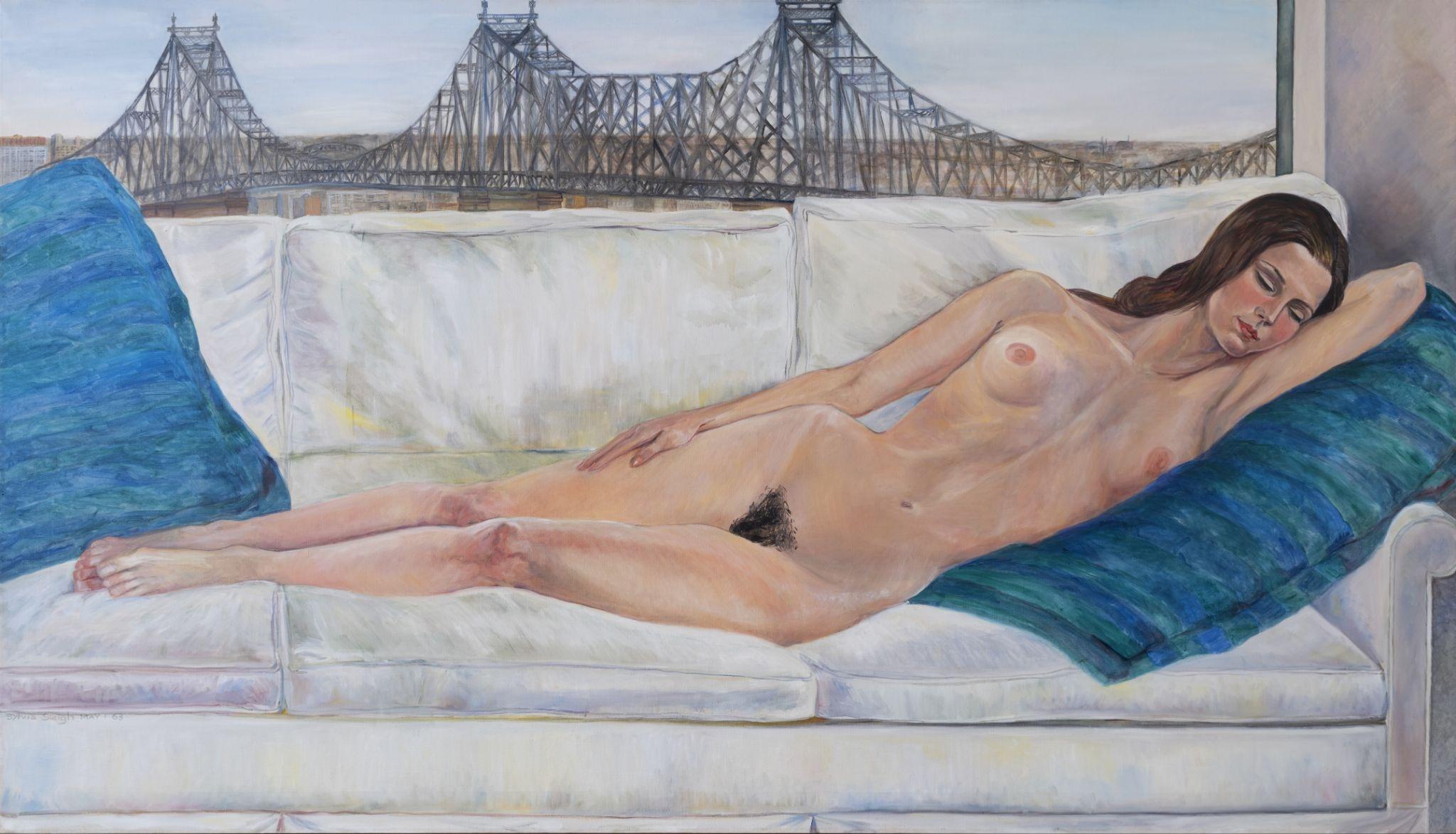
Sometimes, a single painting is all it takes to make an exhibition worth the journey. Ring the art advisor and curator Daniel Malarkey’s bell at 48 Russell Square, climb the flight of stairs to his office-cum-gallery, and you’ll be greeted with one such painting.
Sylvia Sleigh’s The Bridge is a panoramic, just bigger than life-sized, painting of a sleeping nude sitter. Her architecture is mimicked by a supple Queensboro Bridge – a rollercoasteresque structure connecting Manhattan’s Upper East Side with Long Island City – that extends behind her.
Painted in 1963, it is a distinctly New Yorkpainting: its subjects are stacked on top of each other; the smoggy atmosphere renders the city’s buildings indistinct; instead of the satiny white that cradles Titian’s Venus, Sleigh has painted her sofa in a grubby chorus of greys and yellows. Nothing is perfect, but it’s all very beautiful. (We can reveal that the Guardian received at least one complaint after Jonathan Jones described this dour and subtle nude in this show as ‘eye-popping’).
Sylvia Sleigh, The Bridge, 1963. Oil on canvas. Photograph Eleonora Agostini ©Estate of Sylvia Sleigh. Courtesy the artist and Daniel Malarkey.
The exhibition’s other paintings serve as accoutrements to The Bridge, many executed with a charming naïveté and tenderness. The willowy pattern of the fabric enrobing her Still Life with Decanter (1949) looks like it was painted with more affection than professional exactitude. Robert Wamsganz (1980) appears to be a toupéed, but undeniably beloved, Ryan Gosling lookalike.
These works look like they were painted not by a fuhgeddaboudit New Yorker but by a wide-eyed and perceptive transplant from the more pastoral climes of, say, North Wales. That’s because Sleigh is exactly that; born in the town of Llandudno, she moved to New York just two years before painting the centrepiece of this exhibition. With work in the MoMA and the Whitney, Malarkey’s show marks an almost-homecoming for Sleigh.
If seeing what Jones slobberingly describes as ‘elegant brunette with enviably long legs’ has whetted your appetite for nudes, Lara Shahnavaz’s exhibition Dust at Ginny on Frederick on Charterhouse Street contains some rather heartbreaking ones. Or there’s always, you know, The National Gallery.
La Grand Bouffe
Has any London restaurant been on quite the same speed run that Otto’s has? Not even a decade ago, the Grey’s Inn swagpad was something of a genuine anomaly, a freaky eccentricity to rank alongside the long-departed LMNT on the Kingsland Road, as red-faced barristers and Channel 4 execs wolfed down the canard á la presse with some perfectly serviceable claret while they watched the tableside theatrics.
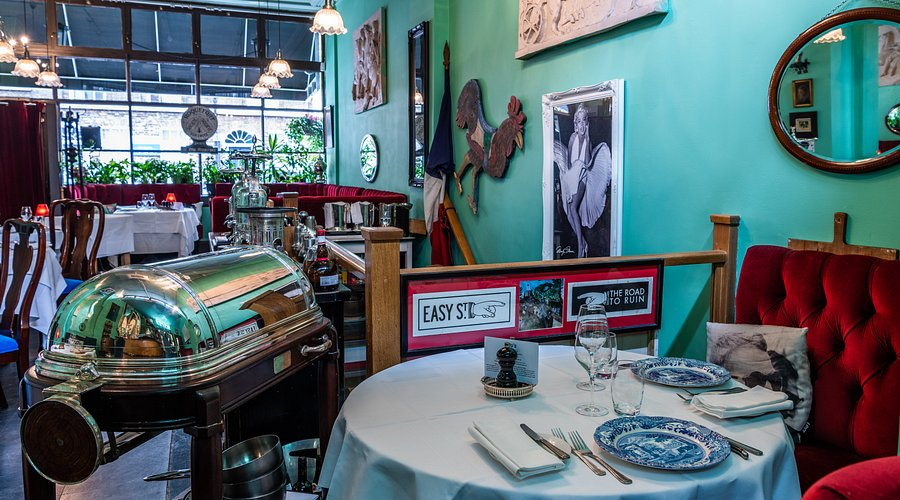
These days, Otto is jostling with Nusr-Et for the title of London’s Most Vulgar Restaurant, as stars from Rise of the Footsoldier rub shoulders with bald TikTokkers to chow down on four-figure burgers for the socials. It’s truly repulsive, but it makes you think… was it not always the case? It’s decorated like a Home Counties junk shop, and there are girlie photos galore. The obsequious service is ideal if you don’t like the people you’re dining with, but it makes for handy talking points if you’re struggling for conversation. As for the prices, they’re absurd, but that’s beside the point.
Anyway, which former ‘hidden gem’ has burned through fame and is heading towards ignominy? Let us know in comments or via the usual channels.
Shakedown Street
Suha Kidwai ranks the best places to be in the worst situation
Forget Bacchanalia – the toughest reservation in London is now with the Metropolitan Police. So, with 200,000 strictly invite-only check-ins, it helps to know exactly where to commit your social faux pas if you want the best service from London’s thin blue line.
We begin with my local: Islington Police Station (★ ★ ☆ ☆ ☆), where I recently experienced the joy of an overnight stay after a protest-related arrest. Upon entry, I was met with a thorough groping, and any potentially lethal biros were confiscated, so bonus points there. Said points were then lost on the slow tea service (special microplastic brew, served in a polystyrene set).
Moving to the sleeping quarters, I queried the presence of a security camera placed discreetly above the cell toilet, but was assured that said camera was equipped with sophisticated cop-tech, which cuts the recording every time someone makes contact with the fixed metal seat. This seemed rather odd, slightly unlikely and a serious breach in security.
Safeguarding aside, the experience was saved by the Islington clink’s spatial planning. An indisputable flow between the mugshot, DNA and phone call stations gives the interior an authoritarian Feng Shui that almost grants the experience a kind of softened intimacy.
Moving on, should you find yourself processed further south – you’ll likely be directed toward Charing Cross Police Station (★ ☆ ☆ ☆ ☆). Located a stone’s throw from almost every tourist trap in London, expect chaos in the form of an eternal line consisting of the red-eyed, red-faced and red-knuckled.
The food dished up to these folk – mandated by the Police and Criminal Evidence Act 1984 – manifested itself in the form of a Quaker Oats instant porridge pot. Whilst I was disappointed in the lack of choice, such a taxpayer-funded luxury (RRP £1.30) must be celebrated as nothing short of a miracle. Unfortunately, the 1984 Act does not cover the provision of cutlery. Instead, I was given a cardboard ‘spoon’, created by folding an approximately 4x1” piece of cereal board in half, which succumbed to the porridge only four mouthfuls in.
The next Charing-Cross disappointment came in their bedding department. Here, bedding is a mere euphemism for an (appropriately) blue mat. Whilst a thin blanket resembling a potato sack can be obtained upon request, pillows are out of the question. As such, should you be invited for an overnight stay, be sure to pack your own three-piece bed set. And a mattress.
The final place on this list is a Station so exclusive, I have not yet received the pleasure of an overnight stay: Lewisham Police Station (★ ★ ★ ★ ☆). Nonetheless, I was able to obtain details from an old friend who had recently experienced the privilege of some 14 hours in custody. He shared that, putting the ‘brutally brutalist architecture’ aside, his time at Lewisham Station was characterised by a slightly more luxurious feel, with the £120 million station boasting not only a far wider range of porridge flavours, but a 30-horse stable – the same as Buckingham Palace. The only discernible difference between them, he concluded, was the pervasive smell of horse manure.
So, which station to visit first?
Now Play Classical Gas
You may remember a previous CL let you all in on which pub you could find most of any orchestra in after their performance at the proms. Well, the same valuable source close to The Fence is advising that the upcoming concerts Quatuor Ébène are giving at the Wigmore Hall (16th May, 3rd and 4th July) are do-not-misses. They are, in the words of this anonymous classical musician, ‘the best string quartet in the world’. And they are not playing any of that woke nonsense either, it’s Beethoven the whole way. We’d recommend getting a ticket pronto.
A Believable Old Curmudgeon
We managed to get a very hot ticket at the start of the week to see Sir Gary ‘Gazza’ ‘Gazprom’ ‘G-dog’ Oldman in Samuel Beckett’s Krapp’s Last Tape. So, how was the starry affair?
The show starts with a ‘curtain raiser’ – an opening act in the form of Leo Simpe-Asante’s play Godot’s To-Do List. It is bright and funny, and offers a strong performance by Shakeel Haakim as Godot, finally appearing on stage and trapped by an endless to-do list imposed by a bodyless Siri-esque voice. It’s a great decision by artistic director David Byrne, maintaining the Court’s commitment to new writing – Simpe-Asante is their 19-year-old young playwright winner – while honouring tradition: when Beckett’s Endgame played on the same stage years ago, it also premiered with a Beckett-penned opener.
We also understand that the Theatre Royal York, where this production started, is receiving box office from the London transfer, which is more than a nice gesture. It is positively lifesaving for a regional theatre at a time when such venues are disappearing. Whatever we make of the production, this use of star power deserves praise. Oldman made his debut at Theatre Royal York, and companies like Complicité owe their early freedom to the backbone of regional theatre.
Then the lights go down. We hear some music. Big Garibaldi is ready.
For our money, Krapp’s Last Tape is a brilliant, haunting piece of writing, finding a genius solution to the challenge of revealing a character’s internal world without simply stating it outright. It is also a play that contains one of the funniest and stupidest gags in theatre history (three bananas) for people who think Beckett is pure misery.
And Oldman is an experienced actor. His vocal control in contrasting the younger and older Krapp is interesting, his physical timing is strong, and he crafts a believable old curmudgeon. There is also a brilliant lighting design by Malcolm Rippeth which nails the ending: an unbearably slow fade prolonged by the glow of Krapp’s reel-to-reel tape recorder, the light draining from Oldman’s eyes.
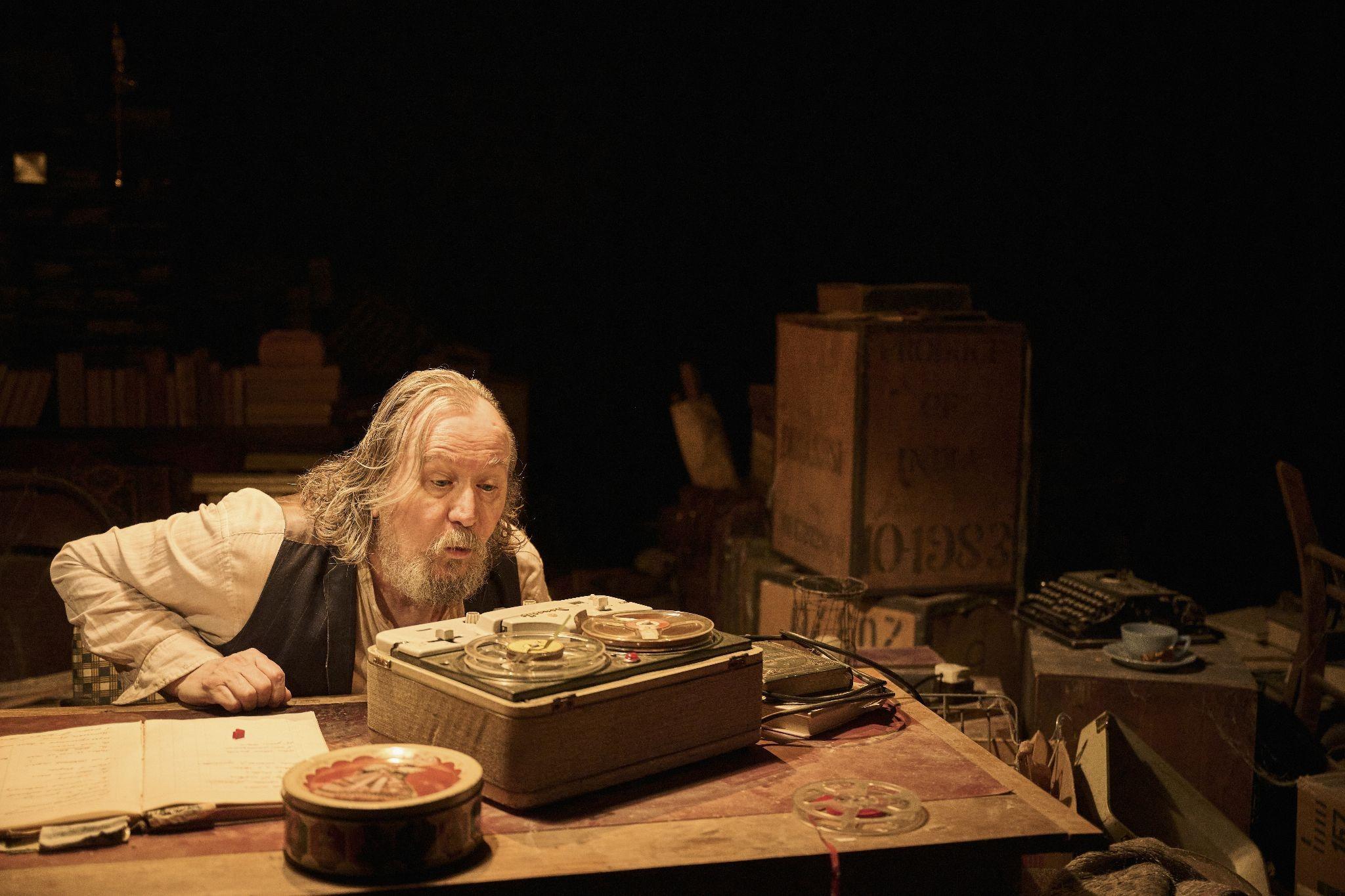
So there is, unsurprisingly, a great deal of quality on offer. But by God, do we wish there was a director and a designer involved. Instead, Gazprom does both. The set apparently began as a tiny scale model built by Gazza himself. A number of venerable designers were then brought in to improve it, but their ideas were not fully taken on board. The final product is full of meaningless visual clobber, which feels distracting and overly realistic for a writer who operated with a purposefully elevated style. And this confusion bleeds into the self-directed performance. Oldman nails some sections, but as one acting grandee put it to us, ‘there was no real tension in it at all.’ The result is an affecting story of an old man whose life is slipping away, but Krapp is deeper than a vignette of a lonely grump.
Indeed, the text we are served up is shortened, with several notable cuts. One among many is the original playtext’s calls for Krapp to leave the room on several occasions, both to get a bottle of Champagne (it’s his birthday) and to go for a piss (funny). It is frankly amazing they managed to get away with these cuts given the scrupulous reputation of the Beckett estate. Beckett was fanatical about these movements for a reason – every exit, entrance, walk, stop and gesture tells the story. With their removal, the text feels poorer.
With these shortcomings in mind, it is hard not to think back to Stephen Rea’s performance at the Barbican last year. Rea’s set was unbelievably sparse, emphasising his isolated table and the darkness around him with just a thin, ghostly corridor connecting him to the outside world. His Krapp was also far more absurd and archetypal, reaching deeper into the play’s larger themes.
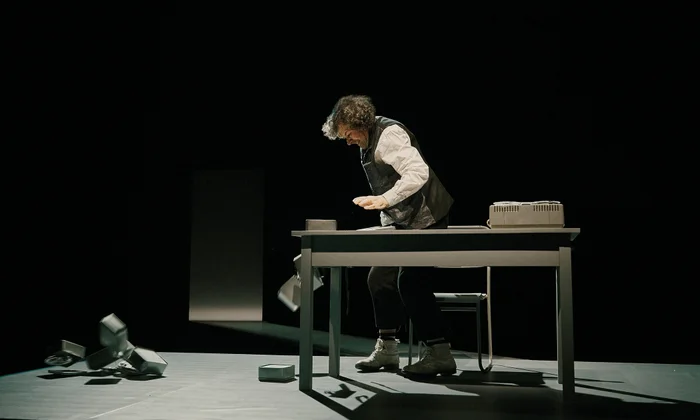
Fundamentally, this remains a good night of theatre and a brilliant piece of programming, the kind which has reinvented the Royal Court after a few years of relative irrelevance. If you can get yourself one of their £15 Monday tickets (the run is, of course, sold out) we would recommend it.
Staying Sharp
Even as the weather gets warmer, we’re big fans of incorporating a healthy amount of classic tailoring into your wardrobe. Whether you don the full suit or break apart the elements to take up a position in that fashion nebula known as ‘smart-casual’, something that’s well fitted, full in profile and even with a pleat or two just looks so good. But it can be a slightly intimidating and pricey world to get into. We have a few regular hunting grounds.
First is Soho’s Reign Vintage. A classic of a vintage shop, its stock in some areas leaves a bit to be desired. But its suit racks (immediately on your right as you enter or downstairs at the back) are often populated with gems. In-office purchases have included a vintage Versace two-piece with a long-cut jacket and beautifully detailed buttons, a black velvet YSL number and a double-breasted pinstripe from Savile Row. What makes this a good place to start is the variety on offer as well as some much more moderate price tags as far as suits go. You can easily walk out with a brand new whistle for as little as £80.
A step up might take you to Blackout II. The stock here is a little pricier, but it is what you might call ‘true vintage’, that is very little of the stock dates past the 70s, and some of it dates so far back that the correct term is actually ‘antique’ rather than vintage. It’s a nice change, because a quick look around the shop and you will realise how much 90s and even early 00s stuff gets passed off as retro to many unsuspecting customers. The quality on offer is also damn good, although do be warned that the staff, while perfectly amicable are, in a rather retro manner, aggressive sellers. Take a friend whose opinion you trust – the shop staff will always tell you it fits perfectly and that you have to buy it.
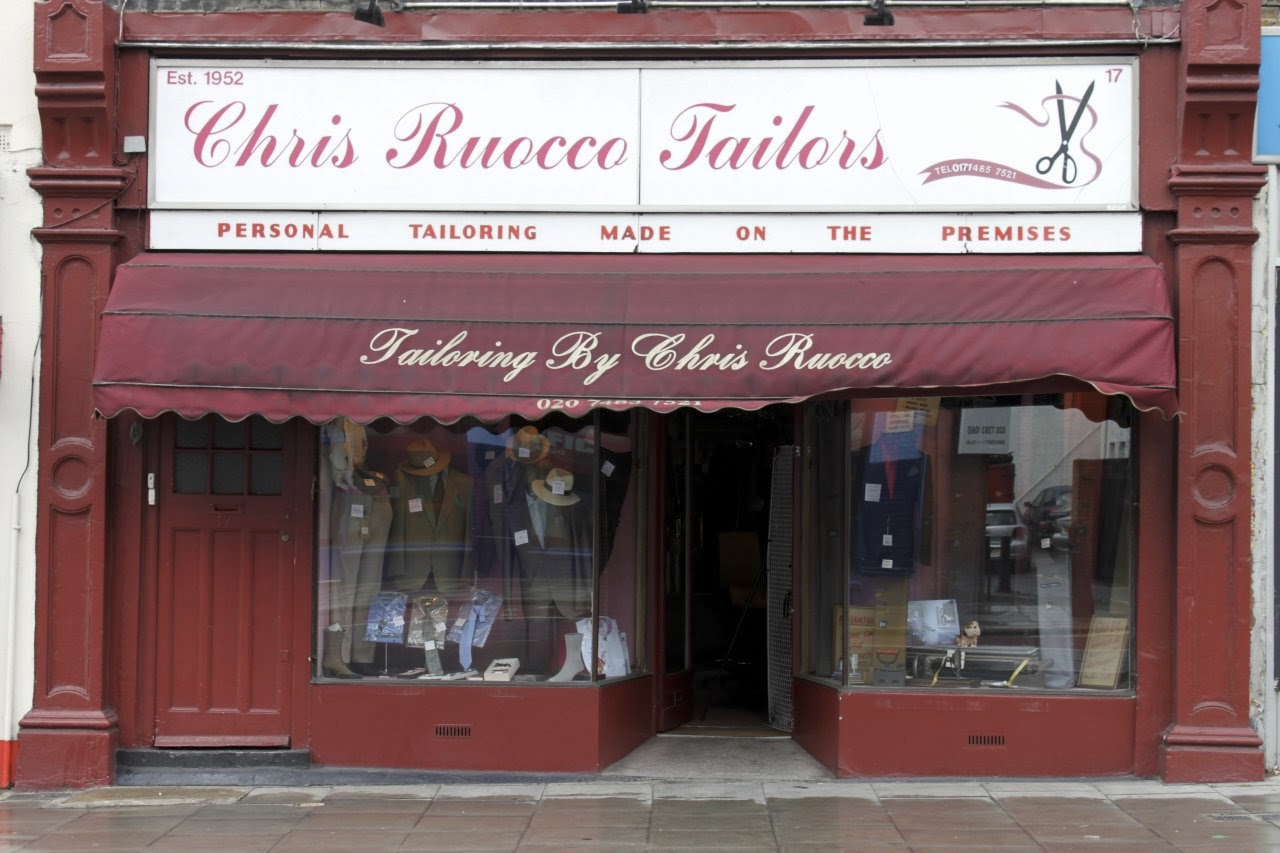
Finally, if you’ve got a handle on the Blackout II bunch, Chris Ruocco is a damn good tailor operating out of Kentish Town. This should not be your first stop, nor an idle wander in and out. Come here if you know you want to buy a good-quality fitted suit, because Chris is, as they say, ‘a character’. What is indisputable is his skill and that he offers this skill considerably cheaper than many other tailors. The V&A holds seven of his pieces.
Wren in Sydenham
Where is the best place to see Christopher Wren’s genius?
The obvious answer is St Paul’s but we at The Fence think that if you like your Wren monumental, then the Painted Hall – and indeed the entire set-up – at Greenwich takes some beating, if you like him monumental but intimate, then it’s St Stephen’s Walbrook. Who doesn’t love a Byzantine squinch? But if you want to see the place where Wren is quietly transformational, then the best place is on a post-war housing estate in Sydenham.
It is amidst the bungalows of the Round Hill estate, SE26, that you can probably get most up close and personal with a piece of Wren proper. The spire of St Antholin’s, Budge Row, once topped a tower of a city church near Watling Street, famed for its early morning services. It’s a fine piece of Wren’s work, carefully designed and intricately carved. It now stands towering over the houses in South London after it was purchased by a man called Robert Harrild after it was struck by lightning in 1829. Harrild made a fortune in the printing business, times, as The Fence’s staff will tell you, were different then, and bought a large estate in Sydenham. He plonked his spire in the garden by way of decoration.
The spire survived Harrild, his house and even the church from whence it came, which was demolished during Victorian traffic easing measures in the 1870s. The spire even survived the successor church built in Nunhead and financed by the City Church’s sale and demolition. That was destroyed by incendiary bombs in the Blitz. So the spire is the last survivor. It’s worth a wander and a look, for its incongruity as much as anything else. A wander down to the Bricklayers Arms on the Dartmouth road – with its piano and dart board riddled interior and handsome brick frontage – makes the trip worthwhile.
Well, that’s another ending to another jaunt around the city. Our As always, we always want to hear from you as we grow this newsletter. If you’d like to tell us what you want more of, give us a tip or even pitch a piece to us, do reach out on editorial@the-fence.com. Otherwise, we’ll see you in a short fortnight’s time.
All the best,
TF