Dear Readers,
Good evening, and welcome to Capital Letter, our guide to everything that is exciting in London. It’s our last outing for the year, and what a year it’s been. Just gaze at our map, groaning with the recommendations that we’ve doled out these past 11 months.
Remember, there are some truly astonishing prizes to be won on our Christmas prize draw. You can spend the night at Osip (RRP:£1500), have lunch at Mountain or score a case of Chateau Musar. There are a whole host of other things up for grabs, and all entries go towards expanding our editorial mission next year, so if you love what we do, and you’d like to see more, please support us below.
Now, if you find Christmas in London a bit overwhelming, we’ve got a fantastic tip for you, but we kick off with a trip to Sloane Square.
Mods and Rockers
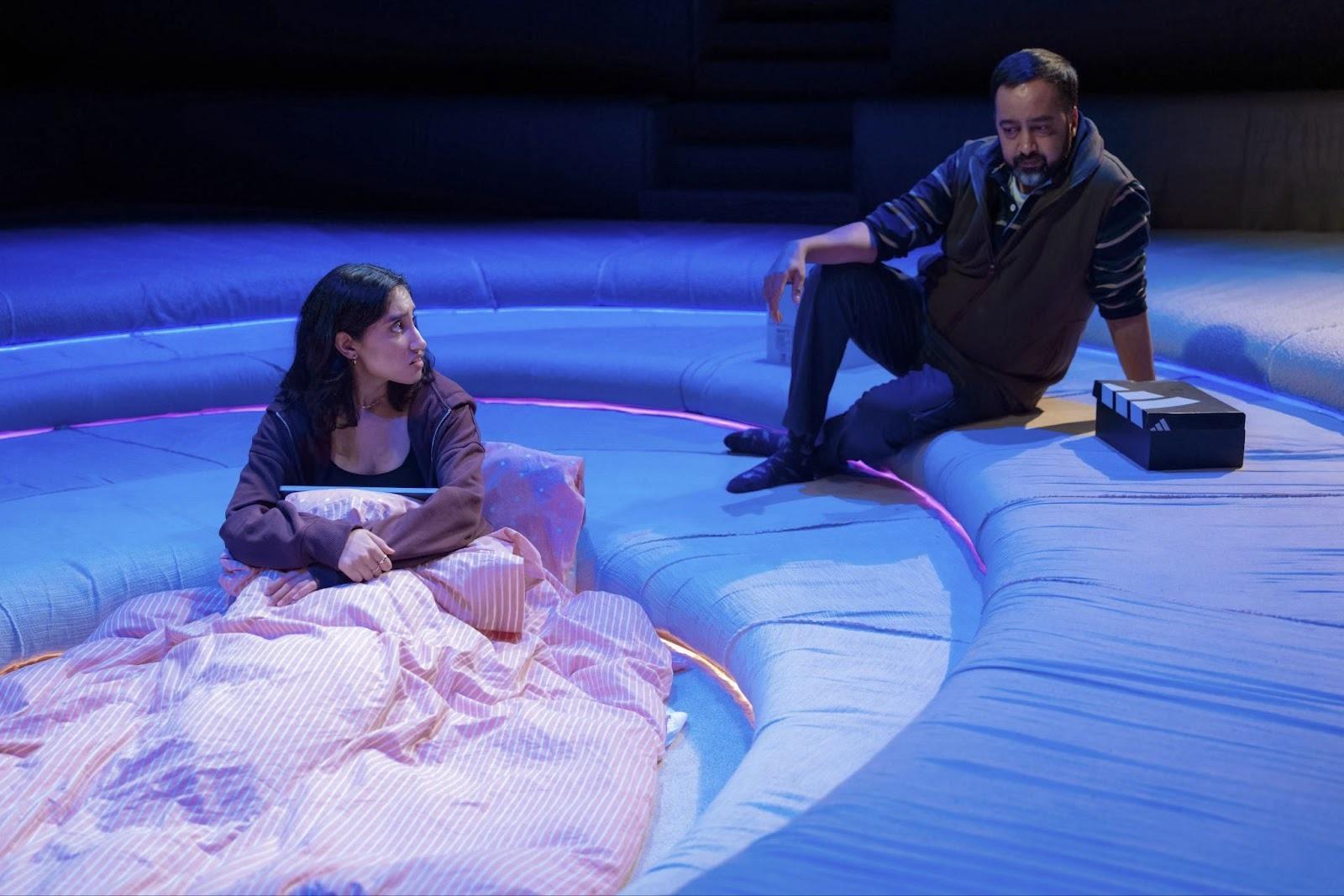
We are at the Royal Court to watch Porn Play. As we climb the stairs to the upstairs theatre, we are issued with a set of shoe covers, provoking the terrifying possibility of a splash zone. Porn Play is the Court’s most recent offering, and it has received some pretty glowing reviews, especially for its celeb star, Ambika Mod. The play is about a Milton-obsessed academic called Annie (played by Mod) who has an increasingly consuming addiction to violent porn. It begins to affect her relationships and then her career; a classic trajectory.
It’s the latest step in Mod’s rapid rise to power. Her first big acting role came only in 2022, when she played the lead alongside Ben Whishaw in This Is Going To Hurt. Prior to that, she had largely been an improv comedian on the Edinburgh Fringe beat, having come out of her university comedy troupe Durham Review. From here, it was a run of TV successes with the stewy romcom One Day and then a flashy but basically forgettable series called The Stolen Girl. Her theatre transition has been equally swift as she’s taken on roles in White Rabbit, Red Rabbit and Every Brilliant Thing, although it must be said, these are both solo-performer shows, the first of which functions on the premise that the actor is seeing the script for the first time as they perform it. Porn Play is her first effort at an actual drama. So, is it worth donning the galoshes?
Well, fortunately, the shoe covers are the result of the set, rather than any impending fluids – which is one of the most interesting things in the production. Designed by Yimei Zhao, it has drawn some wonderfully coy descriptions from many publications. Why? Basically, it’s a Great Big Floor Pussy of cushioned concentric rings. Is it a good design? Sort of. The deepest section is used a couple of times as a reflective pool – reminiscent of Eve seeing herself in still water in Milton’s Paradise Lost – and there’s a fun device of unearthing props from prepared slots between bits of cushion. But it is a heavy-handed design to be sure, and sometimes watching the actors navigate up, down and across its labia can get a little tiresome.
The biggest problem, however, is that for a show that was billed as being ‘controversial’, it was rather timid. We are never subjected to watching any of the violent porn in question, hearing only a few direct descriptions – as a result, it’s a bit of a toothless affair. One of the more arresting scenes comes at a low point for Annie, when she desperately seeks violent sex with a student whom she barely knows. Seeing the beginnings of their violent sexual encounter before Annie bails out is deeply unpleasant. It’s effective, but a rarity. Otherwise, there’s a lot of stage wanking and a scene where Annie, forced to go cold turkey for a period, keeps mishearing the most scandalous things.
In a world where porn consumption is so common and porn addiction is a growing issue, the play fails to meet the bar it sets itself. Moreover, it’s a bar that many other theatre makers, past and present, have been able to clear (we’re thinking of our favourite Sarah Kane, as well as the excellent new duo PISS/CARNATION, who we recommended to you a few editions ago). This feels like another show trying to place itself in the Fleabag slipstream, without realising that the wake has largely settled. Women having sexual desires – gosh! – on stage is much less shocking or provoking than theatre makers seem to think.
The writing also feels relatively safe and at times, a little simplistic. Annie’s dual obsession with porn and Milton means the script is full of literary allusions. But where some are good, others feel pretty naff, and the whole thing is overdone. Annie, mirrored with Milton’s Eve throughout, starts the play eating an apple pie; the academic award she is given is a glass apple, her laptop is, of course, an Apple. For the FT’s Sarah Hemming this was an excellent ‘mischievous allusion’. We are not so sure. Mod delivers two lengthy monologues about Milton; her safe word in the violent sex scene is ‘Milton’, and the reconciliation speech between her and her father is about Milton. There are some bright spots in the writing, to be sure, but overall it feels a bit overly clever and subsequently a little underwhelming.
The other disappointing element was Ambika Mod’s performance. Frankly, we cannot understand the hype. From our seat, she gave a pretty unfeeling and uninteresting performance. Beats were hit in a technical manner, but she didn’t really seem to embody the inner world of the character and that makes sense given her background is really in comedy and TV. Getting used to doing short takes that look good for a camera or playing a thinly sketched character in a comedy bit doesn’t really translate into carrying a full-length drama.
As it happens, the rest of the cast are really solid, particularly Lizzy Connolly and Asif Khan. The latter plays an understated father-figure whose bewilderment at his daughter’s condition is very affecting. His Milton speech is easily the best. Connolly is equally strong, multi-roling brilliantly, and helping produce one of the funniest scenes when she plays a caricature of the slightly uncaring, overworked GP. But a fun design and some good supporting acting can’t really make this a good show. The Court has been bold in its experimentation of late, and that is to be praised, but this could perhaps have done with a few more weeks in the lab.
Fortunately, we were able to catch Bengal Tiger At The Baghdad Zoo two nights ago. It was one of our best guesses for good theatre in the last edition and, if we may, we were so fucking right. This is a great example of how to talk about a ‘topic’ – the Iraq War – without becoming boring, predictable or didactic. There was an added bonus that, though David Threlfall has fallen ill, Kathryn Hunter has stepped in to play the titular tiger. She is, quite possibly, the best actor alive, and will only play the role for a few more days. Catch her tiger while you can.
They Call Me Mr Medici
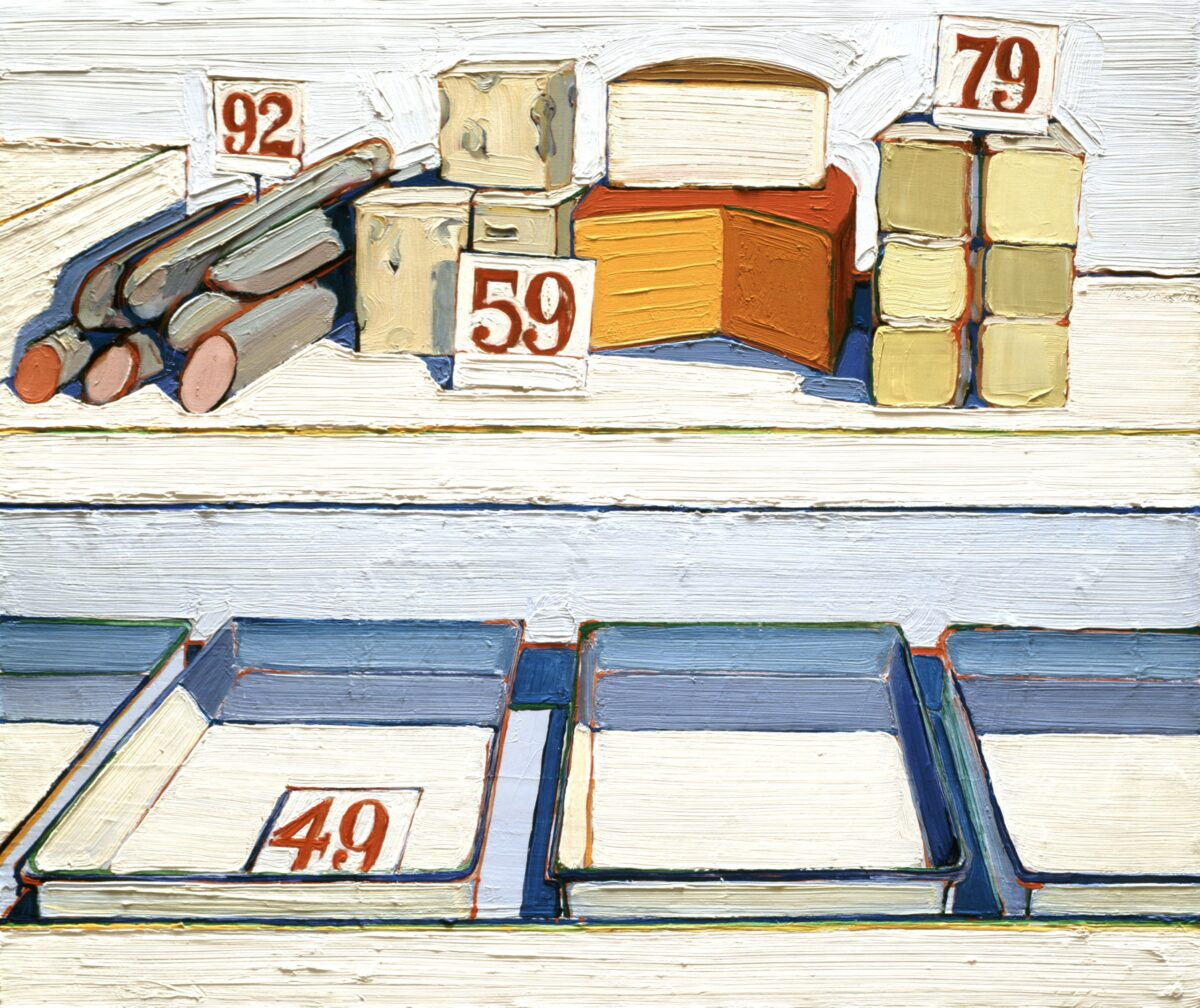
The late painter Wayne Thiebaud’s first museum show in the UK, American Still Life at The Courtauld, is small but potent. Across two rooms, containing hundreds of thickly painted fast-food items, it introduces his distinct vision of midcentury America – both sickly sweet and severely spare. Walk through it naming everything you see out loud and you’ll find yourself singing a depressing retelling of The Twelve Days of Christmas; eight pie slices, seven cream cakes, six blocks of cheese, fiiiiiiive hot dogs, et cetera.
Though he renders them with incredible verve and plenty of oil paint – thick licks of it protrude from the canvas to describe the peaks of a meringue or the tubularity of a salami – Thiebaud’s treats carry a lingering ennui. Lined up like little sculptures on empty counters against white backgrounds, they look delicious but pathetic – an embarrassment of riches. You have 13 slices of Boston cream pie, the painter seems to be asking us, now what? Though it’s been on since October, this show promises to hit different over Christmas, fortified by gluttony and seasonal depression.
The best and bleakest painting is Delicatessen Counter, a meats-and-cheeses still life set in an empty deli. There’s plenty of food, but most of it is encased behind glass, nothing looks particularly edible, and there’s nobody to enjoy it with. This image is both excessive and completely vacant, in the manner of Édouard Manet’s Un Bar aux Folies-Bergère, the 19th-century masterpiece displayed just a few metres away. A life full of delicious, intoxicating things, somehow still hopelessly depressing… Happy Christmas to all, and to all a good night.
Now, there are more than enough ‘trend forecasters’ on the internet, and we are proud not to be one of them, but we do have one prediction to offer for London’s visual art scene in 2026. Following decades of reliance on the increasingly useless and mercurial Arts Council, this will be the year that public art enters its private funding era.
Collector-funded institutions are becoming increasingly popular: two of the city’s most exciting new small institutions – Yan Du Projects and Ibraaz, both in Fitzrovia – are fully funded by their owners. In Bloomsbury, The Perimeter, a similar setup run by the collector Alexander Petalas, recently expanded to subsume its neighbour, the Blue Lion pub.
Elsewhere, the Vinted co-founder Justas Janauskas recently announced a new philanthropic endeavour, the Upė Foundation, which will sponsor curatorial placements at the Hayward Gallery and the Camden Art Centre.
If you’ve ever been to one of their VIP openings, noting the pervasive presence of shiny-suited finance bros, you’ll know that the Serpentine – whose board is chaired by none other than Michael Bloomberg – wears the crown for private fundraising in London. Perhaps as a measure to remind the newbies on its patch who’s boss, it has just announced a new art prize, funded by New York’s FLAG Art Foundation. In the next ten years, it will award five artists £200,000 each – eight times the value of a Turner Prize.
Next year, we’ll keep exploring how, if at all, this influx of private money plays out in the cultural landscape. For now, we take a moment to congratulate the museum workers who might find themselves next year spending less time filling out endless funding forms and taking more billionaires for lunch.
Two Glasses of St Emilion and a Packet of Crisps
It’s that time of year when you find yourself wandering down Regent Street burdened with bags and hankering for a pitstop. But the streets are flooded with shoppers and every pub or bar you go to is heaving, bursting, freighted with Christmas traffic. So where to go for a drink or two, to calm down and hear yourself think?
Davy’s Wine Bar in St James’s has a range of cellars far from the maddening crowds – there’s no boisterous crowds or piped muzak, but there might be some chuntering oil traders on their third bottle of claret. On our last visit, the rooms behind the bar and through the restaurant were totally, blissfully empty. Might this be the best recommendation we’ve given lately? To the SW1 outpost of a chain of rather tacky wine bars? Yes, it might well be.
Brick by Brick Lane
Part of what made the East End such a vital place of Jewish existence was its foil, the West End. The latter was a North Star for the newly arriving and aspirational Jewish population. It was the home of class and culture, and there could be no surer sign in the community of having made it than to make a permanent shift in residences away from Mitteleuropa and towards Mayfair. It was west that Disraeli, Sir Rufus Isaacs and the Rothschilds laid their hats: at Hughenden, 32 Curzon Street, and of course, Gunnersbury Park.
What these buildings can’t show you is the ways they were used and populated by Jewish Londoners past. The tension between the East and West Ends created a youth subculture in the Jewish community. There were the so-called ‘Monkey walks’, where young Jews would dress up and make their way down Whitechapel Road, their parents’ fury still ringing in their ears, to the nice side of town. Here, they might speak ‘Wej Patter’, a backslang beautifully poised between a Jewish and a British world, using and reworking Yiddish words to describe British conditions, making sure to be unintelligible to both the goys and their elders. A cheder, a classroom in Yiddish, was used to mean prison cell; Mieskeit, an ugly person, was reversed and shortened into reem to describe beauty and the word for a busybody, macher, came to mean policeman.
This more elusive oral history can also key you into all the buildings of Jewish London past that are long gone. The old East End was home to many a vast cinema and a vibrant sprawl of Yiddish Theatres, along with prayer rooms, meeting houses and boxing rings. Almost all of this world was lost either in the Blitz or withered away as the community moved on to different pastures. Only a few ghostly remnants can still be spotted. The Grand Palais, a Yiddish theatre on Commercial Street, managed to survive well past its rivals into the 1970s, which perhaps is why the ornamental hood that used to sit above its sign can still be seen above Billi clothing wholesale. One of the last living Jewish elements, Fieldgate Street Synagogue, finished its services in 2007 and was sold in 2015. Gladly, the work of historians has allowed us to hold on to some of these morsels of times gone by, and there is a lovely interactive memory map of Whitechapel that you can access here.
Even as Jewish Whitechapel died out, the mantle has been taken over. This breaks out in a physical mirroring all around the area. As there were once signs in English and Yiddish, there are now signs in English and Bengali. The former Spitalfields Great Synagogue is now the Brick Lane Jamme Masjid.
There we have it. We are going to publish an updated pitch guide for Capital Letter next week, for those of you who’re looking to write for us in the new year. We will be going weekly from the end of January too, which is very exciting indeed. Have a wonderful Christmas.
All the best,
TF