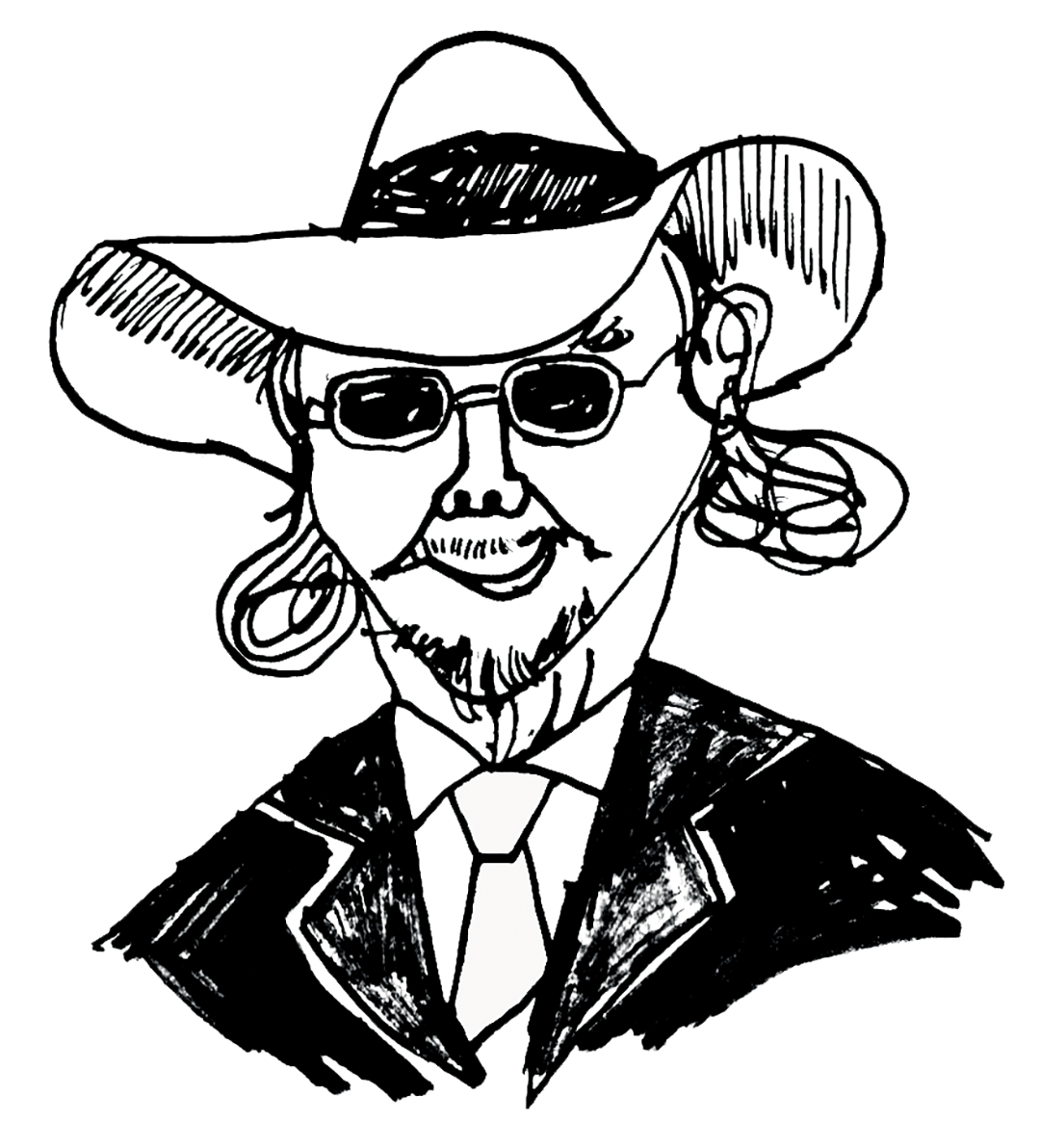
Feuds, awards, prank calls, defamation suits, and public fights, hilarity, cruel jokes, innovative audio productions, TV stinkers, brilliant parodies, hypocrisy and acres of newsprint. It’s the legacy for the 90s and noughties broadcaster and critic Victor Lewis-Smith, recognisable for his sloping black blazers and white-guy dreadlocks. He was a character we might charitably term complicated, whose radio work inspired a generation and a writer whose columns were compelling reading for over two decades. His university friend Richard Pite, one of many with whom relations soured, says, ‘I’ve never met anyone like him.’ Paul Sparks, his co-writer and the friend who knew him the longest, says: ‘It’s been a few years now since his death, but I still miss Victor.’
Lewis-Smith was born Victor Smith in Ilford on 12 May 1957. Sparks and Lewis-Smith met in the mid-70s, when they were both studying music A level at Barking Technical College. He claimed his father was a surgeon, though Sparks says, ‘I don’t know if this actually was true or he just liked to say it.’ A document seen by The Fence indicates that he was in fact a GPO telephonist. Sparks recalls that Lewis-Smith had an unhappy home life: divorcing parents and two older brothers who beat him up. He told Sparks that he’d previously attended ‘some grammar school’ but later told many university friends that he’d gone to Rugby School. Sparks admits he ‘told different people different things’ and Pite says he was ‘obsessively secretive about his background, and to the extent that he would tell stories [that] would contradict later.’
Lewis-Smith went to York to study music, and made an immediate impact on campus. Pite, one of a tight-knit group of friends, says ‘he was one of these people who was interesting to be around, and somebody who, right from the start, knew that he had a certain power over people, and I think that made him the kind of person he was: he took a great deal of pleasure in pushing situations into the red, as far as embarrassment or compromising people, and he would kind of look on.’ He played in various bands: one story tells of him leading a bandmate in the group Exciting Neckwear to appall a jazz audience with increasing profanity; another of a fake group of Arab musicians he toured around daytime TV programmes.

Lewis-Smith met his future wife and business partner, Virginia Duff, at York. Pite describes a glamorous, Debbie Harry type. After university, they stayed on, in an attic flat Smith had his eyes on even while Pite had lived there ‘It wasn’t unusual for me to come in at ten, 11 o’clock at night and find him asleep in my bed. I’d throw him out, and he was extremely disgruntled about that. What was I making a fuss about? It just happened to be my flat and my bed, and he was in it! But there we are. That was Victor.’
After university, Lewis-Smith began writing, working in radio and making vignettes with the broadcaster and sociologist Laurie Taylor, and producing the show Snooze Button for the newly launched BBC Radio York. He was already a skilled producer: Sparks says, ‘he was a genius with tape. I mean, he could do these incredible things.’ He soon graduated to Radio 4 as producer on Start the Week and Midweek with the presenter and journalist Libby Purves, but it was not a natural fit for a man who Pite says modelled himself on Peter Cook’s demonic character in Bedazzled (1967). Sparks says, ‘he hated what he used to call the “net curtains” of Libby Purves, all the kind of nice, twee, home-counties, middle-classness and he just wanted to disrupt things.’ In May 1986, when Purves was away for holiday, Smith booked in her place the gruff character actor Arthur Mullard – anti-Purves, working-class and cockney.
Despite that mischief, Lewis-Smith was invited to contribute segments to Loose Ends, for which he started working with his friend from college, Sparks. Produced in his home studio in Pite’s old flat in York, these showed his command of densely layered tape-editing and his skill with voices, including a pitch-perfect Radio 1 DJ parody persona, Steve Nage. The comedy writer and performer Jake Yapp, who worked with Lewis-Smith remembers these as ‘the finest audio comedy ever produced, quite possibly.’
‘I think Radio 4 could see he was bright and smart and innovative,’ says Sparks, ‘but I think they realised they brought an untamed tiger into the building afterwards.’ The contributions lasted until 1989 when Lewis-Smith pranked Call the Controller on Radio 4 in the guise of the crisply well-spoken creation of Harold Coltart from Driffield, haranguing his boss Michael Green about the soap opera Citizens.
Having self-immolated in a staid environment, Lewis-Smith was taken to Radio 1 by the producer John Walters. His eponymous 1990 show developed his aesthetic: a dense mesh of meta-narratives, richly structured spoof songs, and the baroque and quick-witted prank calls that influenced TV and radio comedy for the next decade. It was scabrous and daft in equal measure, erudite and in wilfully bad taste. The irony was bone-deep, and like all of Smith’s work it assumed buy-in, thick skin and an understanding that nothing was sacred. Despite winning a comedy award, it caused the BBC big problems when the Times reported that clearance to broadcast prank calls had not been sought from those pranked. Lewis-Smith later claimed that the art critic Brian Sewell was particularly exercised, and got his mother involved.
Hoax calls were both Lewis-Smith’s super-power and his kryptonite: his authoritative tone, preternaturally quick wit and apparent disdain for all consequences produced absurdity and puerility in equal measure. A call to Princess Diana as Stephen Hawking was a masterpiece of blagging and audio production, but he held back from releasing it until 2015. The sample of his Marcus Garvey call to BBC reception on The Orb’s Tower of Dub has ensured stoner immortality. He would phone acquaintances late at night when drunk; The Fence has seen a statement from one who claims Smith left him a death threat.
In a notorious episode of the late-night chat show After Dark, broadcast on 26 January 1991, during which a drunken Oliver Reed manhandled the feminist Kate Millet, Lewis-Smith phoned the channel pretending to be the ‘duty officer’ of the Independent Broadcasting Authority, and succeeded in having the show pulled from the air for 20 minutes. The kicker? After Dark’s producer was another university friend with whom he’d subsequently fallen out: Sebastian Cody.
Cody is clear in his view of Lewis-Smith’s character. ‘He was a cruel bully who took particular pleasure in humiliating those who were not able – for reasons of lesser intelligence, education, employment, disability or whatever – to fight back. Anyone who knew him would surely agree he was a coward who postured as courageous, while hiding behind silly voices, various weak-minded patsies, or simply being unavailable for comment.’
Cody offers a story as illustrative. ‘VLS was billed as the star turn at the memorial service of one of his longest-standing friends (or at least drinking partners), a leading York academic he exploited for decades – but on the day of the event, he made an excuse and didn’t turn up. Cunt.’
With bridges burnt behind him, Smith advanced. He had always wanted to work in TV, says Sparks. In 1991 he bought the logo of Associated Rediffusion, the then-dormant company that had been the first ITV franchise and made Inside Victor Lewis-Smith for Channel 4 in 1993. By now, Smith had moved with his family to rural Cumbria and as well as making television, he was writing about it, having become the Evening Standard’s TV critic in 1992: a column every weekday followed for the next 15 years.
TV Offal was filmed in a barn at his home. At 21 years old, Jake Yapp had been taken on as a writer and researcher after stopping Smith and Sparks in the street outside the BBC and telling them what a fan he was. ‘The thing you have to know about Victor is he was always ready for a fight, and he was always expecting a fight, and it meant that the quickest and easiest way to disarm him was to be nice to him, because it was so off his radar. It was so unexpected that he would instantly capitulate and employ you.’
This was a double-edged sword. Yapp was tasked with cleaning up scripts written by two writers Lewis-Smith had met and become friends with over the course of one night at the Groucho Club – ‘I mean, if you ever wanted a job, all you had to do was go to the Groucho for long enough for Victor to show up’ – but the flighty approach to HR also meant for rapid progression within his company. ‘When he ran into some staffing issues, I produced and directed the second series.’ And some of the innovative editing also carried over from radio. Yapp highlights one of the repeat sketches in TV Offal, for which they took footage of musical performances, stripped out the audio and re-recorded it in an absurdly amateur fashion, an early example of comedy editing that has proliferated online as ‘shredding.’
Disregard for protocols was carried over from the radio – Yapp’s job involved retrospectively clearing music and footage that had already been broadcast. ‘He could be absolutely savage to work for. I mean, he reduced me to tears on several occasions. It could be quite dark in there. The closer into his circle you were welcomed, the more he would lash out.’ But his splenetic outbursts were also frequently funny, says Yapp. ‘We were on the phone, and he said, “So, what’s the situation with something or other?” And I said, “Well, basically, we’re looking at…” and he said, “Basically, oh, basically, we’re saying basically now, are we? Well, basically, goodbye,’’ and just hung up the phone because he just didn’t like the word basically.’
If he could bully those he knew, he was many degrees harsher in print. His reviews were hilarious and brutal, and never shied away from personal barbs about intellect or appearance. A typical line, when reviewing The Truth About Richard and Judy (2005): ‘I’ve long suspected Richard has to whistle when at stool, to remind himself which end to wipe.’ The savagery was relentless, and he expected it to be one-sided. Sparks says: ‘People used to say to Victor, “You can dish it out, but you can’t take it,” and he would say, “That’s absolutely right!” He would get outraged if anybody attacked him, but he felt it was fine for him to do it.’
‘I think there was this sort of bizarre shame cycle with him,’ says Yapp. ‘I’ve done a terrible thing. I’m going to kill again. It was like a sort of comedy serial killer, wasn’t it? What have I done? So much blood. He was the comedy Zodiac.’
That attitude meant that he kept returning to the scene of the crime. His feuds became legend. An incomplete list of those he crossed swords with includes Vanessa Feltz (‘he’s a malevolent, mealy-mouthed monster’), Chris Morris (‘It will run and run until he has a heart attack and falls flat on his fat face’), Adrian Chiles (‘he can call me ugly, I don’t fucking care’), Jenny Eclair (‘you are a total cunt’, shouted out a car window) and Jonathan Ross (‘fucking critic you fucking failure’ during an altercation at the Groucho). Dame Esther Rantzen was his bête noire.
A particularly unedifying set-to with the actor and presenter Mat Fraser took place in the lobby at Channel 4, after ‘a column of mine had dared to include a jocular reference to Thalidomide (the drug that had caused him to be born with foreshortened arms.)’ An altercation with the comedian Jack Dee outside the Groucho made the front page of The Sun, reported by one Andy Coulson. Dee later regretted it; Lewis-Smith took great pleasure in Coulson’s very public fall from grace. ‘What goes around comes around, eh Andy?’
On two occasions, acts of ‘journalistic arson’ as Sparks refers to them, ended up in court. In 2006 the stage hypnotist Paul McKenna won a libel suit against the Daily Mirror when a judge was persuaded that he might reasonably not have realised that his PhD from the unaccredited LaSalle University was not a proper PhD, as Lewis-Smith’s column had repeatedly claimed. Sparks gave evidence, and fainted twice. Lewis-Smith had a sick note. The same year Gordon Ramsay was awarded £75,000 from the Evening Standard for the claim that elements of Ramsay’s Kitchen Nightmares had been staged. Two years later Channel 4 apologised for a faked scene in Gordon Ramsay’s F-Word.
At Private Eye, Ian Hislop edited Lewis-Smith for 30 years, replacing a column previously written by the poet Christopher Logue. Hislop had first met Smith when he was at Radio 4, ‘a prankster and collector of strange information. So he was a perfect fit.’ The Funny Old World column republished bizarre stories that had already been published elsewhere, and Hislop says that Lewis-Smith was quite good at checking them, the rigour of the original sources notwithstanding. ‘He was very funny,’ says Hislop. ‘I remember him telling me that he had reviewed something for the Standard and the editor said, “we’ve already covered it,” and he said “I don’t read the Standard. I live in Cumbria.” The editor said, “I can get you a copy,” and he said “don’t bother, I won’t read it.” For us, he properly turned up, and I think he did read the Eye, so I never needed to be offended.’
‘By the last decade of Victor’s life, our moment had come and gone slightly,’ says Sparks. ‘You start getting a reputation as just being awkward to work with and he told too many controllers to fuck off.’ Editors who had stuck by him – Piers Morgan and Max Hastings – had moved on. ‘I think if we were still doing it, we’d be cancelled before the end of the first paragraph. And I think Victor would be very upset if we weren’t, really.’ Lewis-Smith and Virginia had moved to a chateau in the north of France, where he was able to indulge his love of gastronomy, but the commissions were thinning.
By 2022, the Lewis-Smiths moved to a flat in Bruges. He contacted Sparks to say he was taking some time off, and six months later died of cancer. Despite their relationship ending acrimoniously in legal threats, Yapp prefers to remember a particular car journey. ‘He drove me up to Cumbria once from Soho, basically from the Groucho, and we had this long drive up into the night. And we talked the whole trip. And he told me, “There are people who I know will literally dance on my grave when I die.” And I was a kid and I was kind of like, “Really?” and he’s like, “Yeah, yeah, they will, they’ve told me they are literally going to dance on my grave when I die.” And I thought: what’s that like to live with? And then we drove into some black ice on this little single-track road somewhere in the wilds of Cumbria, and the car started skidding and was really careening from one bank to the other, and he was very sweet, and he reached over to kind of press me back into my seat, and he was saying, “It’s all right, it’s all right, it’s all right, it’s all right.”’