Keen, at the end, to leave the nation with a single happy memory, Sir Keir Starmer allowed the pubs to stay open until 5 AM the night England played Mexico. I was in Plymouth, the anchorage from which both the Mayflower and the Beagle departed, and like everywhere, the pubs were strung with St George’s flags. The air was taut with rangy energy, brought on by the heatwave and hours of anticipatory drinking. A goggle-eyed man in the Crown & Anchor demanded to know if I was a spy. Perhaps it was the late kick-off, or perhaps it was the long, slow train through parched and yellowed countryside, but I sensed a pervasive jitter as I arrived at my destination, a Plymouth bar called the Treasury: home to the purpose of my visit, the regional Devon heat of this year’s Miss Great Britain competition.
But there was no option but to be swept up in the exuberant mood in the Treasury. The heat kicked off at 7 PM with about 30 performers from a local dance school, in black blazers, performing to Who Runs the World, and all the hot, aimless energy of the day turned purposeful. The contestants were introduced by the evening’s host and regional director, Jasmine Vigus-Huggins; they were met with bellows from the audience. The next two and a half exhilarating, emotional hours were taken up with dancing, bikinis, sarongs, baroque evening dresses and a talent segment in which one contestant sang I Dreamed a Dream from Les Misérables. During the intervals between rounds, two exuberant men played jazz and, at one point, the taller of the pair lay flat on his back to hoot on a saxophone. The evening climaxed with live questions for three shortlisted finalists, which they answered on stage (all three responded to the prompt ‘Winning a crown is an achievement, but wearing it is a responsibility. If you became the winner of Miss Great Britain Devon, how would you use your platform to inspire others and make a positive difference?’) The final two held hands on the runway, close to tears, and then Dexy Victoria Souter was crowned the winner and Hall of Fame by The Script rang out. I ride the wave back to my Travelodge, where at daybreak I am woken by men roaring in the street.
Later that month, as the heatwave bore on, I took a taxi from Rainham to the Thurrock Hotel in Purfleet-on-Thames. The driver told me about the colossal amounts of fruit he eats, including four to five mangoes a day, which – he said sadly – now cost nearly two pounds each, and have made his liver fatty, like that of an alcoholic’s. By then, England had been evicted from the World Cup, but the Essex heat had been moved forward to 4 PM to accommodate the final. Perhaps as a result, the mood was less febrile than it had been in Plymouth.
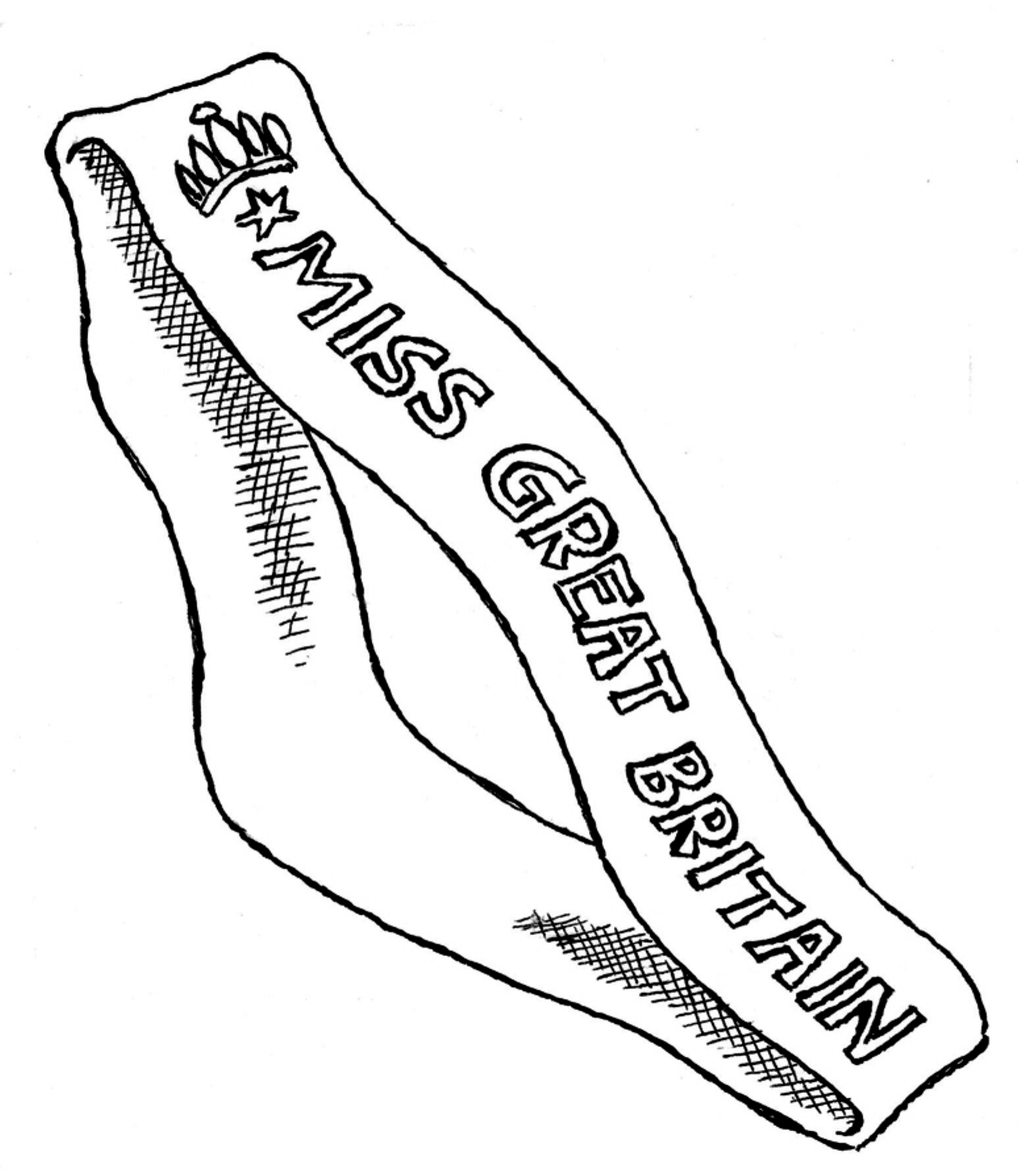
Many of the women here had never competed before, Essex’s formidable regional director Nicoll Moss tells us, and the crowd gamely responds by clapping and whooping steadily through the three and a half hours of the proceedings. Some of these women gave no indication of being new to this at all: 24-year-old Madison Maria O’Brien, in particular, had an astonishingly powerful aura, a mix of regality and flirtiness, like a beautiful, commanding courtesan. Her friend was sat close to me and filmed as Madison sent perfectly timed winks to the camera. After the event, she told me that she loved every second. Some of the other women were less confident – 23-year-old Panusha Limbu, a British-Nepalese finalist, struggled not to trip over the hem of her enormous red taffeta dress during the eveningwear round. Still, she proceeded down the runway with dignity, and the judges beamed encouragingly.
As in Devon, feelings ran high. When Louise-Marie Fisher is crowned the winner – a sparkling contestant with a striking resemblance to Lola Young – her grandmother leaped from her seat, waved her arms in the air, and burst into tears. When the crown is lowered onto Louise-Marie’s head, she could no longer contain herself and came forward to embrace her granddaughter. Many in the room carefully wiped away a tear. It was an emotional moment, her mum told me, because she lost her grandad only eight weeks earlier.
The Essex heat was full of sweet displays of camaraderie. The loudest and most encouraging table in the room was populated by previous winners, or winners in other competitions in the sprawling network of UK pageants, of which Miss Great Britain is only one. After the eveningwear round, the regional director invited ‘anyone wearing a sash or a crown’ to walk the runway – takers, of which there were many, included Miss Teen, Miss Pre-Teen and a Miss Petite Global Europe (open only to women under 5”6); Miss London 2025, Miss Sussex 2023; a few Classics (40 and over), who appeared to be having – if it were possible to choose – the most fun.
These are categories within the overarching pageant categories that make up the separate competitions of Miss England, Miss United Kingdom, Miss Universe Great Britain, Miss Earth United Kingdom and Miss Grand United Kingdom. Miss Great Britain is the oldest, founded in 1945, and perhaps the most traditional. At Miss England, for instance, run by Angie Beasley since 2002, features an eco-fashion round where women make their own outfits from second-hand clothes. The swimwear round has been semi-retracted, too – the judges view photos taken in a studio, instead of having the women walk the runway in bikinis. At Miss Great Britain, however, the offerings haven’t changed much since the competition’s inception in 1945: an introductory walk, swimwear, eveningwear, and then live questions onstage. The mute catwalking is balanced by an emphasis on the contestants’ own histories, personalities and aspirations. A private interview takes place before the show starts.
While the Miss Great Britain trademark is owned by a man, Midlands entrepreneur John Singh, the pageant runs on a franchise model, like McDonald’s, and is orchestrated almost entirely by women. Singh, who made his money in Nottingham with what he calls ‘the first upmarket Snooker and Leisure Club’, bought the Miss Great Britain title in 1991 and grew it by franchising the business to individuals and other operators. The resulting network of licensed regional organisers under the Miss Great Britain umbrella forms a structure that’s much looser than a single-company operation, with operational and financial responsibility for the heats falling to their regional directors.
This piece was originally conceived as an investigation into this franchise model – how it works, and why it’s worth it for the women who choose to take part. Why are these regional directors willing to take on the financial burden of running these heats? Why do so many of them come to their leadership roles after taking part in the competitions themselves? It was going to include the stories of those women who, like Moss, have described the institution as a ‘family’; who talk about the competition as changing their lives. Moss also runs the Kent and Sussex heats – she stepped in when no other director was available, just for the love of the game. She has committed hours and hours to recruiting, organising and supporting young women, and many contestants cosign its – and her – virtues, in person and on Instagram. After I return from the heats, I duly reach out to the regional directors, from Belfast to Glasgow to Nottinghamshire. However, as my emails, Instagram messages and WhatsApps go unanswered, I begin to suspect that there may have been some communication behind the scenes. By the time I receive a terse refusal for an interview from one previously friendly director, it’s clear that the memo has circulated: do not speak to this woman.
When I speak to onlookers and participants at the events themselves, everyone takes pains to stress the collaborative nature of the competition – they’re keen to counter the general idea that pageantry is either vicious or superficial. For similar reasons, Miss Great Britain insists that the competition is primarily invested in empowerment, not beauty. In Plymouth, the regional director Vigus-Huggins, who is 21 and runs it alongside her mum, declared that the competition ‘is about giving women a platform, confidence and a voice’. One after another, contestants backed this up – ‘I’ve never felt as confident in a swimming costume as I did today’, said one, while still on stage. Another told me that because of her eczema, she would never have thought she’d be in a bikini in front of all these people. Louise-Marie, the Essex winner, used the word ‘empowerment’ twice in her Instagram post about the swimwear round. While there were some extraordinarily toned and tall bodies on display at both events, there were far more ordinary-sized ones. One woman walked with a cane. It occurs to me that the most radical aesthetic deviation would have been short hair – everyone’s was long, loosely curled and often a similar colour to the parched landscapes beyond the windows.
At both events, I had no doubt that nearly everyone on the stage was made to feel more powerful and beautiful by dint of competing. They told us as much when they addressed the judges, and most looked visibly exhilarated both on and off the runway. When I spoke to Madison in the break before the judges’ verdict, we were interrupted at least three times by women telling her how amazing she was. It’s a riot of sisterly solidarity – it’s no surprise that there emerged some wariness of a journalist coming to demolish it because she thinks its feminism isn’t urbane enough.
London can be excessively pompous about its role as fomenter and arbitrator of culture. What we might vaguely call ‘quality’ may spring from anywhere, and perhaps especially from places which have traditionally received less attention. When I was a child in the West Midlands, my stepfather took part in our local village fete by baking for the category called ‘best fruitcake made by a man’. There was only one other entrant, but nevertheless my stepdad was awarded a third-place certificate, alongside a note informing him that a fruitcake should never be served warm. Sometimes I remember that fete when I encounter one of London’s more depressing cultural avatars. This anonymous judge’s commitment to quality as an abstract ideal remains inspiring.
Miss Great Britain was conceived in the summer of 1945, when the first ‘Bathing Beauty Queen’ contest was held at Morecambe’s Super Swimming Stadium, organised jointly by Morecambe Local Council and the Sunday Dispatch newspaper. In the post-war period, beauty contests sprang up along the Lancashire and North Wales coastlines as part of an effort to retain tourism in towns like Rhyl, New Brighton, Southport, Blackpool and Morecambe (these tourist economies limped on for another 30 years or so, until the advent of budget airlines). These struggling towns sought to increase visitor numbers to boost failing local economies – as the Miss Great Britain website puts it, ‘men could enjoy watching pretty girls, women could have fun backing their favourites and young girls could aspire to be a bathing beauty when they grew up’ (it also notes that ‘the first ever Miss Great Britain final was watched by 4,300 people in a continuous downpour’). The franchise model itself was also born of economic necessity. Martha Matilda Harper is widely credited as the inventor of retail franchising after she launched a network of beauty salons in Rochester, New York, in 1891. The model successfully sought to circumvent the fact that women at the end of the Victorian era found it almost impossible to get loans: franchising gave them an opportunity to take on an established brand at a relatively low cost.
Miss Great Britain, with its sponsors from local hairdressers and independent retail, also reflects the increasing importance of the beauty sector to the UK economy. Hair and beauty has expanded dramatically while much of the high street has shrivelled. An analysis of VAT-registered business data found an additional 11,835 hairdressers and beauty salons have sprung up since 2010 – more than doubling their number. The beauty industry overall employs more people than steel and gas combined. This has felt particularly evident in the UK’s towns and villages, where for decades, the most typical local business has been a Chinese takeaway; now, it’s a nail bar. There are several reasons for this, from the cynical (nail shops are popular facades for money laundering) to the self-evident – compared to a decade ago, beauty has become a more rigorously applied set of conventions, with non-intrusive but not inexpensive cosmetic procedures increasingly normalised for girls and women of all income brackets and age groups.
Another key reason there are, in relative terms, more beauty parlours and hairdressers on high streets is that these services must be done in person and can’t be moved as easily or cheaply to online delivery, like shopping, or automated, like banking. The economic concept known as ‘Baumol’s cost disease’, formulated by economists William Baumol and William Bowen, uses the example of a string quartet to illustrate what happens when services can’t be made more efficient: it still takes four people 40 minutes to play a Beethoven string quartet today, just as it did in the 19th century, meaning zero growth in labour productivity. Yet, musicians’ wages must rise to match general economic growth so they do not leave their careers for higher-paying jobs, driving up the relative cost of live performances. If the work cannot be automated or done by AI – as neither a musical performance or a haircut can be – the cost of the service keeps on rising. One day, our high streets may be nothing but nail bars and hairdressers, and they’ll be the most expensive, and most valuable, sector of our economy.
Though Miss Great Britain as it exists today is no longer a branch of local-authority economic development policy, it still tells us something about the way regional and national economies work. In the press, economic analysis is broadly confined to gilt yields, Bank of England policy and headline inflation numbers. At the same time, we’re treated to incessant thinkpieces about depressed regional economies, replete with rich visual detail: rotting piers, boarded-up Dinky Doughnuts stands, seagulls wheeling overhead empty carparks, spice smokers passed out in shopping centres. The idea of ‘levelling up’, as proposed by Boris Johnson in 2019, seems just as lifeless, doomed by its insistence that regional empowerment would be managed from central government. But this year may see a renewed drive towards fiscal devolution and with it, a new set of relations between the capital and the regions.
Andy Burnham is the UK’s first Prime Minister to have focused his branding on being a ‘place first’ politician, however mindless the messaging (when Mumsnet asked him, ‘What’s your favourite biscuit?’, he replied with ‘beer, chips and gravy’). As a result, commentators are already getting excited about the possible fiscal policies he may adopt to devolve economic power to Britain’s regional authorities. Currently, an estimated 95 per cent of UK tax revenue goes to central government; metro mayors and local councils squabble over the remainder. In Germany, local and state governments collect 40 per cent. Greater tax devolution would allow local authorities revenues that might appeal to investors, allowing them, in turn, to borrow more through bonds, creating a proper municipal bond market that would help councils invest in the kinds of large-scale infrastructure projects that might risk becoming politically poisonous at national level. When we look at Miss Great Britain, and its model of small-scale, relational economics, we might glimpse our brave new Britain – a happy nation of metro mayors, ruling over their local authorities like benign warlords, just as the pageant’s regional directors do.
Even after attending two Miss Great Britain heats, I found it hard to work out what metrics the judges were using to award their crowns. Beauty, notoriously, is subjective, and beyond obvious qualities like ‘longest legs’ – which I doubt was on the score sheet – it seems impossible to rank the shimmering substances of aura and personality. But perhaps the competition’s inscrutability – its mysterious judging systems and its managerial muteness – also arises from the fact that what constitutes ‘value’ is fundamentally illegible to those outside of the local systems of its exchange. Focusing on the winners and why they won, anyway, would be to miss the point. I looked at every beaming young woman on stage and felt crushed by beauty. 25-year old Natalia, who was competing to show that it was possible to be beautiful with eczema, told me when she came off stage, ‘Honestly, I feel like my whole body’s vibrating’. I also felt the reverberations. Who’s to judge?