The Quernmore Road out of Lancaster boasts one of England’s finest views. To the north, the Lake District and the Yorkshire Dales converge, their crags and peaks set against the verdant scoop of the Lune Valley. Bearing to the left, you pass through a copse of alder, and a discreet sign for Quernmore Park Hall, an austere late-Georgian mansion nestled in its own parkland. Built in 1798, the house still stands at its original extent: over 20,000 square feet, with two flanking wings and 12 bedrooms spread over three floors. The entrance hall is dominated by the skeleton of a woolly mammoth, four metres at the shoulder, high enough to reach the first-floor landing. The specimen is one of the few interior additions made by the house’s only permanent resident, a 92-year-old man called Owen Oyston.
Ten decades have afforded Oyston a remarkable CV: a miner’s son turned actor turned multi-millionaire; a property baron whose family landholdings march alongside the King’s and the Duke of Westminster’s; a grandfather and a great-grandfather; an avowed socialist and the largest private funder of Neil Kinnock’s Labour Party; a media maverick who invested in a left-wing national newspaper and tried to buy Manchester United; a boyhood fan of Blackpool FC who eventually bought the club and turned its fans against him and his family; a serial and successful litigant who took a six-figure sum from the Sunday Times; the victim of a decades-long conspiracy by members of the local Conservative Party; a convicted rapist who spent three and a half years in prison on charges he still vehemently denies.

Oyston’s life has dominated Lancashire headlines since the 80s. His infamous ownership of Blackpool FC – one of the eternal underdogs of English football – resulted in the club’s fans campaigning with righteous anger against clan Oyston, the Seasiders taking to the streets and social media in a remarkable bid to wrestle back control of a beloved local asset.
Since 2019, the fans have had their wish; the club is now under the ownership of Simon Sadler, another local boy made good. But in high summer, The Fence heard rumours that Oyston is preparing to once again involve himself in the club. Sadler is currently embroiled in a trial in Hong Kong for alleged insider trading – which he denies – and there are whispers that he is keen to offload a depreciating asset. Oyston, we were told, is looking for one last grand gesture before he dies. He says he wants to give Blackpool FC – a club he owned for 32 years – to the fans.
It would be a fascinating finale to Oyston’s life, but when we made initial enquiries, we found ourselves under questioning. Two journalists asked if Oyston himself was paying us to write this feature. Another was adamant: ‘Be careful… you’re entering the swamp.’
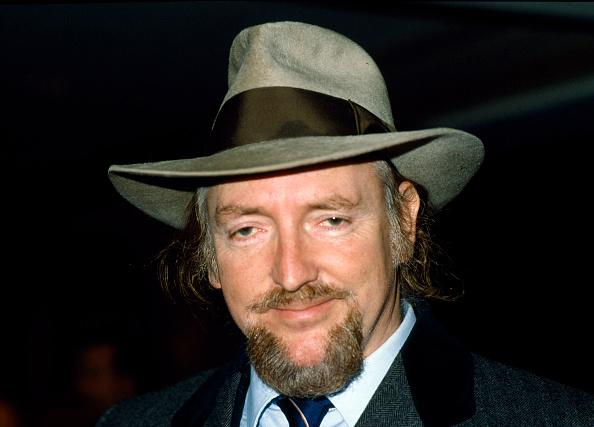
The Oyston family made their name in Lancashire, but for centuries they laboured in the fields and coalpits of County Durham, where Owen Oyston was born in 1934. His father, Selsby, worked at Burnopfield Colliery, and had to queue for coarse black rye bread when work was scarce. When Oyston was just two years old, the family moved to Blackpool, where he attended a Catholic Brothers school, St Joseph’s. His parents ran a boarding house on the South Shore, two minutes’ walk from Blackpool’s stadium at Bloomfield Road. Oyston heard the roar of a football crowd and was forever hooked. Owning the club would become a lifelong dream.
As a young man, Oyston was not a successful student, but his inability to earn a single qualification did nothing to dampen his aspirations. He first set his sights on becoming an actor and worked at Jack Rose’s repertory theatre at Blackpool’s Royal Pavilion before he decamped to London to find work at the age of 18; he appeared as a barrister on the Granada afternoon TV series, The Verdict Is Yours. When stardom proved elusive, he started selling zig-zag sewing machines door to door, before returning to Blackpool. There, he met a property agent called Fred Ritchie through his parents when they were selling their house. It was Ritchie who told Oyston to set up shop on his own. He did, opening his eponymous estate agency in 1960. He worked hard, all seven days of the week, and made his name thanks to a ‘no sale, no fee’ strategy. Oyston even put his thespian past to good use for the venture: he is best remembered from that period for a TV advertisement in which, wearing a black suit and with a jaunty hand on his hip, he fell backwards into a swimming pool. He shouts ‘It could be youuu!’ as he hits the water.
Just before the 1987 stock market crash, Oyston sold his estate agency business to what was then a major insurance holdings company, Royal Insurance, for a sum never publicly divulged, although the figure is believed to be north of £30 million. The sale piled vast wealth on an already fabulously rich man. By that point, he was living in a great Tudor barn perched on top of the moors called Claughton Hall, where he kept a herd of bison roaming on the grass outside. Locals called it ‘Castle Dracula’.
Yet despite – or perhaps because of – his stratospheric social ascension, Oyston was devoted to the story of his scrappy start. As he got more famous, the scrutiny increased. Throughout the 70s, his wealth and loyalty to the Labour Party invited suspicion from both political and business opponents.
But the criticism ballooned from dissatisfied grumblings to full-on conspiracy, as a group of local Conservative politicians plotted to bring down this left-wing tycoon.
Leading the campaign on the ground was Michael Murrin, a former fish-and-chip shop owner, and the man who became Oyston’s most implacable enemy. ‘You couldn’t make Murrin up,’ chuckles Andrew Rosthorn, an 84-year-old haulage director and journalist who has covered the Oyston sagas since before any member of The Fence was born.
Rosthorn’s book The Oyston Files (2021) is his magnum opus and the apex creation of a life spent covering Oyston’s many enemies. Across 463 pages of fastidious and often dizzying detail, Rosthorn defends a spurned man. Some of its most incredible details come courtesy of Murrin himself, who carefully recorded and kept copies of every conversation he had with his co-conspirators on tape.
Oyston was still building his real estate empire when Murrin began his campaign. Murrin started on solid enough ground: in 1983, as head of the Lancashire Rate Payers Association, he correctly suspected Oyston of paying a local Labour councillor. This was unwise, but certainly not illegal. From there, Murrin picked up the intoxicating scent of scandal, and would hammer his discoveries to a board outside his fish-and-chip shop.
Murrin didn’t work alone. William Harrison, a prominent local businessman, was along for the ride, too. He’d been sour on Oyston for some time after he felt the estate agent had isolated him out of a big payoff from a land sale. The genesis for Harrison’s hatred of Oyston has a dateable moment: 3:20 AM on 10 August 1975, when Harrison’s daughter mounted the pavement in her Ford Escort and killed two young mothers, Lilian Tierney and Sharon Moyles.
Harrison worked overtime to bury the story, leaning on the Lancashire Chief Constable, Stanley Parr, to downgrade the charges and keep the press away – no journalists were in the gallery at the trial. Such was the extent of Harrison’s local influence, that when a young PC Bailey rose to intervene and supply evidence that otherwise would not have been heard, his superior officer pulled him back to his seat by his vest.
The cover-up was exposed anyway, after a local alderman leaked an internal police investigation, deliberately dropping it into a wastepaper basket for a journalist to retrieve. The story was published in the local Lancashire Evening News in which Oyston was the leading advertiser. Harrison, convinced Oyston was behind the leak, handed Murrin £20,000 to secure evidence from various disgruntled ex-employees of the Oystons, as well as a private investigator. The decision proved unwise. ‘I feel as though I’ve taken a suitcase with 20-odd thousand in, and thrown it off the bloody North Pier,’ he complained to Murrin on the phone.
The money only escalated Murrin’s fantasy further. His concerns drifted from the municipal to the national and, finally, the cosmic.
Murrin variously and incorrectly claimed Oyston had turned up to a party for Jewish businessmen in an SS uniform, was laundering drug money and keeping child pornography, or children, somewhere on his property, and that he may even be guilty of murder.
For Murrin, the obsession simply grew. On one recorded call, he can be heard vowing, ‘I’m going to have him. One way or another, I'm going to have him.’
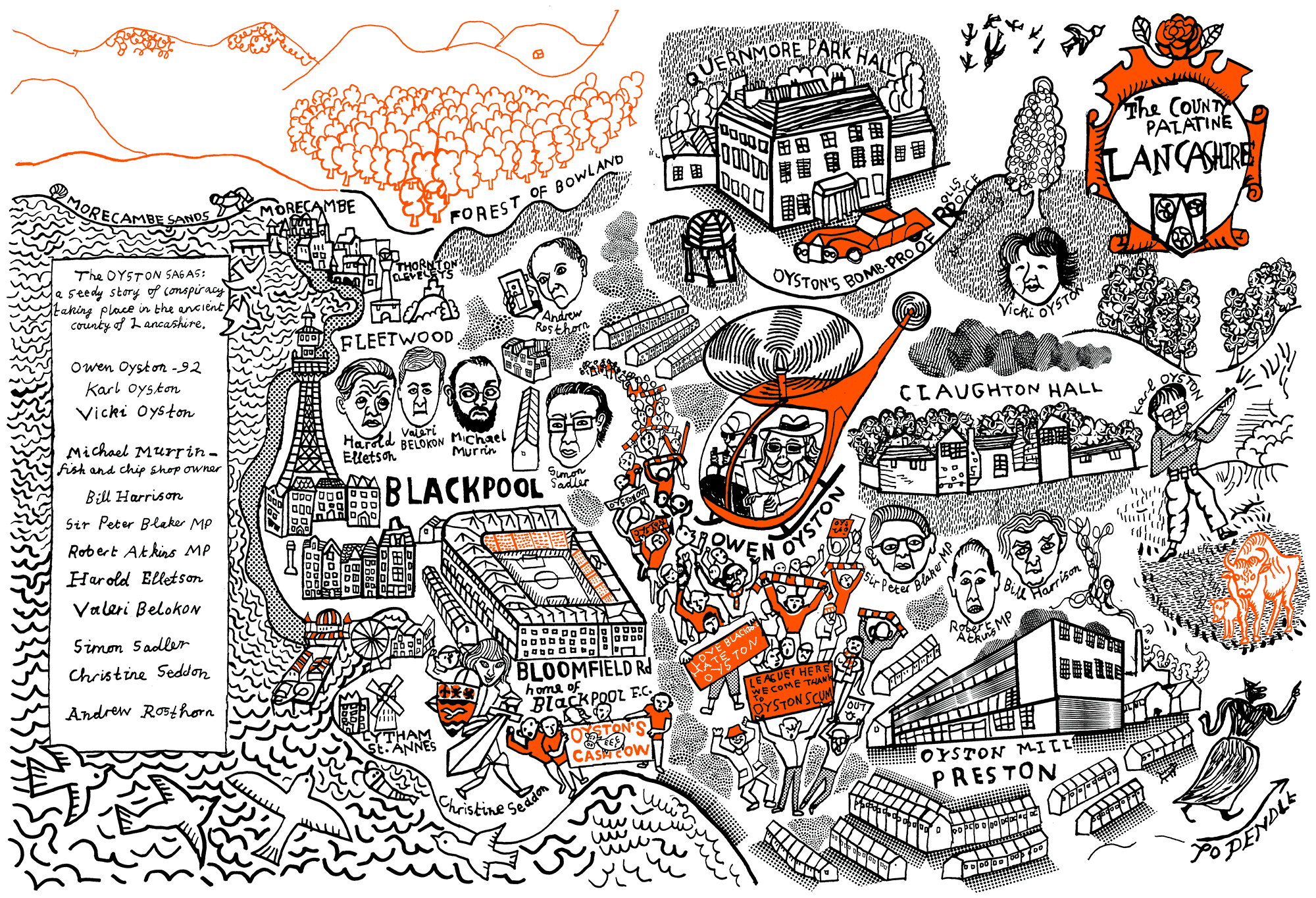
Harrison and Murrin were actually supported, encouraged and even connected by serving Conservative representatives sitting in local constituencies. They had been introduced to each other by a local MP, Sir Robert Atkins, who was one of then Prime Minister John Major’s oldest friends. Another local Tory heavyweight, Sir Peter Blaker, helped fund Murrin’s cause, too, and encouraged him on the best approaches to the Chief Whip, David Waddington.
Murrin’s extensive recordings reveal just how committed his backers were to the cause. In one exchange, he and Blaker weighed up whether Oyston might ‘do a runner’ to Rio.
Blaker: Yes, well that will be a victory of sorts, but not such a good one as the one we want. Not the one we want.
Murrin: No, we want him here. We don’t want him to do a Biggs.
Blaker: Behind bars, that’s right absolutely.
Murrin: He’s sticking two fingers up and is laughing at us.
It is remarkable how far Murrin got with his flights of fancy. At one point, Murrin found an obscure company called Oyston Ltd based out of the Isle of Man. It was tied to Patrick Diamond, a lawyer who used the company to launder cash. The Oyston name and the fact Diamond had been arrested with a small amount of cocaine was sufficient for Murrin to conclude he’d uncovered Oyston’s underground drug operation.
But at every step, Murrin’s backers validated his efforts. In the tapes, Blaker reminds Murrin that his other political supporter, Robert Atkins, had recently become a cabinet minister, adding that, ‘I think we should keep Robert in on this, by the way.’
But as time passed, the conspiracy started to deal real damage to Oyston. Leaked material triggered two Inland Revenue investigations, costing him £300,000 in back taxes just as he was negotiating with Royal Insurance, and a 1989 dossier Murrin wrote and disseminated then fed three Sunday Times pieces. This, Oyston claims, cost him £1.8 million.
They also proved to be Murrin’s undoing: with claims in print, Oyston could sue, and he won a fortune from the paper with the assistance of Peter Carter-Ruck. Through the legal proceedings, Oyston was able to make the conspiracy public.
People in the establishment believe that Oyston’s position as socialist – a magnate with a heart and a bombproof gold Rolls-Royce – made him especially vulnerable. ‘When you are rich, and you are Labour,’ the Labour peer Lord Campbell-Savours told us, ‘you put a target on your back.’
Oyston was friends with the then-leader of the party, Neil Kinnock, and also invested in the ill-fated left-wing national paper, the News on Sunday. He was expanding his holdings in media across radio, magazines and cable television.
Yet throughout, his boyhood football club remained the prize he wanted most. One of the oldest clubs in the north-west, Blackpool had its heyday in 1953, when Stanley Matthews won them the FA Cup, turning around a 3-1 deficit with 15 minutes to spare, a black-and-white fantasia of Brylcreem England. Since those halcyon days, however, the club had taken a hit. The players hadn’t competed in the First Division since 1971, and the stadium had fallen into disrepair.
Oyston finally realised his dream in 1987, purchasing Blackpool FC for a small sum, although not the nominal £1 that became common lore. Nevertheless, it was framed as a rescue. Oyston intended to restore a team languishing in basement leagues, and to do away with the poor decision-making that had left the club in the lurch. He talked up the prospect of a new 50,000-seat stadium with a ‘coliseum’ of shops. The fans were thrilled.
They were soon disappointed. His early tenure saw the club run through seven managers in nine years, all of whom struggled to get the players to shine. Fans were beginning to lose patience with the chaos. For Oyston himself, though, life was about to take a much darker turn.
No one ever doubted he could be a difficult man. Oyston had first got into trouble with the law in 1955 for running illegal betting spreads with his father. In 1986, he got into a dispute with a former business partner. But a rape trial was another thing entirely. The accusations were bleak. In February 1995, Oyston was charged on multiple counts of rape, sexual assault and conspiracy to procure women between 1988 and 1991.
Oyston denies any wrongdoing. He was convicted on one count of rape and cleared on all other charges. The trial centred on a modelling agency in central Manchester run by Oyston’s friend, the former police officer, Peter Martin, who was himself imprisoned for rape and indecent assault. In a five-month investigation into the agency, the Greater Manchester Police found that the company had illicitly filmed 482 videos of girls undressing, and that Martin had regularly drugged girls under the guise of slimming pills and vitamin supplements.
Oyston’s involvement with young women and girls was unearthed in the process of the investigation; Martin had allegedly introduced several of the models under his care to Oyston. One former model described how Oyston had forced her to have oral sex with him in the back of a Toyota Supra. He then raped her in his bedroom at Claugton Hall. During the young woman’s testimony, three jury members were reduced to tears: ‘He treated me like an object, and I’m not,’ she said. At the time of the rape, she was 16.
Throughout his time in prison, Oyston maintained his innocence even though it harmed his chances of parole. He believed the whole thing was just another set-up. In December 1999, over halfway through his six-year sentence, Oyston emerged from HMP Wealstun, to taste freedom and watch Blackpool once more. He had never renounced ownership of the club. What followed was perhaps the most turbulent saga in the history of professional English football.
Blackpool on a summer weekend: the British seaside on steroids. Crowds flood the beach for a deafening RAF flypast as a Typhoon fighter jet dips and swoops over Morecambe Bay. Bed and breakfasts display chipped ‘no vacancy’ signs. It is the Rebellion Festival, headlined by The Stranglers and the Cockney Rejects at the Winter Gardens. The streets teem with middle-aged skinheads and mohawked punks posing for photos and swigging pints while onlookers their same age trundle past on mobility scooters. Young Traveller men clip horse-drawn Cinderella coaches full of chuckling women in niqabs down the promenade.
South of the Pleasure Beach, on the quieter stretch of the Highfield Road, The Fence is meeting with Christine Seddon, former chairwoman of Blackpool FC Supporters’ Trust. Christine is charming and amusing company, sporting a tangerine cardigan in the precise shade of her football club. Over coffee, she does not mince words about the Oystons: ‘It made me feel physically sick to see how they destroyed this wonderful thing for our community.’
Football clubs may have started in the late Victorian era as mutual organisations. Today they are, with the odd exception, private companies, traded by the world’s richest individuals and nation-states. At the top of the game, there are hundreds of millions – even billions – to be made by canny operators.
Owen Oyston was not the only member of his family in the director’s box during his three decades of ownership. Two of his children served as chairman, his grandson Sam was briefly chief executive, but it was his then-wife Vicki – who he married when she was a teenager – who first took the role of chairman when her husband was serving at Her Majesty’s pleasure.
A finalist in the 1961 Miss Great Britain pageant and later a schoolteacher, Vicki ran the club in her husband’s absence. A woman of considerable flair, she fought and won a discrimination case against Tranmere Rovers, where she was banned from entering the boardroom on account of her gender.
Nonetheless, she received a wall of abuse at Bloomfield Road, and was spat on by her own fans. Today, she’s the only member of her family whom Christine Seddon has any sympathy for. ‘What she went through was unacceptable.’
After three years, she stepped down to be replaced by her son Karl Oyston, supposedly named after Karl Marx. As a young man, Karl had frequently run into difficulties with the police for speeding offences, notably crashing his father’s Ferrari. He cheerily admits to having no interest in football. A former club member said Karl took him out for a drive and announced that he would have preferred to be a pig farmer. Some of the most astonishing tales of Karl’s behaviour are excellently reported in Nathan Fogg’s book How Not to Run a Football Club.
In 2015, he was sanctioned by the Football Association for baiting fans over social media and text. One quote to a member of the public who had written him a friendly message about the club’s progress: ‘Impossible to have a meaningful conversation with such a fuctard [sic] as you. The day you ever advise me about anything other than paint colour will not come.’ Karl Oyston has since apologised.
While Karl was seemingly at ease as a provocateur and a troll, he was also successful, at least initially, as a hard-headed businessman. The club was losing a fortune every year in 1999, and Karl looked at the books dispassionately, and took the losses down to a far more manageable level. With his refusal to engage with the services of agents and their superfluous fees, Karl impressed other chairmen across the country for doing things differently.
This frustrated players like Brett Ormerod, who was working in a cotton mill when he signed for Blackpool in 1997. A striker, he played for the team for two spells, scoring for them in four different divisions. ‘I actually agreed with a lot of what Karl did,’ he says.
One of the chairman’s initiatives was to pay players a lower wage (just £90 a week) in the off-season than in the summer. ‘But Karl has no idea what it’s like to grow up working class – he grew up in a castle. It was all a game to him. He never had to scrap for a living’.
So, why did he take over running the club in 1999 in the first place and then spend years in unseemly, costly disputes? Christine Seddon posits the theory that it was primal: ‘Karl hates people generally. I just think that’s how he is. But I think he wanted revenge for his mum because he was always very close to her. And that’s why he didn't like his dad, because of how his dad had treated his mum, and then he hated the Blackpool fans for how they treated his mum – and this is how it’s all gone on.’ When we speak to Karl about this, he laughs and says, ‘You’ve condensed about 25 years of history into four sentences.’
Thanks to an oversight with the leases, the Oyston family maintained a foothold in the club until very recently, at the penthouse apartment in the club hotel, which is part of the main ground. It is believed that one of Oyston’s daughters was using it as her primary residence, much to the displeasure of Simon Sadler.
When she was eventually forced out of the building in 2024, it was likely Sadler who encouraged the club to announce it on the tannoy system during a match, to cheers around Bloomfield Road. There was a time in the not-so-distant past when the Oystons were briefly the toast of Blackpool. In May 2010, under the management of Ian Holloway, the club was catapulted into the Premier League.
There were several reasons for this apparent overnight success. One flew over from Latvia. In 2006, Valeri Belokon, a businessman who owned a majority share in Baltic International Bank, bought a 20 per cent stake in the club. His connection to the club was Harold Elletson, a longstanding friend of the Oystons. Together, they would talk long into the night about politics, about how the government could work for the people.
Yet Elletson was cut from a different cloth to the Oystons. He was the scion of a family influential in the county since the 17th century, a one-time Conservative MP for Blackpool North who, according to one contemporary, was legendary for his charm, and had a ‘tendency towards tweed, even in suit form’. He also turned out to be an MI6 agent, a role that was outed by the Observer in 1996.
It was through Elleston’s ‘continued interests’ in Eastern Europe that he met the Russo-Latvian Belokon. Over a series of meetings in Riga and a shooting weekend at Claughton Hall, Belokon was wooed by the Lancastrians. Fellow guests on that trip included Nicholas Louis, the son of Victor Louis, infamous as the go-between for the British media and the KGB, and who worked for Belokon running the bank’s UK bureau. The influence of dark Russian money in Britain in the early 21st century has been covered almost exhaustively – but this particular episode is only being reported for the first time.
Belokon’s finances were far from pure, and a French court would find that his Manas Bank in Kyrgyzstan was used to facilitate ‘massive’ money-laundering. Several years after this ruling, in 2023, Baltic International Bank was raided by a police task force armed with submachine guns. The bank had suspended its financial services the previous month. Among other things, the scandal posed a problem for King Charles III, whose charity Belokon has been a trustee of for three years. Belokon had also donated to Charles’ charity and set up joint ventures with the King.
Belokon’s investments proved vital to pushing the club forward – two financial injections that totalled £9.25 million were a considerable boon for the club in an era where a £32-million-pound deal for Real Madrid’s Robinho could set a British transfer record.
On 14 August 2010, an opening day 4-0 victory over Wigan Athletic sent them to the top of the Premier League, the apex of the English football pyramid, a position that they hadn’t occupied since the first fixture of the 1957/58 season. The green weeks, however, were short-lived. Struggling heroically against teams with greater resources, Blackpool were relegated on the final day of the season after blowing a 2-1 lead against Manchester United.
If the club had persisted in the highest level of the sport, Oyston would have been compelled to divest himself of the club under the Premier League’s ‘fit and proper person’ rule, under which owners of clubs can’t possess a criminal record. But standing down was far from his mind. In 2011, he was paid a £11-million directors’ salary, more than Wayne Rooney earned that year. The fans began to suspect that the Oystons deliberately weren’t reinvesting the money into the club – indeed, Quernmore Park Hall was purchased soon after this transaction was made, and Claughton Hall was left to other members of the family.
Valeri Belokon was starting to lose patience with the Oystons. He won a case against them in February 2017 relating to a large sum of money he had loaned the club for the development of a stadium stand. Belokon’s lawyers successfully argued that he was due 50 per cent of its resulting income.
Following this ruling, Belokon started a lengthier and more complicated trial at the High Court later that year. He was arguing the case of unfair prejudice, claiming he had been iced out of financial decision-making by his partners. Hell was breaking loose in the executive suites, and it wasn’t helped by the fact that the fans had now launched a boycott designed to force the Oystons to sell off their shares. Led by the ‘Not a penny more’ and ‘Oyston out’ campaigns spearheaded by the Blackpool Supporters’ Trust, attendance had dropped by 51 per cent in 2016/17, after the Oystons led an ill-advised series of libel actions against the Blackpool fans who were making their views heard online.
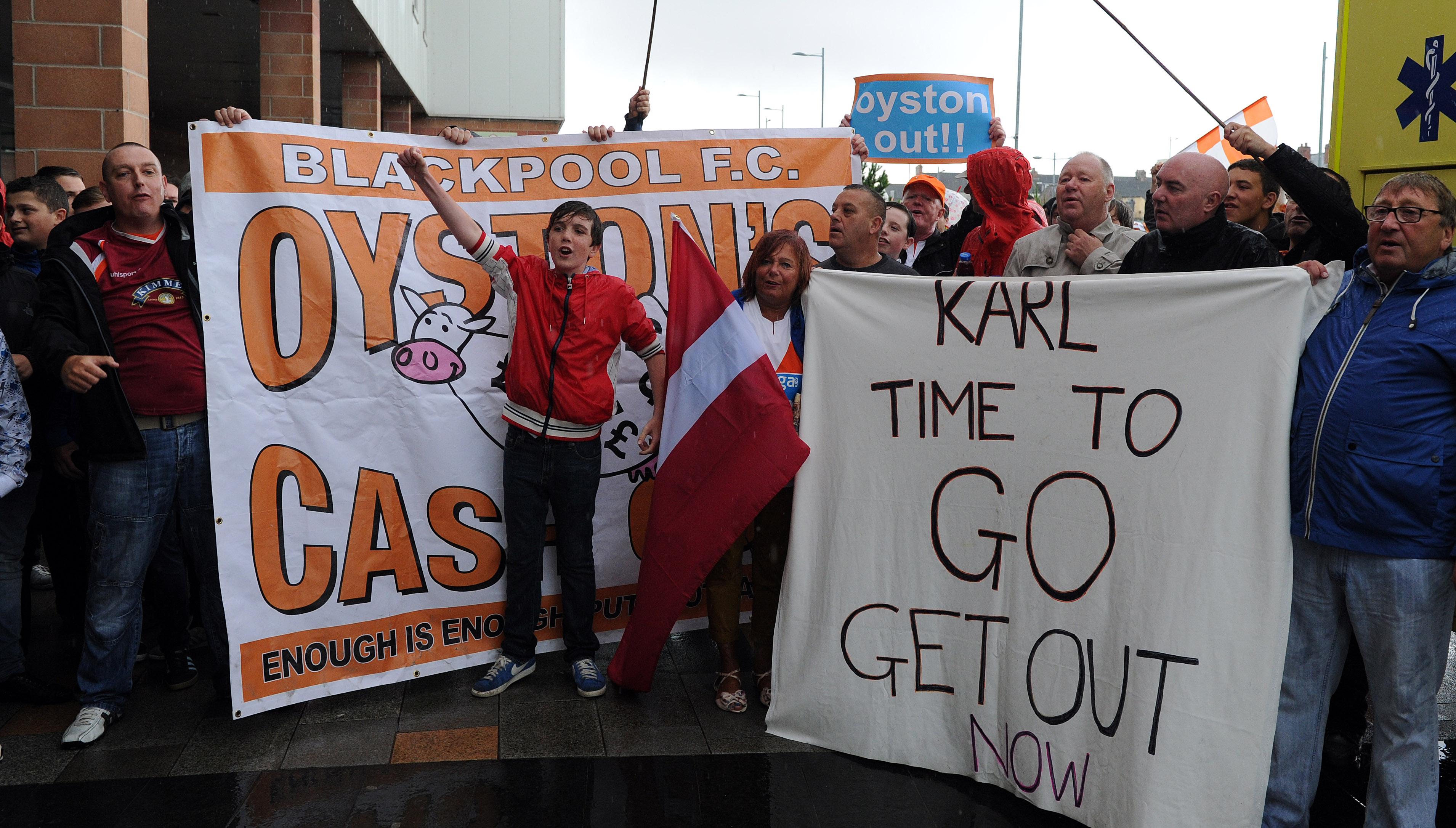
When Belokon won the case against the Oystons in 2017, the judge ordered the Oystons to buy out Belokon’s 20 per cent share for £31.27 million. The jig was up. It had been proven in court that the Oystons had been ‘illegitimately stripping’ the club. By 2019, as the chants predicted, the Oystons were out of the club, and father and son had fallen out and have, by all accounts, never met since.
On a slow Sunday afternoon we motor up the drive to Quernmore Park Hall, past the walled garden and around to the front of the house, where we knock on the door, and listen as it is slowly unbolted. We are greeted by Owen Oyston himself.
He looks like no one else on the planet. He wears cowboy boots, multi-coloured socks, tracksuit bottoms and a plaid shirt. He sports his trademark wide-brimmed hat, underneath which stretch two long locks of dyed hair. We receive a call from him on the drive to the house, his voice booming over the internal audio system, fruity and articulated, like a Welshman impersonating an aristocrat. He requested that The Fence, on arrival, sign a contract stipulating that nothing from our conversation be used without his written approval.
Even in his 93rd year, he is an imposing figure: still six feet tall, welcoming, smiling. He leads us through to his dining room, past his wooly mammoth skeleton – unavoidable, astonishing, rising over the sofas of the entrance hall.
In conversation, Owen tends towards the didactic. He unspools his life story, his childhood spent in poverty next to the roar of the crowd at Bloomfield Road, his manifold business successes, the money he has made for the shareholders in his companies, his aspirations for Britain, how he feels the country was shortchanged by Thatcher, the roads not taken, the paths not followed.
Around him, his dining room overflows with knick-knacks and tchotchkes. Bottles of wine and family photos clutter side tables. Elsewhere in the house there are life-size waxwork models of Henry VIII, Cardinal Wolseley and Anne Boleyn.
It is remarkable to hear Oyston speak, having spent so much time reading about him – more remarkable still, perhaps, is to watch him speak: when he smiles, he reveals a perfect set of ice-white teeth, and his goatee and moustache are meticulously trimmed. The only time he removes his sunglasses is to examine the paperwork he has compelled upon us.
What does he want? He still wants to change the world, he tells us. He talks of his friendship with Neil Kinnock, of the establishment of the Norwegian sovereign wealth fund, of the 179 British soldiers dead in the Iraq War, of the current crop of British politicians. He tells us of ‘a deep concern of the political hierarchies of the last 50 years.’ He is concerned that there might be another civil war in England.
But before the barricades come down, he would like to give Blackpool FC back to the fans, for it to follow the Bundesliga model of ownership. Most German clubs follow what is known as a ‘50 + 1’ voting model. Fans represent 50 per cent, plus one or more votes – i.e. a majority. By enshrining members as the majority in decision-making, outside investors or individuals are blocked from working against the wishes of supporters. This stands in stark contrast to British clubs, which are frequently volleyed between hands and shareholders according to the flow of money, whim and childhood dreams.
In two emails sent to Simon Sadler, Owen lays out his position. ‘Now is the time to gift BFC shares to the long-suffering BFC fans,’ he writes. From his standpoint, Sadler’s ownership of the club is ‘void ab initio’ (void from the start), as Sadler had bought the shares from Valeri Belokon, ‘knowing’ that he was a convicted money launderer, and alleges that he was a ‘player’ in the KGB.
Oyston says that public ownership of the club could have ‘a huge impact on the local and regional economy.’ That he ‘can categorically state and undertake that I will never own shares in Blackpool Football Club again unless it is to pass them over as a gift to the fans.’ He promises that if Sadler agrees to his proposal, he will drop all his lawsuits against him. Sadler is yet to respond.
The last train from Lancaster was calling, and we had to take our leave of Oyston’s hospitality, but over the next few weeks, he proves a willing conversationalist, recalling the early years of his life with no little humour, detailing how close he came to buying Manchester United in 1989 with Michael Knighton (‘the biggest commercial mistake of my life’) and offering guidance to The Fence about which episodes of his life would be best left unrepeated in print. The defeat in court to Valeri Belokon still smarts – he is planning further legal action against the former boss of HMRC, Sir Jim Harra.
His son is adamant that his plans for Blackpool FC are without weight: ‘It’s not his to give away; it has absolutely nothing to do with him or me or anyone but Mr Sadler.’ Christine Seddon is firmer still: ‘This is the fantasy of a deluded old man.’
The verdict in Simon Sadler’s trial will be heard at court in Hong Kong in February. 6,000 miles away, in his office at Quernmore Park Hall, Owen Oyston will be watching – and you can be sure that the fans of Blackpool FC will be waiting to see what he does.