A giant inflatable cock and the unmistakable guff of raw sewage. Welcome to Great Yarmouth, rex et nostra jura. The 30-inch plastic phallus is clutched tightly by a tattooed hen in a skintight white dress, chuffing away on the end of a fag before she heads off on her big East Anglian night out. The stench’s source is harder to ascertain, but a short walk from the station over the Acle New Road, Yarmouth’s main escape route, reveals its origin: the River Bure, site of two pumping stations which, at various points throughout the year, splooge out waves of Norfolkian shit into the Bure’s grimy confluence with the River Yare.
It’s not the most promising start to my day trip in Yarmouth: faded seaside resort, birthplace of Myleene Klass and Jason Statham – and a town that could very well lay claim to being the most right-wing in England, having elected twinkly-eyed multi-millionaire Rupert Lowe to Parliament in 2024, initially as a member of Reform UK. A year later, Lowe had the whip suspended after allegations of workplace bullying and threats of physical violence towards party chairman Zia Yusuf – which prompted the former Southampton chairman to quit and establish Restore Britain, whose manifesto of mass deportations, Christian values and capital punishment makes Nigel Farage seem like a blissed-out Clement Atlee. In 2025, Resurrection 4, a white power festival organised by neo-Nazi promoters Blood & Honour was cancelled at the last hour following pressure from anti-racism charities including HOPE not hate. And in the council elections of this year, Great Yarmouth First, a right-wing affiliate of Restore, won all nine borough divisions at a canter.
Socialist utopia it is not. So, what is it about Great Yarmouth that’s got its populace donning their proverbial black polo necks? Were rumours of the once-grand resort’s demise true? And which pub of the borough’s 65 – the highest density per population of anywhere in the country – is Rupert Lowe’s favourite? On a close and muggy midsummer’s day, I – along with two of The Fence’s finest boozehounds – made my way across the Fenlands understanding that, to truly know an area, one must first get obliterated in its watering holes.
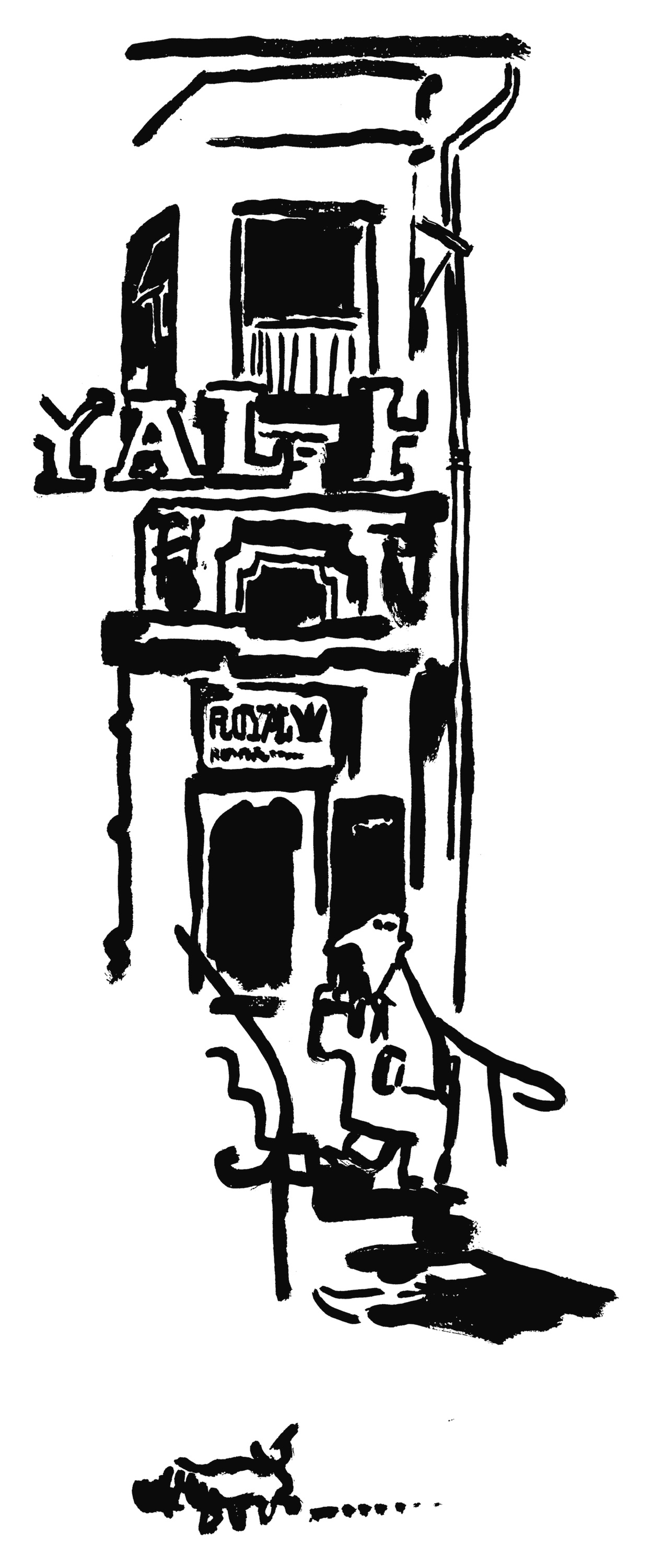
The first stop on our journey was a pilgrimage to Yarmouth’s past; an Art Deco dead pub located to the north of the town, where the beach gives way to barren dunes and rows of static caravans line the promenade like military barracks. The Iron Duke was completed in 1948 as the flagship boozer for Norfolk brewers Lacons, but shut in 2007 after a long period of decline. It’s a magnificent beast; one of the UK’s iconic drinking establishments, and the past five or so years have seen a bitter battle for its future. It’s a battle that was eventually won by Zaks, a local, tacky American diner chain, much to the chagrin of the other side, the Great Yarmouth Preservation Trust, who argued it should be turned back into a public house. Preserving pub culture in sepia-tinted aspic and right-of-centre politics go hand in hand: you only have to look at Restore’s recent headline-grabbing pledge to bring back smoking in boozers to see that a desire to return to the good old days of pubs – before cocktail bars, before Buzzballz, before woke – is at the heart of the right’s ideology.
It was by now 2 PM – an ambrosial hour to start boozing on a Saturday in anyone’s book, let alone for three 30-something writers on a day trip from London. So we made our way to the first living pub of the day, a short journey to The Lacon Arms. Inside it was dark, and completely empty save for one very hungover landlady who, in between putting out little England table flags (which gave the place the feel of an incredibly one-sided UN conference), informed us that the night before had seen a lock-in until the early hours. It was hard to imagine The Lacon as a den of late-night iniquity, and in the entire 45 minutes we were there not a single other customer came in. The next pub, The Sportsman, had more of a pulse in the form of six old boys individually sat at the bar, who swivelled their heads around to suss us out like curious pint owls upon our entry. But, after being told that it was cash only, we moved on to The Kings Arms, a gothic-looking public house with reputed 16th-century origins. At last, Yarmouth had come alive; the pub’s generously sized beer garden awash with progressively harder-looking men and their families soaking up the sun. We somehow managed to sit next to the hardest of the lot, a Scottish man dressed in baby-blue tech gear, who possessed the unmistakable deep scar of a Chelsea smile and was regaling his companions with a tall prison tale. Great Yarmouth has a crime rate 80 per cent higher than the UK average, at 129 crimes per 1,000 people in 2026 so far, and throughout the day there was undoubtedly a sizzle of danger in the air.
Pint two dispatched, we strolled towards the town centre, stopping to admire the majesty of Great Yarmouth Minster and the home of Anna Sewell, author of Black Beauty. All around you encounter these reminders of its rich heritage, with 431 listed buildings, medieval town walls and a number of museums, including the stellar Herring Smokehouse Museum. Great Yarmouth first made its fortune in the 1300s as a herring port, but by the mid-60s the industry had virtually disappeared thanks to over-fishing and cheaper, foreign competition. This, along with Brits heeding the call of the easyJet over staycations, an ageing population (24.4 per cent of the borough’s population is aged 64 and over) and dreadful transport links post-Beeching Axe has created a classic fertile environment for populism to breed.
There was no such worry about cheaper, foreign competition in pub number three of the day, The Oliver Twist, where a round of two Stellas and a Guinness came to a staggering £10.30. ‘How much?’ I asked the barmaid incredulously.
‘Is that too much?’ she replied, genuinely not computing that £3.30 a pint in 2026 is near-mythical. Like almost everywhere in town, The Twist was decked out in its finest St George’s regalia. Like almost everywhere in town, The Twist was overwhelmingly white, staff and patrons alike. In fact, throughout the whole trip signs of the immigration that Restore regularly moan about were thin on the ground, beyond a Kurdistani spa, a few Portuguese cafés and a Romanian grocer.
After a quick pitstop in the Duke of Wellington for the day’s fourth pint, it was off to the seafront to indulge in a delicious cockle-and-whelk lunch by a wide open expanse of clean, golden sand. Adding to the scenery is The Barking Smack, a dilapidated pub whose giant lettering inventive young Yarcos have remodelled to read ‘BRING SMACK’. The esplanade possesses the kind of old world British glamour and kitsch that’s becoming fashionable again in places like Margate: neon arcades with increasingly ridiculous names (Gold Rush, Quasar, The Silver Slipper); an all-day karaoke pub; a fish-and-chip shop shaped like a pirate’s galleon; a regal, peeling hotel with a carpeted lobby bar and four-poster bed rooms. To say Great Yarmouth is poor is an understatement – it’s the 32nd most deprived local authority area in the country (out of 316) and 40.7 per cent of under-16s are from low-income households – but you can’t help but feel the bones are there for a reversal of fortunes. Much of the housing stock is Brightonesque, and cheap. It’s incredibly clean. And investment is coming: Great Yarmouth Borough Council is spending £66.38 million over 2026/27, while the town’s outer harbour is set to be revitalised to the tune of £60 million, creating hundreds of jobs for locals. Whether a Margateification takes place remains to be seen, but money coming into Great Yarmouth is on the surface at least, a good thing.
To pub five: The Red Herring. It’s not an exaggeration to say that it is one of the best boozers in Britain; the kind of place that, if it were in the more CAMRA-coded Norwich, would be making the Telegraph’s infernal list of Best Pubs in the UK. Indeed, to read off its attributes is to describe the platonic ideal of a pub: backstreet, cosy, well-kept, carpeted, good selection of beer. At the bar sat men of all ages, talking animatedly about England’s World Cup chances, beer and chart music from the 80s. We sat down on the maroon banquettes and got chatting to a young YouTuber, who had been travelling up the coast from Lowestoft with his girlfriend. He’s a big fan of Yarmouth – of the coastline; of the community – and comes here a few times a year to camp and check out the pubs. I realised he was the first person I’d seen who wasn’t above 40 or a child.
By now half-cut, and with an hour to kill before the next train, we called in for one last drink at the strangest gaff of the trip, a late-licensed dive bar called the Liberty Rock Cafe – a dark, riotous venue that felt a bit like what you get when you cross a fin-de-siècle Parisian brothel with a honkey tonk. It’s a place that, by rights, shouldn’t really exist in somewhere like Great Yarmouth, which made it all the more heartening to see it rammed on a Saturday night with a cross-generational cast of drinkers and dreamers.
‘Weird things are happening in Great Yarmouth,’ the waitress told me when I asked her what she thought of the area. She declined to elaborate before heading back inside. We followed her in, before a mad dash back along the dual carriage to just about catch the 8:14 PM home.
What did I get out of touring Great Yarmouth’s pubs? Well, not all that much, other than a crippling sofa-day hangover. But it doesn’t take a genius to figure out why someone like Rupert Lowe is successful here. It’s the same in seaside towns up and down the country: a strong sense of community; of being left behind by Westminster; of boredom that tipples over into anger. Yarmouth is Clacton, Yarmouth is Skegness, Yarmouth is Leysdown-on-Sea. It’s easy for metropolitan out-of-towners like me to come in for a day and try and gauge the temperature, but in truth Yarmouth is so much more than just a series of political vox pops. Once the novelty of Restore wears off and England’s media industry looks elsewhere, the town will still be there – hopefully transformed by investment.
In the weeks following my excursion I reached out to Rupert Lowe to ask him what his favourite pub in Great Yarmouth is. He never got back to me. Then again, given his primary residence is a 500-acre farm in the Cotswolds, you’ve got to wonder if he’s ever even set foot in any of Yarmouth’s 65 pubs. So, Rupert, if you’re reading this: have I got just the crawl for you.