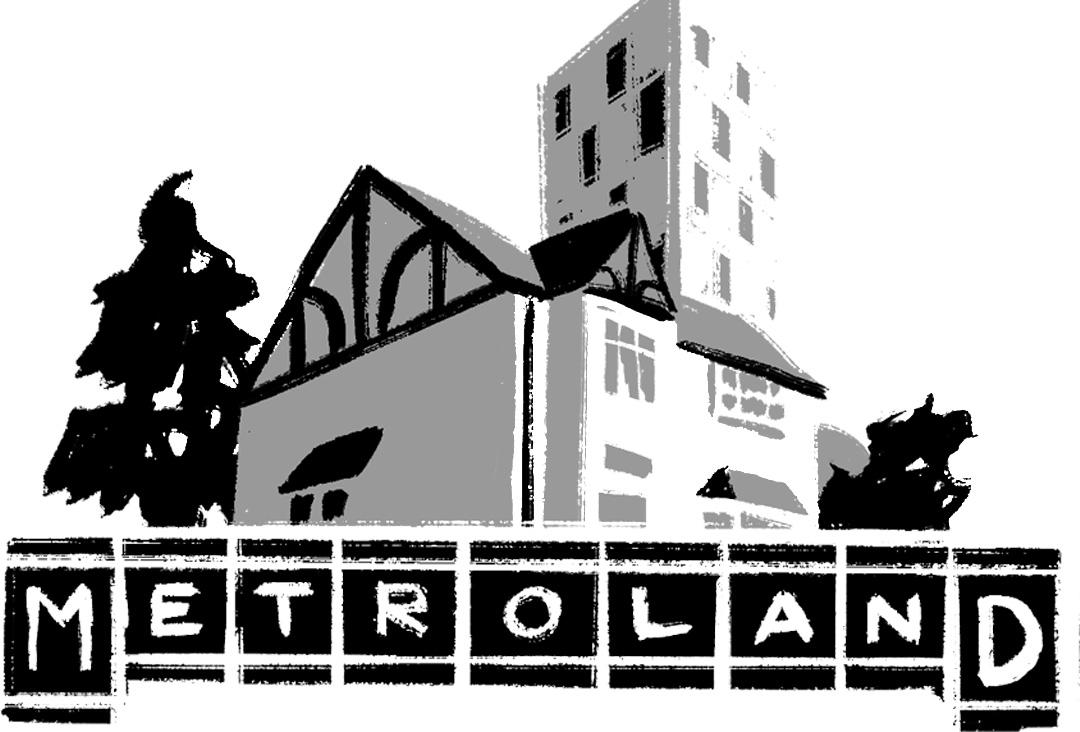
In 1973, Sir John Betjeman produced a memorable BBC documentary, entitled Metro-Land. The concept of Metro-land was concocted in 1915 by the advertising poindexters at the Metropolitan Railway Country Estates, as a means to both promote their train line out into The Chilterns and entice potential homeowners to the developments that were springing up around it. ‘Live in Metro-land’, the posters proclaimed, and escape the city smog to your very own house in a meadow, complete with a brook babbling in your back garden and children frolicking amongst the wildflowers. It was to be just like the imagined glory days of Merrie England – all morris dancers, maypoles and mild occultism.
Metro-land’s scope was broadly defined by the line’s route out from the city: taking in a cheese-shaped wedge of suburban London from Baker Street, through Neasden and Wembley; Harrow and Pinner; and then finally into the countryside of Rickmansworth, Chesham, and Amersham. Today, it’s rather more indefinable: arguably the identikit 1930s estates of Uxbridge or Edgware should also be included in the definition – and besides, most of the land smushed between the A40, M1, and M25 is so built-up and homogenous that it all sort of blends into one anyway.
The interwar demand for housing across London led to a rapid expansion of these areas (and, on the opposite side of the capital, in Becontree and Dagenham), as tens of thousands of semi-detached mock tudor or pebbledashed abodes sprung up in a vast suburban sprawl. The density was low, the snobbery was great, and by the time Metro-Land first went out, the rus in urbe dream had largely dissipated, with the location now a byword for boredom, cars and small-c conservatism.
But as the housing situation in London throbs and swells at the seams once again, the councils of Harrow, Brent and Hillingdon are green-lighting infill development and the construction of taller, higher density properties. Metro-land is now the realm of unlicensed HMOs (House of Multiple Occupancy), with more than 10,000 dwellings classified as overcrowded in Harrow in 2023. The bucolic dream – ‘a rural arcadia’ as the 1932 edition of the Metro-land Guide put it – has become a populous, new-build reality.
I wanted to find out what it was really like today, 100 years after its heyday – and there’s no better way to get to know the soul of an area than by drinking lots of pints in its public houses. So, on the sort of drab and drizzly Saturday afternoon better suited to a spot of half-arsed DIY or staring forlornly out of a condensation flecked window, I met my usual ragtag coterie of hungover dreamers at Euston and, after a swift one at the newly opened Eversholt Street Wetherspoons, boarded the commuter train out to the sleepy land of privet hedges and tarmacked front gardens.
The first pub on our list was to set the tone for the rest of the trip: Barretts Freehouse [sic], opposite Harrow & Wealdstone station. The shop conversion Irish pub is a curious fixture of this part of London, being as they are located solely on the high streets and art deco promenades between Northolt and North Finchley. Wards. Houlihans. Hennessys. This type of possessive-apostrophobic boozer started springing up in the 1980s and proliferated as the Irish population of Counties Kilburn and Archway was pushed out to the suburbs.
Blarneys. The Crock of Gold. Róisín Dubh. Smugglers Cove, Erins Hope, The Shanakee. That these bacchanalian drinking dens now exist almost exclusively in an area originally designed for a Middle England once notorious for its ‘no blacks, no dogs, no Irish’ signs is a delicious anomaly. They are, in many ways, the future of boozing: in a London where getting pissed is no longer the raison d’être of socialising, shop conversion pubs are more intimate, more unhinged and much cheaper to run than the grandiloquent gastro palaces you find nearer the city.
Barretts at half-past-five on a Saturday belied its rowdy reputation, however – with just a handful of older drinkers at the bar half-eyeing the horse racing, and a group of younger, Eastern European lads chatting closely in a booth. We ordered three pints of Guinness (almost every one of these newer Hibernian hooch-holes does an excellent pint of it, if you’re the sort of supercilious person who thinks Guinness quality exists on some sort of quantifiable sliding scale, as opposed to being just ‘good’ or ‘bad’) and sat down to assess the scene. Like many of these establishments, Barretts is narrow, carpeted and adorned with all manner of Gaelic paraphernalia. Maps of Ireland. Rustic signposts to Donegal or Dingle. Numerous photos of hurling champions from years gone by, each as alien to my Barclays-sozzled brain as Stig Inge Bjørnebye would be to a Basset Hound. The olde-worlde Emerald Isle schmaltz means they’re easy places to fall in love with, and really I could have stayed in the warmth and comfort of Barretts the whole evening, harmoniously guzzling pints with abandon and trying to figure out the rules of the hurling. But we had uncharted pavement to travel.