Perhaps it’s something to do with the colours, or the shapes. Red, yellow, blue; square, circle, triangle: the Highway Code is made of primary school stuff. Even the typeface has an ‘early reader’ feel to it, round, black and clear. Graphic designers came up with it in the late 1950s, tasked to improve Britain’s traffic signs by the Department of Transport. They called the font ‘Transport’.
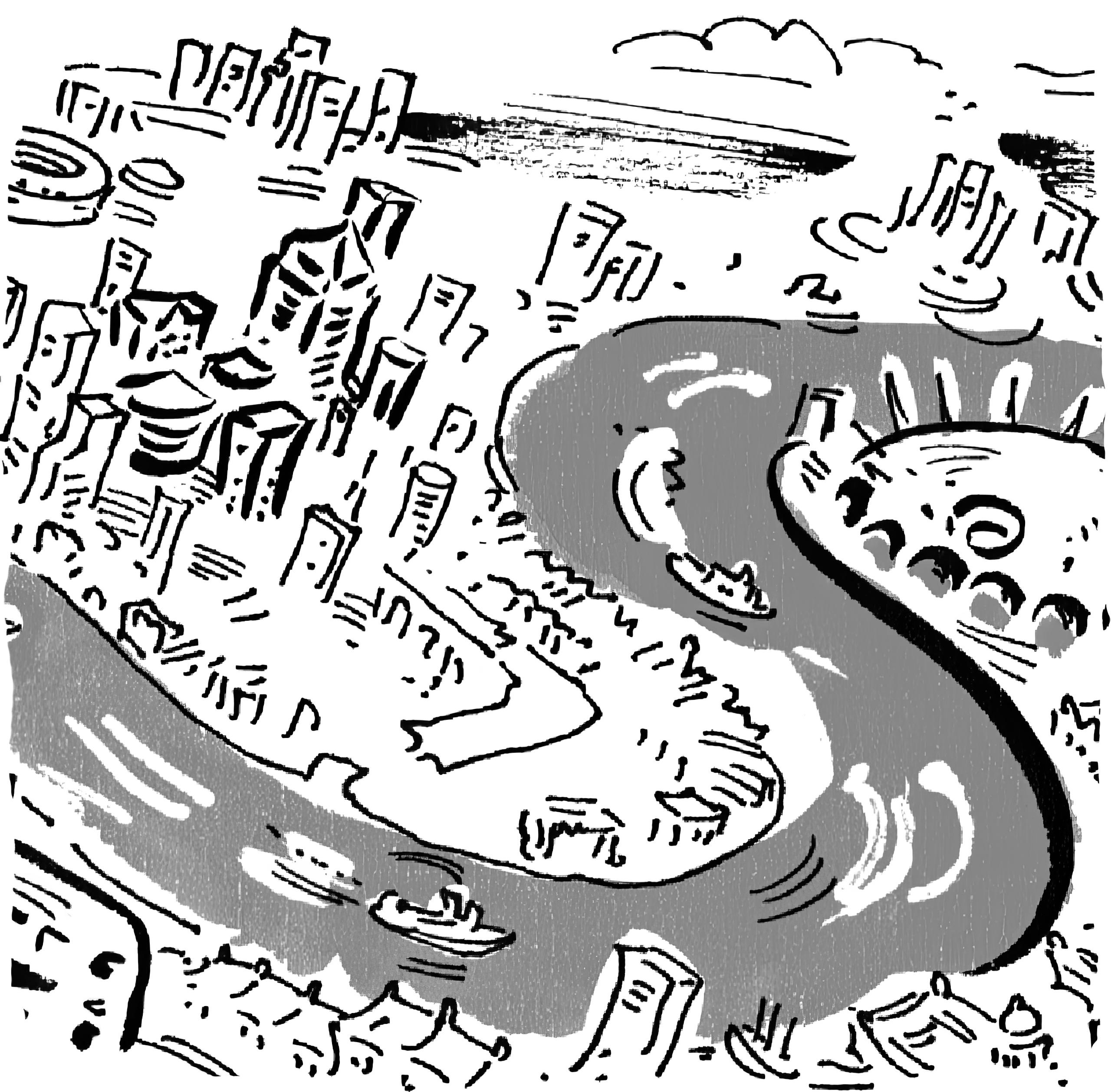
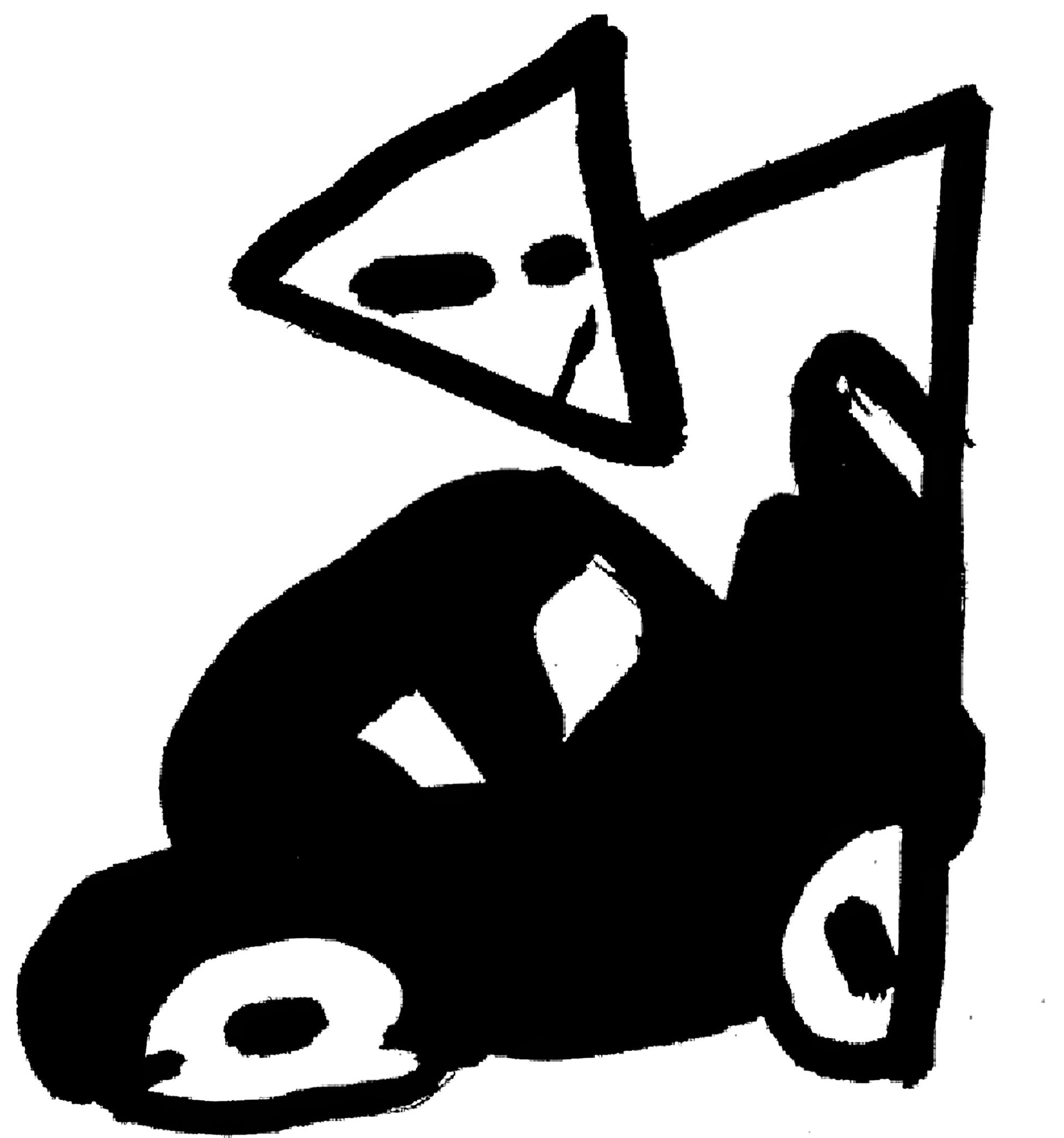
I’ve got some favourite road signs – who doesn’t – usually the red-rimmed triangular warnings which have a little more narrative heft than your average circular speed limit. ‘Falling or fallen rocks’ is arguably as close to art as the Highway Code ever finds itself, unusual in its depiction of movement, the rocks jagged and uneven, chaos tumbling from a mountain. The rare ‘wild horses or ponies’ is lovely, too: the horse fleeing in a spray of running legs. (The cow in ‘cattle’ is allowed none of the same freedom but stands still, with a certain majesty, sure, but also as if in surrender to the oncoming traffic.) Best of all must be ‘quayside or river bank’. You’d think they could have drawn a simple image of a car near water. But no, the car tips at a violent angle off the edge of a high bank, its nose pointing down towards the rolling waves below. It is a picture of death.
If only they were all so memorable. When I was learning to drive, which was a long, erratic and expensive project that spanned several years, I struggled to learn the signs. And the rules. When the Highway Code was first introduced in 1931, it was 21 pages long. Now, the Code reaches 235 pages and lists 307 rules written in a language which contains its own code, the code of the code. In the introduction, the authors – unnamed but plural (an authoritative ‘we’) – declare that some of the rules are legal requirements. ‘Such rules,’ they write, ‘are identified by the use of the words MUST/MUST NOT.’ (The musts and must nots, which appear 270 times, are always in uppercase bold type). For example: ‘You MUST NOT take a horse onto a pavement.’ (Rule 54). It makes for a hectoring read, but you can’t fault them on clarity.
Soften to it, though, and you find a kind of beauty. The ‘hierarchy of road users,’ rule H1, precedes all the other rules because it expresses the code’s underpinning philosophy. Those in charge of the most dangerous vehicles ‘bear the greatest responsibility to take care and reduce the danger they pose to others.’ Or, to put it another way, always give way to those more vulnerable than you, a rule that society wouldn’t do badly to adopt, if only we could turn the world on its head.
Unsurprisingly, between the ages of 17 and 22 I wasn’t at my most receptive to a book of 307 rules. My first attempt at the theory test, shortly after university, went badly. I had an English degree: the worst training. Jazzed on self-importance and seven types of ambiguity, I seemed to be incapable of answering questions. I remember one, about what you should do if you arrive at the scene of an accident where people are trapped inside a wrecked car. Call 999, sure. But after that. Drive away? Keep them warm? Remove pieces of wreckage stuck to their bodies? I wasn’t a psychopath, I wasn’t going to hot-tail it out of there. But what do you do? They hadn’t given me enough information, I felt. The wording was, well, yes, it was ambiguous actually. I opted to remove the pieces of wreckage, which turned out to be very much the wrong answer. A friend suggested afterwards that I’d probably skinned the poor fuckers alive.
So yes, I failed. And then I failed again, and again. At least three times, I think. I kept refusing to learn the code properly, bored by its instructional tone and insistence on facts. I kept thinking I could wing it. I suspect I thought I was above it. Luckily, both for other road users and my personality, you can’t wing things that are either right or wrong. After one failure, I remember going to the front desk of the testing centre to get my result. The woman looked at me with pity, then gave me directions out of the building as though I had suddenly lost a great number of my faculties. She spoke slowly and kindly, and I was grateful and ashamed.
Eventually, I gave in, buckled down, learnt the stuff and passed, just like everyone else. Still, there wasn’t much internalisation. Driving in my twenties, which meant borrowing my mum’s car, was more of an exercise in catastrophe. I had a couple of minor crashes, like the one when I drove extremely slowly into a stationary car while reading a map. (A car on the other side of London from my home, that, in the kind of coincidence that is too awkward to digest, turned out to belong to someone I went out with for three weeks when I was 15.) I wasn’t used to learning something that I would have to use in real life, so it wasn’t long before I fell foul of the rules. I couldn’t quite believe my first speeding fine. What, they actually mean it?
Soon enough, the speed awareness course beckoned. It comes for us all in the end. But, get this, I loved it. As always with learning, it was all about the teachers. Two guys, jacketless, sharp as pins. They knew what they were dealing with: a bunch of people pissed off at being held captive in a hotel conference room in an outer corner of London. People who wanted to get through the morning, then drive off at speed with their newly laundered licence. They were expert wranglers of cynicism, these men. They laughed at us, and scared us, and made something very clear to me: that the Highway Code wasn’t a guide, or a suggestion. It wasn’t open to interpretation. The 307 rules were actual rules.