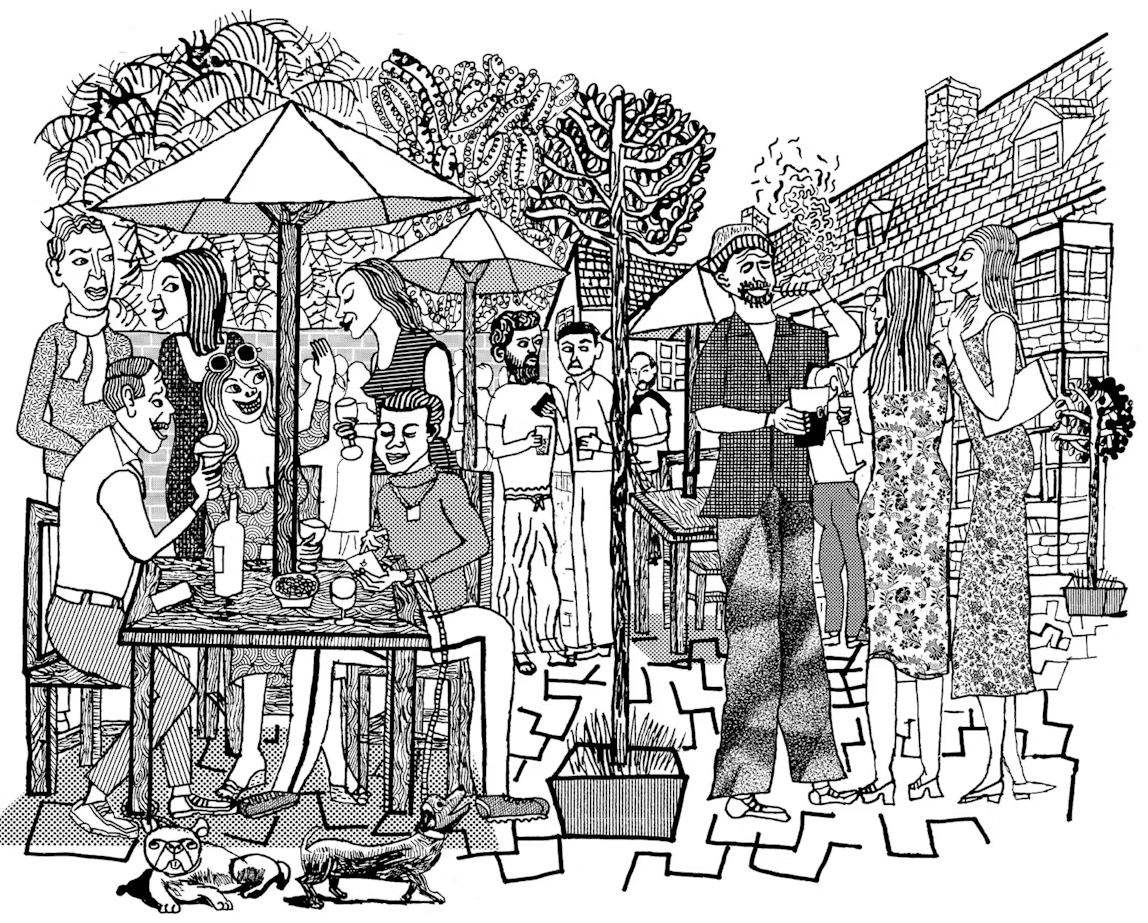
Some months back, during one of those late summer boons that can lead to long, impromptu walks to nowhere in particular, I found myself roaming the Grand Union Canal. Starting at the vast lifestyle shopping mall that is Coal Drops Yard and heading west, we almost forgot what was ahead. Without warning, the canal burst into life, revealing a throng of bare chests and Bluetooth speakers. There were splintered circles of teenagers smoking weed, Instagram boyfriends in beige tracksuits, nervous American tourists and wild-eyed, beer-tanned wrong ‘uns walking German shepherds on rope leads.
‘Oh god,’ said my companion. ‘It’s Camden.’
Although I’ve never actually lived in Camden Town, it does feel as if I grew up there. In my early teens, I went there to spend my pocket money on the imported crazes of the day – wallet chains, band T-shirts, weed paraphernalia and Thrasher DVDs. But it was the vibe on the streets, more than the tat on the shelves, that kept me coming back.
Camden didn’t look or feel like anywhere else in Britain to me. It was ramshackle and almost lawless. To a boy from the ‘burbs it appeared like worlds I’d only seen on TV; like Romeo + Juliet, like Empire Records, MTV and Japanese RPGs. A town that had a foot in the future.
Later, as I started drinking and venturing out on my own, Camden would bring forth new temptations. It was the home of underage, indie scene excess; a disturbing moment in time that has been dragged up by the Russell Brand revelations. It’s a world I know all too well; the infamously tolerant bouncers at Club NME; the vast old piss pubs that probably would serve you if you were openly brandishing a weapon, the fleets of 30-something men whispering in teenage girls’ ears. Much has been made of the ‘indie sleaze’ scene, and its darkest land was undoubtedly Camden. It was a place where things were allowed to slide.
Despite this more recent association with skinny jeans and slimeballs, the area has incubated some incredible scenes over the last 50 years. It will always be indelibly linked to the word ‘subculture’, and almost every British street tribe has made NW1 its home at one point or another. Of course there are the canonical groups: punks, goths, skinheads and emos, the ones who you can still see glimpses of today. Yet it was also the heartland of more niche communities; acid jazz, grindcore, rare groove, rivetheads, candy ravers. It’s also a locale that has attracted some famously ‘difficult’ people; like Walter Sickert, Alan Bennett and Dappy from N-Dubz.
In the months after my accidental visit, I started visiting Camden semi-regularly, in an effort to understand where it sits now, and if it still shelters those subcultures.
Walking out of the station one bleak autumn day, I’m reminded by what an outlier the area is in contemporary London life. I would guess that about 70% of people I know live within a few miles of it, yet nobody ever seems to go there, bar the occasional work-related event at the Roundhouse. Even the Camden Art Centre is not actually in Camden. It exists on the peripheries of the city’s consciousness, like an uncle living in Thailand that nobody talks about.