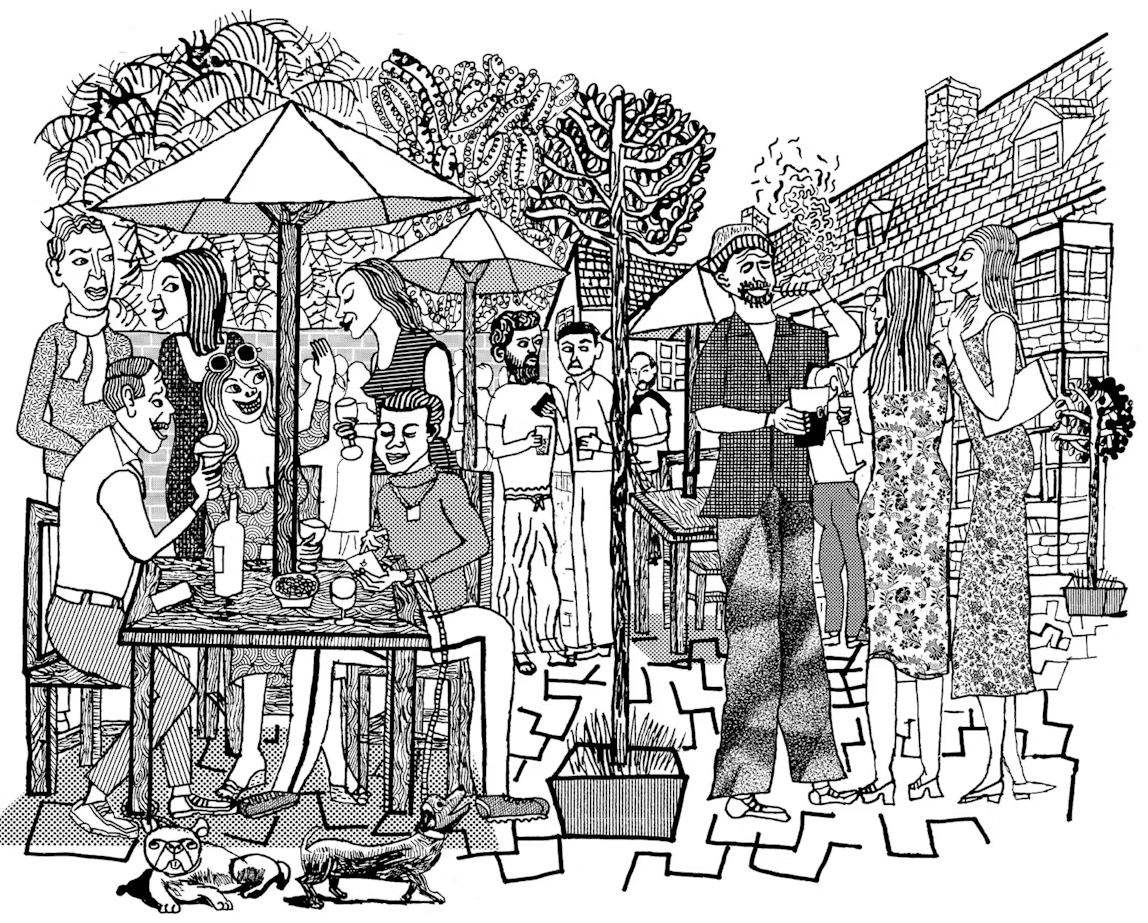
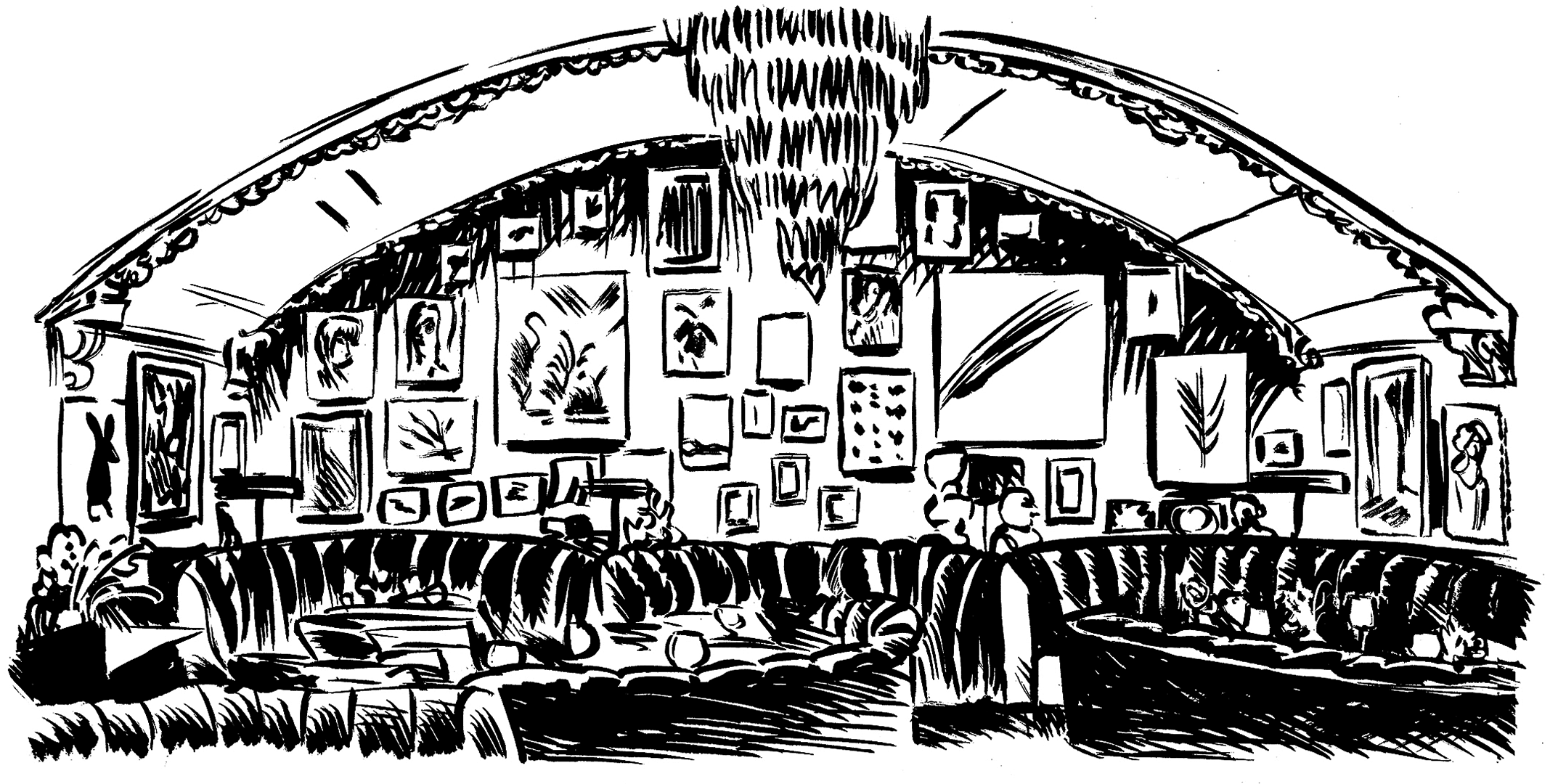
The Hollywood Arms, an airy pseudo-pub, located just off the Fulham Road and ornamented with crushed velvet cushions and job-lot chandeliers, seems a humdrum location to meet a nightlife impresario whose world collided with some of Britains most notorious figures. But the Chelsea that Howard Spooner knew was a very different place.

‘I’ve got very mixed memories,’ he says warily, sipping on an ice-cold sparkling water at £5.60 a bottle. ‘It was here I went from being a complete and utter nobody to a somebody in a very short period of time. I had about ten clubs, 20,000 people a week coming through the doors, lots of money rolling in, a lot of doormen working for me, a lot of muscle around me… mainly just to keep me alive.’

Howard, now a trim, handsome 50-something in a mauve corduroy jacket and long cashmere scarf, was the king of west London party life at the turn of the millennium: a Sloane Square Steve Rubell, a Peter Gatien with a standing order at Gieves & Hawkes.

His venues – among them Embargo, Public, the Leopard Lounge, Crazy Larry’s, the Hammersmith Palais and the Clapham Grand (which he still owns outright) – were part of a hyper-luxe, pre-credit crunch club landscape that brought disparate and dangerous characters together to pop bottles and toast themselves silly.

Although Howard has a digital footprint that reveals a chaotic life – lawsuits, public spats, quotes in a Bristol Cable investigation into organised crime, a Companies House page that warrants a Goodreads listing – only now is he telling his story properly. Recently, Howard offered his services as a source in Patrick Radden Keefe’s mega-selling London Falling, having worked for two years with a ghostwriting team on a memoir.

What makes Howard so fascinating, so appealing to writers, is that he was the lynchpin for a particular kind of milieu: ‘London noir’, a shadowy interzone where wastrels, knaves, wideboys, aristocrats and thugs brush shoulders under mirrorballs and on carpeted dancefloors. Even for Howard, the results of this world could sometimes be surreal.

‘I’ll always remember the VIP balcony at the Leopard Lounge,’ he recalls. ‘You’d see debutantes mixing with very nasty gangsters, sweet posh girls who were obsessed with my bouncers. You’d see washed-up pop stars doing drugs on the table – footballers, actors. It was a great leveller.’

Things really took off for Howard in the mid-90s, when he took over Embargo, a King’s Road nightspot. Howard was given a lesson in the dark arts of nightclub finance.
‘I realised that most of the people who were working there – the head barman, the receptionist, all the doormen – all worked for a crime family. The door money never added up. They would over-order stock. It would go in and out the door like that scene in Goodfellas. There were so many people on the payroll who didn’t exist. So I closed it for “refurbishment” and reopened with my own team. And that’s when the problems really started, because I put some serious people’s noses out of joint.’

Howard, who was often referred to as a ‘plum’ by his criminal acquaintances, grew up in Aberdeenshire, the son of two teachers at the brutal Gordonstoun school, which Prince Phillip, Prince Andrew and King Charles famously attended. He was very much a fish out of water in these villain-laden environments, but survived through a mix of naivety, his ‘heavy’ friends and the impression that he was powerful because he was posh (‘people think you have masonic connections because of the old school tie.’) His well-noted good looks – which land somewhere between a young Darius Danesh and an Argentinian polo captain – also helped him gain access to a lot of dark rooms.

Today, he looks back with a kind of disbelief. ‘I mean, I was just so young, and so fearless. What I now know is that we all think we can have a scrap, but when you’ve seen how proper villains handle themselves, you realise you can’t actually have a scrap.’

One of the more notorious characters Howard met around this time was Verinder ‘Indian Dave’ Sharma, a mythical London gangland figure and one of the two antagonists in London Falling (it was Sharma’s penthouse flat where in 2019 young Zac Brettler met his mysterious end.)

‘When I first met Indian Dave, he came up to me, shaking, coked off his nut. He thought I had something to do with motivating other people to get rid of a man he knew. But I wasn’t scared of Dave because he was just a little bloke with a very, very nasty streak. I kept getting warned not to wind him up, but it was like, you know, fuck off.’

One character Howard was much more wary of was another underworld boogieman, known only in Howard’s book proposal as ‘The Stick,’ but easy enough to cross-reference as the gangland enforcer Gilbert Wynter – a man who was supposedly the inspiration for Rory Breaker in Lock, Stock and Two Smoking Barrels, and whose remains are rumoured to be propping up the Millennium Dome.

‘The Stick was well known,’ Howard remembers. ‘He had his own private enterprise going on in Chelsea. He would walk into bars, empty the till, stick the cash in his pocket in front of all the punters and bash up people on a regular basis. He was a thoroughly ­unpleasant human being.’

‘One day he started rapping his cane on my door.’ (Wynter walked with an aid after reportedly being hit by a police car.) ‘He said he wanted his money. And I was saying it had nothing to do with me. In the end, I told him the police had a surveillance team in the building opposite, that the curtains were twitching.’

Helping Howard navigate the underworld was a character referred to in the book as ‘The Fella’ (but also as ‘The Cornerman’ if you wanted to do some cross-­referencing yourself.) The Fella and Howard are apparently still in contact to this day, and Howard casts him as something of an ordinary decent criminal in a world of opportunistic psychopaths.

‘I could see that he was very intelligent. He had a sort of photographic memory, where he could read things upside down and recite them. That was his trick. He was brilliant with maths, but I could see that he was also incredibly violent. I thought, “This guy fits the bill perfectly, why don’t I help him set up his own security company? And he can be my consultant.” Pretty soon, he had 200 doormen on call, taking a fiver an hour off all of them.’

These were heady times for London nightlife. It was pre-licensing reforms, pre-security reforms. Gunshots on the dancefloor were semi-common, and the reigning generation of criminals were desperate to muscle in on any establishment turning over a few quid. An unofficial license to sell drugs in such places was the golden ticket for villains of all descriptions. And if you owned the club, even better.

Yet, despite his brushes with the underworld, Howard maintains he was not in the drugs business, and although he couldn’t keep substances out of the club entirely, his sensibilities kept it away from the chemically-oriented rave crowd.

‘Most clubs that encourage drug dealing are all about the music,’ he explains. ‘But my venues were commercial; it was very public school, sing-along stuff. I’d said to my door team, “If any of you are caught dealing drugs, you’ll never work again. But if you find anyone else dealing drugs, take them into ‘the blue room’ which was a kind of disused space in the club – and give them a proper fucking hiding. You can take their money, their pills, their clothes, I don’t want to know. And after you’ve finished with them, get Ugly Mark – who was a driver we had on call – to drop them outside Chelsea & Westminster Hospital.” By the time we sold Embargo, my general manager told me there had been 126 unsolved crimes there.’

In his book proposal, Howard speaks freely about having a split personality. And throughout our interview, he flits between seasoned crim and naive posh boy. In many ways, this worked for him. When he needed to change tact, he could do so with ease. Which is perhaps why many villains saw him as a kind of golden goose.

One of Howard’s techniques for keeping gangsters away was not to issue threats of retaliation, but to essentially bore them with bureaucracy. ‘You’d sometimes get security firms trying to muscle in, five big guys coming into my office and going, “We’re your new partners.” I’d be like: “Well, that’s very interesting. I’m sure you run a great security company… but the people that make all the decisions are called Pillar Property PLC. I’ll write down the address in Berkeley Square, and you’re very welcome to go and tender for the business. And then you need clearance from the Clubs and Vice Unit at the Met. I can call them and set up an interview.”

‘And if that didn’t work, then I’d call in The Fella. He had this technique. He’d set up a meeting, arrive late, put two massive lumps on either side of the person who was trying to bully me, and as he sat down, he would pretend to fall into the table, which would fly into their ribs, jabbing them. And it just scared the living shit out of them.’

Throughout this time, Howard’s life ran at a million miles an hour. Even now in the Hollywood Arms, his schedule sounds genuinely anxiety-inducing. ‘I already had children back then. So I’d get up early in the morning, try to get to the office by about nine, run the business during the day, go home, kiss the baby goodnight, and then go out to dinner, normally with friends and colleagues who are going to be out with me that night.

‘Then I’d be straight back out for a few pints. I had a driver take us around the clubs, and I’d be out until about three in the morning. Some nights we’d have a lock-in, some nights I’d go to a mistress’s house, get back at six in the morning, have two or three hours sleep and get straight back out to work. So, really, it was only Sunday and Mondays when I had a chance to catch up on everything else.’

I put it to him that Howard is someone who seems to thrive in chaos. To this day, he is still involved in the more hedonistic end of hospitality, and races cars in his spare time. ‘I wish I didn’t have it now,’ he reveals, tellingly. ‘I can multitask and deal with a lot of pressure… a lot of pressure. I really enjoy that non-stop environment. And then when it finished for a while, I did miss it. It’s like when a sports person retires, they often become depressed for a while. I definitely wasn’t depressed, but I did yearn for the other side of my personality to come back. Because I enjoyed being that person more than the one I had to become, listening to all the parents talking about schools and all that bullshit.’

Yet throughout this, he kept his own peculiar moral code. Howard makes constant reference to keeping drugs out of clubs, and claims to have ‘only ever smoked a reefer.’ ‘I was never really scared of bullies,’ he continues with some braggadocio. ‘Up in the north of Scotland, at probably seven or eight years old, we were having fights with 12-year-olds from the local villages. If I thought someone was bullying me, I’d either just have nothing to do with them, or snap if they crossed the line. I once said to Indian Dave, “If you really want to try and take my business away from me, why don’t we just have a fight. As long as there’s no knives or guns, I’m very happy to have a fight. I have no issue with morally dealing with a bully like that.”’

As an entrepreneur, Howard’s main strength was bringing hedonism to an environment where there was little competition – moving from the inner city into more genteel neighbourhoods.

‘I thought, I don’t want to go to the West End, that’s where everyone’s fighting for the scraps. Yeah, I’m going into residential areas. I want to be the one best club for every residential pocket: Clapham, Hammersmith, Kensington. And then hopefully they won’t grant any more licenses in that area.’

Soon enough, he encountered the Royal Family at his joints. But being a Gordonstoun boy, he was already acquainted with them. ‘Prince Andrew was my babysitter when I was six years old, but in later life, when I met him a couple of times, he didn’t really take any interest in that. He just took interest when one of my clubs became very successful.

‘Suddenly, I had Fergie [the Duchess of York] speed-dialling me every five minutes, asking to let her daughters in and take care of them. We’d always had minor royals coming in, because it was the right kind of environment for them. But then it became a trusted place for princesses.

‘Prince Harry used to frequent my club Public. At first, he was fun, polite, quite guarded. But the more he got into being single and reckless, the less fun he became. He took one of my waitresses to a shooting party, and I remember him later taking the piss out of how she pronounced a certain type of wine – Montrachet. It was a bit distasteful. Some of the things he said were so inappropriate. I actually had to call him up on them. He had no boundaries.

‘When we opened Public in Verbier in 2012, Harry was there for four or five days. One afternoon I came off the slopes with my two eldest children. I walked into the apartment – Guy Pelly had given him the keys – and he was lying there on the sofa, just in his boxer shorts, watching The Inbetweeners.’

His recollections of Prince Andrew are even less favourable: ‘We went for dinner one night, and Andrew, Fergie and his daughters were there too. I hadn’t invited them; they just sort of crashed the table. There were four blondes on the table and Andrew was staring at them and gurning. He reminded me of Benny Hill.’

Perhaps it seems trite to bring up the parallels between gangsters and royals, but did Howard notice any parallels between the two extremes of his customer base?

‘Maybe you get that feeling of ideas of complete grandeur and completely like I can do what I want,’ he considers, ‘Andrew and Harry’s attitude was very similar to the gangsters.’

Interestingly, it was not the villains who proved tricky for Howard, but the royals. By 2012, the publicity around Harry’s visits turned Public into a phenomenon he couldn’t handle. ‘It exploded into an out-of-control zone. We’d have a thousand people in the building, and a thousand people on the street who couldn’t get in. They’d start urinating, shagging, smoking, taking drugs, whatever they were doing. They were queuing so long that they would go and piss in someone’s garden. I’ve seen videos of a girl defecating between two cars. And it was all on my shoulders. They tried to stitch me up for GBH, they tried to say that I was anti-dwarves. Everyone deserted me because I was the licensee.’

It was around this time that Howard started spending a lot of time in court. ‘There was a lot of conspiracy,’ he says. ‘There was a policeman who followed me into the urinals in the courtroom. All sorts of weird stuff.’

But the Public debacle was nothing in comparison to what is referred to in the book proposal as ‘The Farm Lane incident’ – a gangland shooting in which Howard was initially implicated, and then released with no further action. Howard’s account of the incident is hazy and confusing, and probably for good reason. Yet the snatched glimpses paint an extraordinary picture.

Howard’s recollection begins with a dispute with a supercar mechanic, an affair with the mechanic’s exotic dancer receptionist, a visit to the Barclay Playhouse Theatre, The Fella turning up at his office to do coke with a couple of goons, an impromptu trip to a west London garage, a brawl with an ‘Irish drug gang,’ and a pistol ­supposedly being discharged. ‘Nobody was shot,’ Howard clarifies.

The police soon arrived at Howard’s door and believed that he was still in possession of the gun. Howard then claims they inflicted some Sweeney-era brutality on him. ‘I was in a cell for 30 hours. They were doing “good cop, bad cop” on me and the bad cop was throwing punches. There was an athletic sock, covered in human faeces, which had been wiped all over the bed, the floor, so I couldn’t sit down. They took off my wedding ring and pretended to throw it into the distance. They were saying, “I’m going to tell your wife about your affair with this dancer, she’s fessed up.” Then they brought me into a room, showed me one of those walls full of photographs of criminals that you see in cop shows, and I was at the very top – drinking a Champagne glass, looking totally out of place.

‘When I got home, a plainclothes unit intercepted me and said, “There’s a contract out on you, and you’re very likely to be killed if you don’t cooperate.” They offered me something like £20,000 and a chance to join the witness protection programme. At the time my clubs were pulling in about two million a month,’ he shrugs.

Howard’s story, at points, is deliberately vague – and it’s hard to work out exactly where this life of turmoil ended for him, or if indeed, it has. These days, he mostly concentrates on his bougie Isle of Wight hotel. This year, he opened a restaurant named Sexy Lobster in Bournemouth. His son, Felix, is a streetwear entrepreneur who posts TikTok reels of himself smoking cigarettes in front of vintage Mercedes, and Howard seems to view him as a chip off the old block, the rightful heir to the family business.

Perhaps the book will explain what happened in Howard’s life, but no doubt there are many things he can never reveal.

Did he ever wish he took the standard path for a young man of his background, a job in finance or property? ‘No,’ he says. ‘It was a choice between a Spitfire pilot, a racing driver or a scene from Goodfellas.’