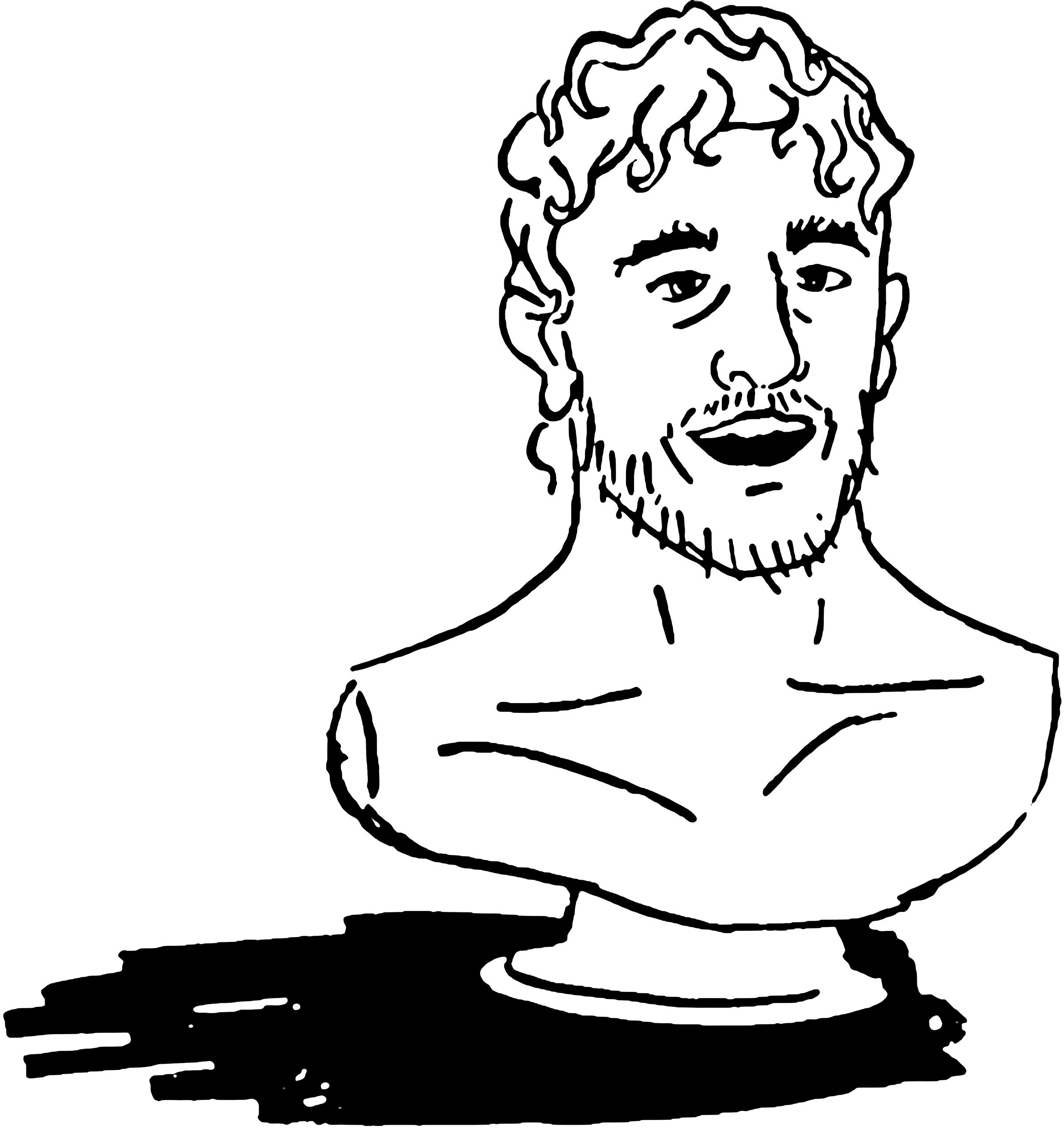
If you’ve been anywhere near central London since the beginning of the year then you’ll already be passively familiar with the face of Medhi Hamadouchi. This January, the 23-year-old Parisian printed out 5,000 copies of his headshot and stuck them all over the city, drawing the ire, he says, of the Met and Westminster City Council. In them, he stares pensively, out of frame, in a black rollneck jumper – the platonic ideal of a drama school aspirant. The caption reads: ACTOR.
It didn’t take me long to become obsessed with seeing Hamadouchi’s mugshot everywhere, so I set about begging – in a very undignified way – to meet him. Turns out he’s a busy man. When I eventually managed to take him for coffee, I had the sense I was meeting someone who was already somewhat famous, particularly as we were meeting at a café located near several posters of his ubiquitous face.
‘Last year, around March, I was really thinking about my life as an actor – how I’m going to make it,’ he says. He’d just come from a meeting with a director in Shoreditch House off the back of his poster stunt. The meeting was about a comedy-horror film; Hamadouchi hooked his fingers onto his teeth at me. Vampires? Yes. Vampires. ‘I realised, this industry is a business. You’re new in London, you’re French, mixed race, Algerian, Italian. So many money issues as well. I was thinking about my family back in France, how I’m going to provide for them.’ His eyes suddenly widened. ‘I woke up at 5am one night, like: oh my God. I had a revelation. I said, “They are crazy. They think they’re going to stop Medhi Hamadouchi?” Never. I said: “OK, fine, I am going to put my stickers on the street. I’m going to promote myself.”’
In person, Hamadouchi is intense. He sometimes refers to himself in the second and third person. He is handsome and ambitious. He paid £80 to a company in Portugal for his headshots. He tried in London, then Manhattan: nothing. Or nothing good, anyway. He talks about being sent bizarre messages: ‘strange favours’ – which I imagine to mean dick pics, offers for sex work and so on. ‘At the beginning of January I was desperate. I was like, nothing works as I want it.’ So he just tried again. More posters, new headshots, featuring, he says, ‘five different energies’. This time, it worked.
Hamadouchi is now signed with an agent, Paul Byram. ‘He found my stickers on the street and called me. He said “I just love [you].”’ His website (which you can find through a QR code underneath his face) reveals his previous roles: a caveman in a history programme, a gritty La Haine-style art flick, some modelling – all in France. But Hamadouchi wants to act in English and thrive in the country that ‘gave the world Shakespeare’. Byram signed him on a whim, he says. ‘Imagine you’re an agent or director, you’re casting. You receive 1,000 emails. Anything that now happens in my life is through the stickers, it’s interesting.’
Yes, interesting, because plenty of people would have given up. I would have given up. But Hamadouchi is tenacious. He tells me his story: he grew up poor in Paris, the eldest of six. His mum is a cleaner; his family don’t know about his life as an actor and poster boy. He was going to join the army. He came to London in the middle of the pandemic, just under the wire of the Brexit transition period. He spoke no English and didn’t know anyone. He walked through Trafalgar Square with suitcases asking strangers for help and slept on the street. Eventually, he met two men who spoke French and Arabic and they helped him get a job as a delivery driver. He shared a room with ten other men. Now he works as a waiter, he taught himself English. He lives in Dalston in a room he shares with a friend. Hamadouchi tells me all this with a kind of shrug, even though it sounds pretty harrowing. ‘Adventure,’ he says. ‘My life is an adventure.’
His fairytale-esque story led to profiles in Variety and The Stage (subheading: ‘Homeless to Hollywood?’). He tried to bring the articles up on his phone, while rattling off some of the interview spiel he had given to them and was now giving to me. ‘Some people try to manipulate you for fame or money. I’m not doing this for money or fame. I’m not interested in these kinds of things. The only thing I want to do is if someone can take some hope from me, I will be very happy if I can give you a smile. It’s why I want to become an actor.’
I feel weirdly protective over Hamadouchi. Perhaps it’s his story, the improbability of it, the obviousness of his need to succeed. It’s all very cinematic. But I’m caught between cynicism and an urge to make sure he’s not being exploited, or making a mistake. When he tells me he’s filming an independent movie right now, for free, I’m scandalised (‘I’m doing it to grow as an actor,’ he says). Hamadouchi says he’s struggled with his mental health. He calls the posters an act of desperation. He also lives in a city that eats up the young and hungry in spite of how talented they might be.