‘Souvenir’ is one of those borrowed-from-the-French words that sounds sexy but actually describes something a bit bleh. In its original sense, the souvenir is anything which prompts a memory or recollection, whether it’s an object, a sound or a smell. Think Proust’s madeleines, or the HBO static noise that prefigured every good TV show from the 2000s. Somehow, that meaning has been distilled down to refer solely to an object; specifically, an object associated with travel to a place, and more specifically, a cheaply-made piece of kitsch. For this shift, you can blame three truly irrepressible forces in the history of the modern world: tourism, capitalism and the British upper-classes.
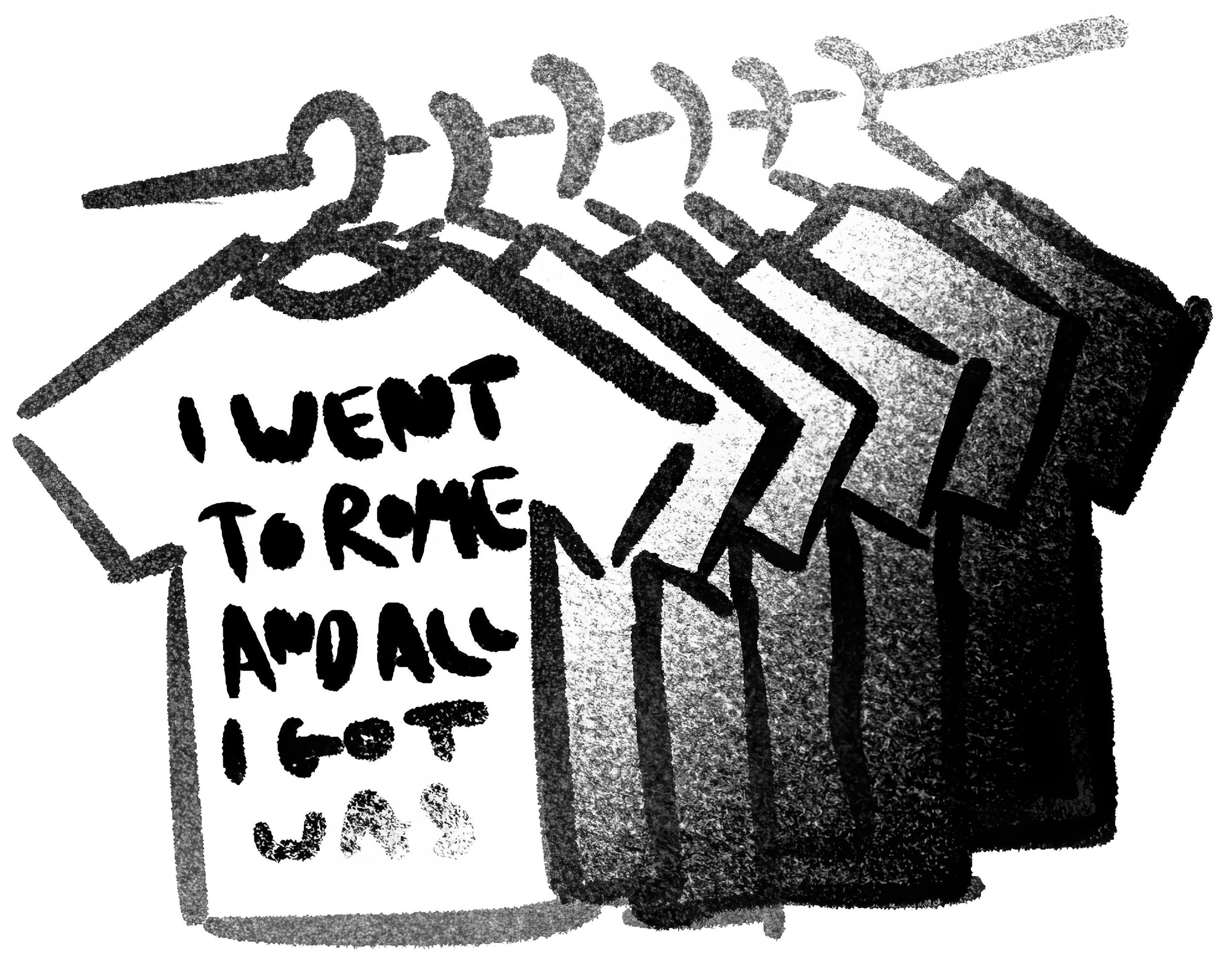
To be entirely just, the rise of the souvenir cannot be wholly attributed to gallivanting, Grand Tour-ing aristos. There were earlier precedents: take the ancient Roman iron stylus, one of which was unearthed in London in 2019. It’s inscribed with a Latin motto which translates, very loosely, to ‘I went to Rome and all I got you was this lousy stylus.’ Or the pilgrim badge, sold throughout medieval Europe in their millions.
Nonetheless, the souvenir industry proper didn’t come into being until the development of tourism as a leisure activity. This was the preserve of the wealthy at first – the aforementioned Grand Tourists of the 18th century, whose souvenirs were rather more highbrow than the mass-produced tat that would follow. Notably, the Venetian painter Canaletto made his name and fortune producing detailed vedute, or city views, aimed directly at these aristocratic visitors.
As the gentry and professional classes emulated their social superiors, albeit confining themselves to domestic travel, a humbler type of mass-produced souvenir came into being, which went hand in hand with rapid industrialisation.
Industrial sites such as the Soho Manufactory in Birmingham became tourist destinations in their own right, as symbols of British industrial might and cutting-edge technology. A few miles from said trinket-makers, the town of Bilston specialised in enamel tchotchkes, especially ‘trifle’ boxes. These were small enamelled snuffboxes with a motto painted on the lid, ‘A Trifle From [Town]’, which could be purchased in said town and given as gifts when a traveller returned from their peregrinations. Among the best-selling of these was ‘A Trifle From Norwich’, which sounds like an Alan Partridge cookbook but was, in fact, testament to that city’s importance as an industrial and cultural centre.
By this point, the practice of selling and buying souvenirs had moved beyond its original purpose (to provoke a memory or recollection). Souvenirs were, and are, bought as gifts for those left at home, just like the hapless recipients of all those Trifles From Norwich.
The person most responsible for this cultural shift was Prince Albert, the well-endowed driving force behind the Great Exhibition of 1851. More than six million visitors came to see the exhibition, equivalent to a third of the entire English population, many of whom travelled by a newfangled mode known to history as ‘trains’. This was a captive market spanning the social hierarchy, and so the souvenirs on offer ranged from engraved silverware, ladies’ fans and porcelain to cheap prints, commemorative handkerchiefs and even novelty soap. These items did not simply function as valued mementos, but were also markers of status and cultural savoir faire, particularly for working-class visitors taking what might be a once-in-a-lifetime trip away from home.
Souvenirs, after all, derive their resonance from the fact that we bring them home with us. They confer bragging rights and – intentionally or not – reveal something about ourselves. If, for example, your walls are adorned with a copy of Calendario Romano, aka the Hot Priest Calendar, it instantly signifies not only that you’ve been to Italy, but also that you possess either a deep Catholic faith or a Fleabag-esque thirst for clerical beefcake.