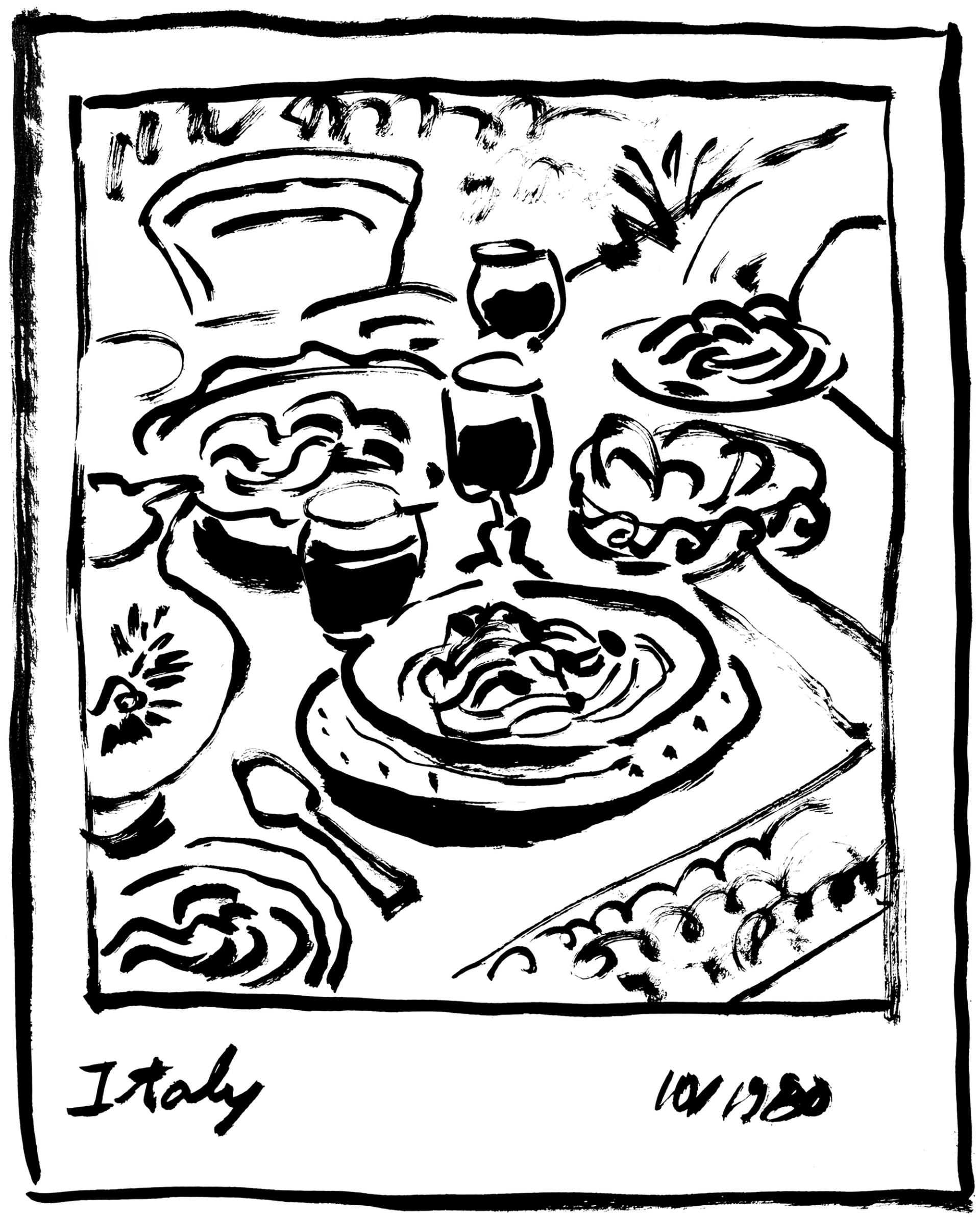

We were on holiday in the hills outside Spoleto. It was the early 1980s, so Italy was not as dense with the locust clouds of tourists as it is now. We were not tourists, of course, oh, no – we were visitors, and we could prove it, too, because we were staying at the house of a friend. It was a big old rambling place, that had been our friend’s family home for more generations than anyone could remember, set high up among immemorial woodlands and looking north over range upon range of dream-blue mountains.
The early October days were gauzy and warm, but the nights were bitterly cold. We were a big group – friends, relatives, children – but each bed in the house was equipped with its own warming pan. This was a handsome as well as a handy utensil, consisting of a wooden handle polished by long use, to the end of which was nailed a copper box with a lid. At eventide, after the pasta and the wine had been consumed, the box was fed with a shovelful of fragrantly smouldering embers from the huge fireplace in the central living room, borne gingerly upstairs and slid under the bedclothes and left there until we were ready to retire. How we avoided burning the house to the ground is a mystery.
Mostly we ate ‘at home’. In the mornings one of us would drive down the switchback road to forage among the city’s many open-air markets. Autumn fare in Umbria is redolent of loam and smoke and dry leaves. I can still summon up the flavours of freshly picked mushrooms – funghi porcini – grass-green olive oil, ricotta soft as ice cream, and farm eggs with yolks of a deep, deep shade of cadmium yellow.
One of the party, let us call him Bill, was a black American long resident in Italy. My wife had been to college with him in Berkeley, his hometown. He was a linguist, and made his living as an interpreter, but his true calling was as an operatic tenor. He sang a Purcell anthem at our wedding. He was funny and irreverent, with a strain of melancholy that was peculiarly attractive. Years later, somewhere outside Parma, where he was living at the time, he dived one evening deep into a natural pool beside an olive grove sacred to one of the ancient gods, and suffered a fatal heart attack. I have some recordings of him singing, but I have not the heart – the heart! – to listen to them.
One day, my wife and Bill and I left Spoleto behind and went on an outing to the little town of Todi, perched atop its pointy hill halfway between Spoleto and Orvieto. It is, or was, a sleepy place, the air over which seemed to vibrate ceaselessly with the pealing of church bells. We looked at the sights, such as they were – I recall a particularly grisly crucifixion scene above the altar in one of the town’s innumerable tiny churches – after which our thoughts turned inevitably to lunch.
The prospects were not promising. Todi is not, or was not then, a restaurant town. We wandered the narrow streets radiating from the Piazza del Popolo with sinking hearts and rumbling stomachs. Then Bill spotted, down a cobbled alleyway, a neon sign for ‘Taverna da Maria’ with a flickering arrow pointing to a narrow, bottle-green doorway. He remembered the place, he said: he had eaten there once, long ago. Should we try it? We should.
That doorway really was narrow – I see us shuffling in sideways in single file, our chins averted. There was a stone floor, and three small round tables with plastic tablecloths of a shade of bile-green. There was only one window giving on to the street, and the air within was greyly shadowed. On each of the three tables there stood a lonely, unlit, bedribbled candle stub. Silence reigned, and had been reigning, perhaps, since the time of Garibaldi.
We looked at each other with fraught misgiving. Perhaps we should quietly leave, we whispered, and look for a more approachable place, even if only a pizzeria.