In the flesh, Wendy Erskine is as luminous as her prose. Tonight, she’s wearing a white silk blouse with a black bow, black leather skirt and ankle boots. Pale as a Sex Pistol with a slash of lipstick, she floats cream and coral in the liaison-dark lighting of the Hilton bar.
We’re meeting on a cold, damp Northern Irish Wednesday towards the end of February. ‘This is nice,’ Erskine says, sipping her margarita and eyeing the room, the staff, our fellow drinkers. I wonder if she’s weighing them up for material. Is the jolly, ingratiating barman harbouring a broken heart? Is the vacuum-tugging cleaner over in the lobby pulling a double shift to support an elderly mother who we will learn is incapable of returning her love? Tonight will take us to Ox, one of only two Michelin-starred restaurants in Belfast.
Belfast. Over the past seven years, across two superlative collections of short stories (Sweet Home, Dance Move) and a sickeningly assured debut novel, The Benefactors (a mystifying omission from last year’s Booker shortlist), Erskine has made the city hers in the same way that LA was Joan Didion’s, or Chicago Saul Bellow’s. Its people – the bluntness of their speech, the ellipsis of their thought patterns – are the plasma of her writing. She only published her first book as she turned 50. ‘It’s a nice narrative to say I bided my time until I was fully formed or whatever’, she sighs. ‘But it’s not true. I wish I’d got going earlier.’
We do get going. We drain our glasses and cleave the night.
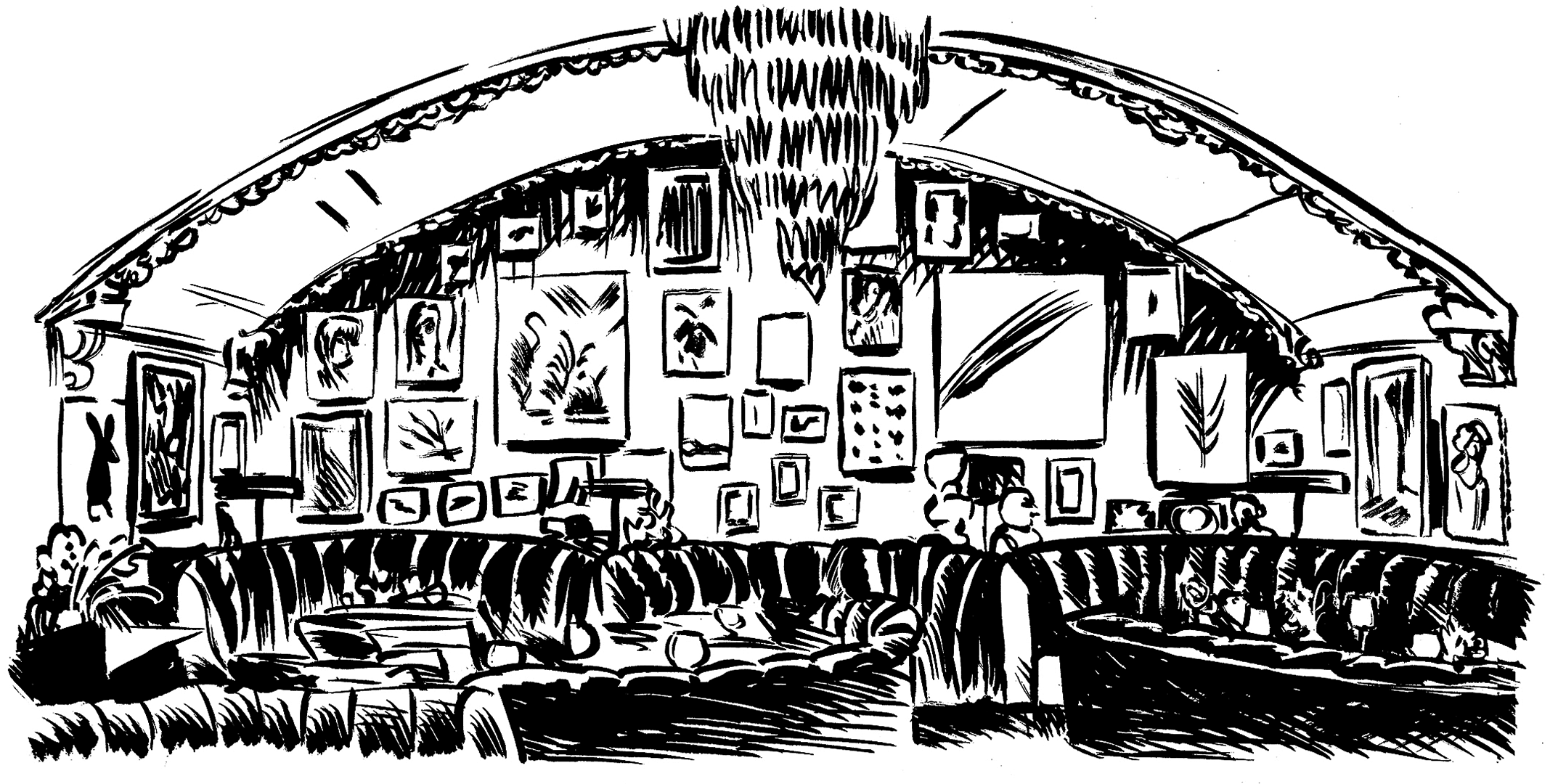
When Stephen Toman and Alain Kerloc’h opened Ox back in 2013, Belfast was just beginning to glitter as a food destination. 13 years on, it is blazing. There’s Edo, Stove, Beau and Wine & Brine, along with the city’s other Michelin-starred restaurant, The Muddler’s Club. We’re eased into a table smack in the centre of the room, the soft thrum of the kitchen at our backs. What does she make of all the culinary changes in her city?
‘Well, one of the things that surprises me is that there aren’t too many places these days that do good “Irish/Ulster” food, beyond the Ulster fry. I met some French tourists on the train the other day and they so wanted to get an Irish stew. I was thinking – I couldn’t tell you a single place in the town where you could get that. But I could tell you five places that do Korean fried chicken.’
Erskine was born here in 1968, her father a bank inspector, her mother a teaching assistant. It’s a background she describes as ‘solidly lower-middle class by the standards of the day. But we were coming from more of a working-class place in terms of food.’
Did you grow up in a dinner-in-front-of-the-tv house?
‘No no. Well, only on a Friday night. Me and my brother were allowed to have our tea in front of the telly and we’d watch Monkey and then The Tube. We’d quite often have steak and chips.’
The fucking dream. Onion rings?
‘Onion rings, yeah. Fried tomato. The steak would be really, really well done.’
There’s no à la carte at Ox – just the set five-course menu. We order a bottle of gewürztraminer with a sangiovese to follow. The white is poured as the first course is placed in front of us: a tiny scallop with curried squash and grilled verbena (‘a perennial herbaceous flowering plant.’ Thank you, Google), the scallop as fresh and salty-sweet as dunking your face in the rushing River Lagan across the road.
Are you a seafood fan?
‘I am now, yes. When I was growing up, my granny – my dad’s mum – you’d go there on a Saturday, and you’d have fish fingers, but you’d eat them with proper fish knives. But, like, my other granny, my mum’s mum, she was born in 1908 or something, and when you’d go round there, when you were like 11 or whatever, she’d give you a whisky and ask you if you wanted a smoke!’
Did your mum do all the cooking when you were growing up?
‘Yeah. I think my mum was a super-creative person and the way she channelled a lot of that was through cooking. Intricate things with pastry or painting rose leaves with chocolate. My dad never cooked. The only thing he could do was fried rice, and he would only do it like a celebrity chef. Like if my mum had done all the prep and everything was already out in little pots and then all he had to do was throw it all in.’
No fried rice appears tonight. Instead it’s venison from County Wicklow, garnished with transparent slivers of radish, pine nuts and a red wine vinaigrette; the deer meat is as rare as kindness and as tender as poetry. ‘I love venison,’ Erskine purrs. In 1986, she left Belfast to read English Literature at Glasgow University. I wonder if it was there she discovered there was more to food than the stuff she’d grown up with?
‘Yeah, definitely. I made this friend who lived in Hyndland, the posh part of the West End, and they invited me to a dinner party. They said to bring a bottle. I brought a bottle of cider. I knew nothing about wine. Just wasn’t on my radar at all. They’re all sipping it and going, “Ooh cider! How original!” So we’re in the kitchen, everyone’s cooking, and someone says to me, “Oh would you mind making the salad dressing?” And I was like, “The what? ” I mean, I’d love that now. Make the salad dressing? What a nice wee job! But back then I didn’t know what to do. I thought salad dressing meant salad cream.’
It’s all part of the self-middle-classifying process of going to university, right? Were you first-generation?
‘I was, yeah. My parents could have gone if they’d been born a little later. Definitely. My dad was a really smart fellah, you know? He died eight years ago.’
I do the arithmetic in my head and ask the question.
Did he live to see your first book come out?
She shakes her head. ‘No, he didn’t. And he would have loved that. But he saw the first stories getting published in The Stinging Fly, and, you know– ’
She breaks off as the next course appears: halibut in a bonito beurre blanc with oyster mushrooms. We fork ice-white flesh and sluice the last of the gewürztraminer. There comes a point in any great meal where the food and wine conspire to nudge you into an awareness of what a fantastic thing their combination is. You become conscious of it in the moment. This happens now. ‘John,’ she says with slow emphasis, putting her fork down, ‘this is just wonderful.’
She doesn’t just mean the food. She means being in this brilliant room on a cold night, eating and drinking. Being alive. Or perhaps it’s in the thinking of our dead that we become most aware of – and most alive to – pleasure. ‘See my dad,’ Erskine goes on. ‘He loved tales. He loved hearing about it all as I started to have a wee bit of success. He loved hearing about stuff like, “So you went down to Dublin to read at a thing? Did you stay in a hotel? Did you get breakfast included? What was the breakfast like?”’
Brilliant. Fuck literature – how were the sausages?
‘Yeah. The real questions!’
About the late-starting thing, what did you see yourself doing after graduation?
‘You know, I used to look at the Guardian, at the arts and media jobs section, and think, I wonder if I could do some of those things? You know, if I’d moved to London like you did and got a job at a record label, like Mute or Heavenly or whatever. But it all just seemed so remote and unlikely. It all seemed so far removed from my life and my experience.’
Instead, she went to teacher training college, then returned to Belfast at the end of the 90s to begin a career as a secondary school teacher that continues to this day. Marriage and children came along too. But the idea of writing gnawed away.
‘I’d always suspected I might have some talent as a writer. But I’d put it off and off and off. Then, finally, when I had an afternoon off, some time to myself, I’d do some bits and pieces and that eventually became Blue Lamp Disco. I guess the kids were getting to the age where they didn’t need me all the time and I was starting to think, Well, what am I all about here? ’ She puts a glass to her lips.
You were into your 40s at this point. Where do you think this reticence in your character comes from?
‘Umm. That’s… I don’t really know. See, I love David Holmes, and David tells this story about when he was younger and he was invited out to LA by Danny DeVito to do this soundtrack (for Out of Sight) and how he’d never done anything like that before. And I asked him, “How did you feel on that plane ride out there?” Because I’d have been terrified. And David didn’t even really understand my question. Because he’s so far removed from that kind of universe of self-doubt. But I guess I was always more of an… umm, on-the-sidelines kind of person.’ I think of Erskine’s characters, observing from a distance. Jean in ‘Inakeen’, peering through her net curtains, fascinated by her exotic Muslim neighbours. ‘But where does it come from? I couldn’t really say.’
She twists her napkin. Any awkwardness is salved by the arrival of the chateaubriand. It’s served on a bed of pearl barley with ‘first of the season wild garlic.’ As a dish that speaks to its homeland, the combination of beef and pearl barley is unbeatable. A moment goes by. The boom of the room. We circle back around to the question of What Makes Wendy Run.
‘See, my daughter, who’s in her 20s now, she tells me that how I operate with people is that I’m often coming from a place of nostalgia. She says, “Mum, you go on about what you think are really distinctive moments in relationships and half the time people can’t remember what you’re talking about.”’
I think about what makes her writing great. About the exactitude of her emotional recall.
But you remember, don’t you?
She thinks for a moment, then nods fiercely. ‘Yeah. I do.’