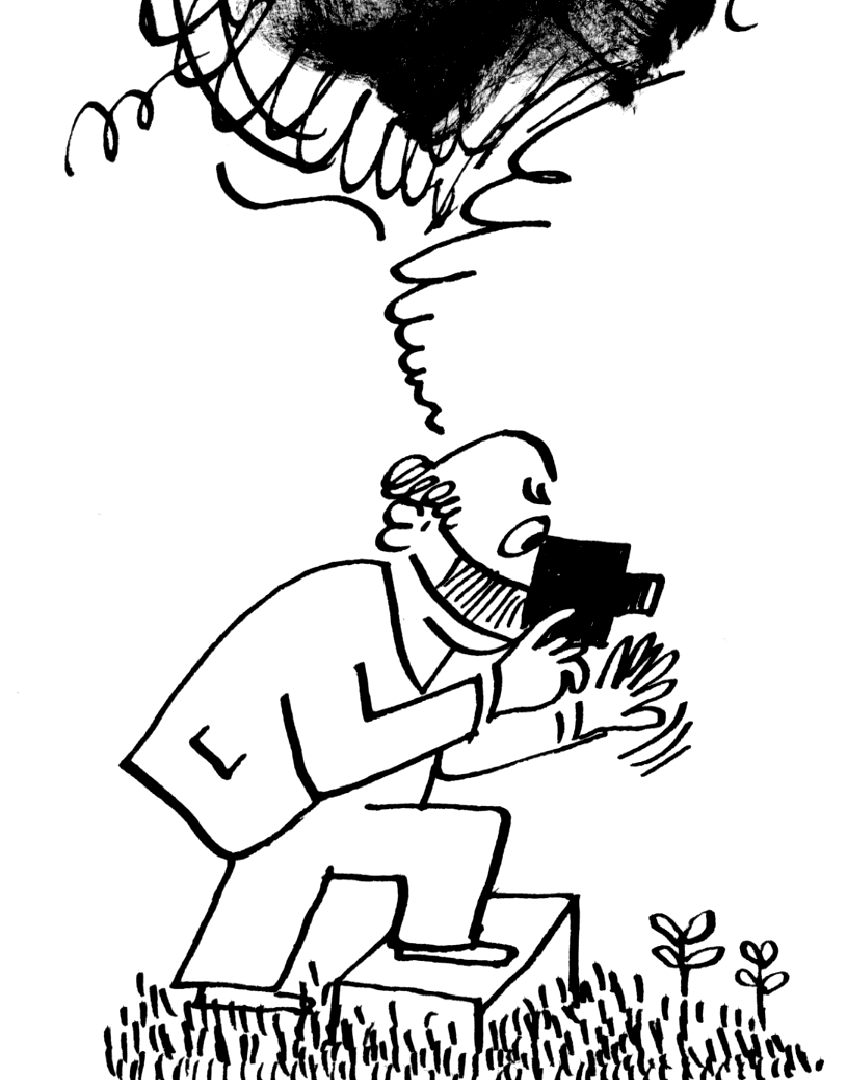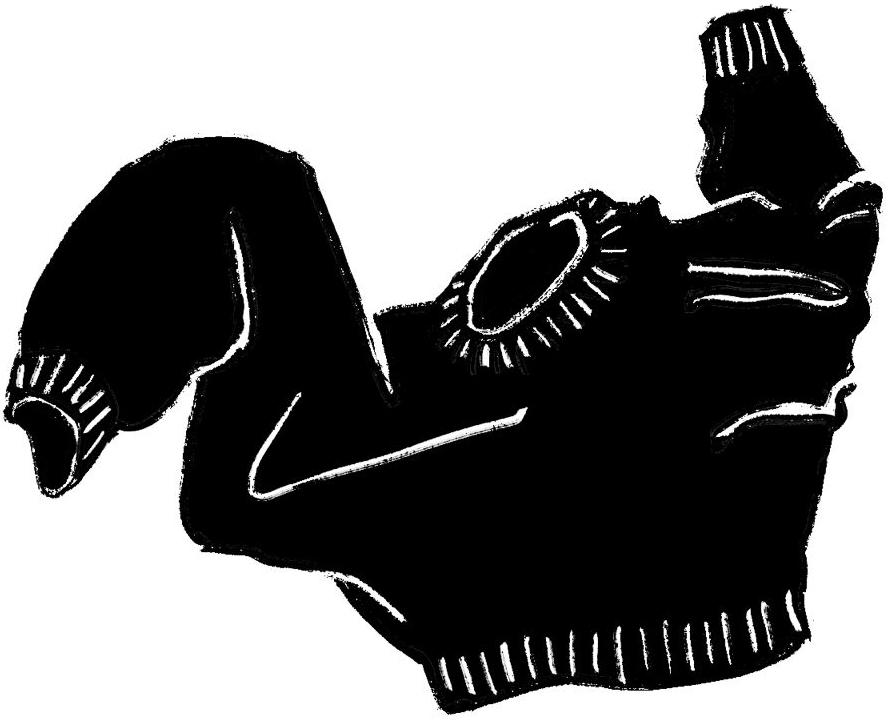
In his story, ‘Don’t Blame Anyone’, Julio Cortázar depicts one man’s interminable struggle to put on a jumper. The man is supposed to be meeting his wife at a store, and it is cold outside, so he reaches for a jumper before leaving his flat. The ensuing tangle suspends him in a permanent state of paralysis. Any gains he makes, as when his right hand comes out into the open, are soon undone – it turns out that freeing this hand comes at the cost of trapping his head, for his head is stuck up a sleeve and his right hand is in fact where his head should be. His right hand frequently disobeys, even, at times, attacks him, so that cause and effect are drastically off kilter. The man spends the story contemplating whether he should take off the jumper and start again or go on forcing himself through. He opts for the latter. By the end he has not freed himself.
When I’m asked what Long COVID is like, it’s tempting to tell people to read Cortázar’s parable, because it is close to articulating the experience of living with this illness. Like Cortázar’s deeply unheroic hero, the Long COVID patient is condemned to a sudden upheaval that traps him in the home and locks him in perpetual combat with an oddly intimate enemy that engulfs and incapacitates him. Any improvements are quickly subverted by complications that become more entrenched the more he attempts to alleviate them, and, crucially, his body has turned against itself. All the while baffled family members wait offstage, wondering what on earth is taking so long.
Convalescence is often understood as a linear process in which the convalescent moves inexorably towards health. For those of us with Long COVID, convalescence, if we can call it that, is less a straight line, more a twisted web of false starts and failed efforts to disentangle ourselves from the clutches of symptoms. Progress is profoundly wobbly, liable, at any moment, to slide into reverse. I may feel some improvement one week and timidly expand into life, only to relapse after ‘overexerting’ – some days, this might be a 20-minute walk and a fateful scrub of the crockery; others, it will be a ten-minute conversation. The only constant here is inconstancy, which makes it impossible to manage.
The defining feature of Long COVID and other post-viral syndromes, such as ME, is the rather meek-sounding post-exertional malaise. The rule is this: do too much, pay for days, weeks or months to come. For me, payment is weeks in bed. The symptoms vary, but fatigue, headaches, brain fog and dizziness are all widely enjoyed by the typical post-viral patient, including this one. Fatigue is popularly translated as ‘just feeling tired all the time’, an eradication – via a stressed adverb – of swathes of suffering. In reality, it’s like waking up in a suit of medieval armour after a night on the mead.
Before I got ill, I was a full-time English teacher at a secondary girls’ school in London, working long hours to teach sceptical adolescent foreheads the virtues of Austen and Joyce. Now I spend 20 hours a day in bed, flitting between anger, despair and Breaking Bad. Because cognitive exertion is just as taxing as physical activity, it’s difficult to read for more than a couple of hours each day. Boredom is a big theme. Time outside the bed is spent on the sofa, taking short, five-minute walks and eating meals prepared by my long-suffering girlfriend who has somehow managed to combine the incongruous roles of feminist academic and Victorian Angel in the House. Each day I play the same game: can I conserve more energy than I spend? Each day the parameters shift, so that you feel like an amateur up against the grand master of whatever perverse game this is.
A good doctor can go some way towards outfoxing the grand master. They may prescribe a host of medicines and food supplements, some of which might, to some degree, help alleviate some symptoms. At various points over the two years I’ve have Long COVID, I’ve trialled blood-thinners, antihistamines, antivirals, antibiotics and I’ve been on a steady dose of high-strength vitamins and amino acids and mitochondrial boosters and gut support. Success has been minimal and I, like so many others, have been compelled to look outside medicine-based methods and towards more holistic alternatives. A silver bullet there is not. And until there is serious investment in workable pharmacological interventions, it’s unlikely that there will be one anytime soon.
To have Long COVID, then, is to be trapped in paradox. This is no more apparent than in our furious efforts to recover, in which a profane blend of Puritanism and Paltrowism (the Gwyneth variety) do battle. The former sees us inflict the most penal of practices on our flailing bodies, from fasting, cold water immersion and paleo-ketogenic diets, to self-imposed lockdowns spent staring at white walls, praying for deliverance. It is to forgo ice cream for ice baths, wine for water, a social life for self-flagellating hours of bedrest. We must abjure all the good things in life and embark on a regimen of ascetic misery and reluctant abeyance.
These penitential measures are crossbred with the latest from the wellness types. When reiki invariably fails, we practice meditation, ‘somatic tracking’, gratitude journaling (I know) and ‘acceptance’ in the vague hope that the zany nutters who promote this stuff might be onto something. We listen to cooing Californians imploring us to ‘practice self-compassion’ or – shudder – to ‘get nice and cosy in your Yoga Nidra nest’, subjecting our English tongue to a kind of yogic flaying. ‘I don’t want to be in the Yoga Nidra nest’, you want to cry. ‘I want to tear it apart, hurl the chicks to the ground and fly to the nearest pub.’ None of these alternative approaches have remotely helped me.