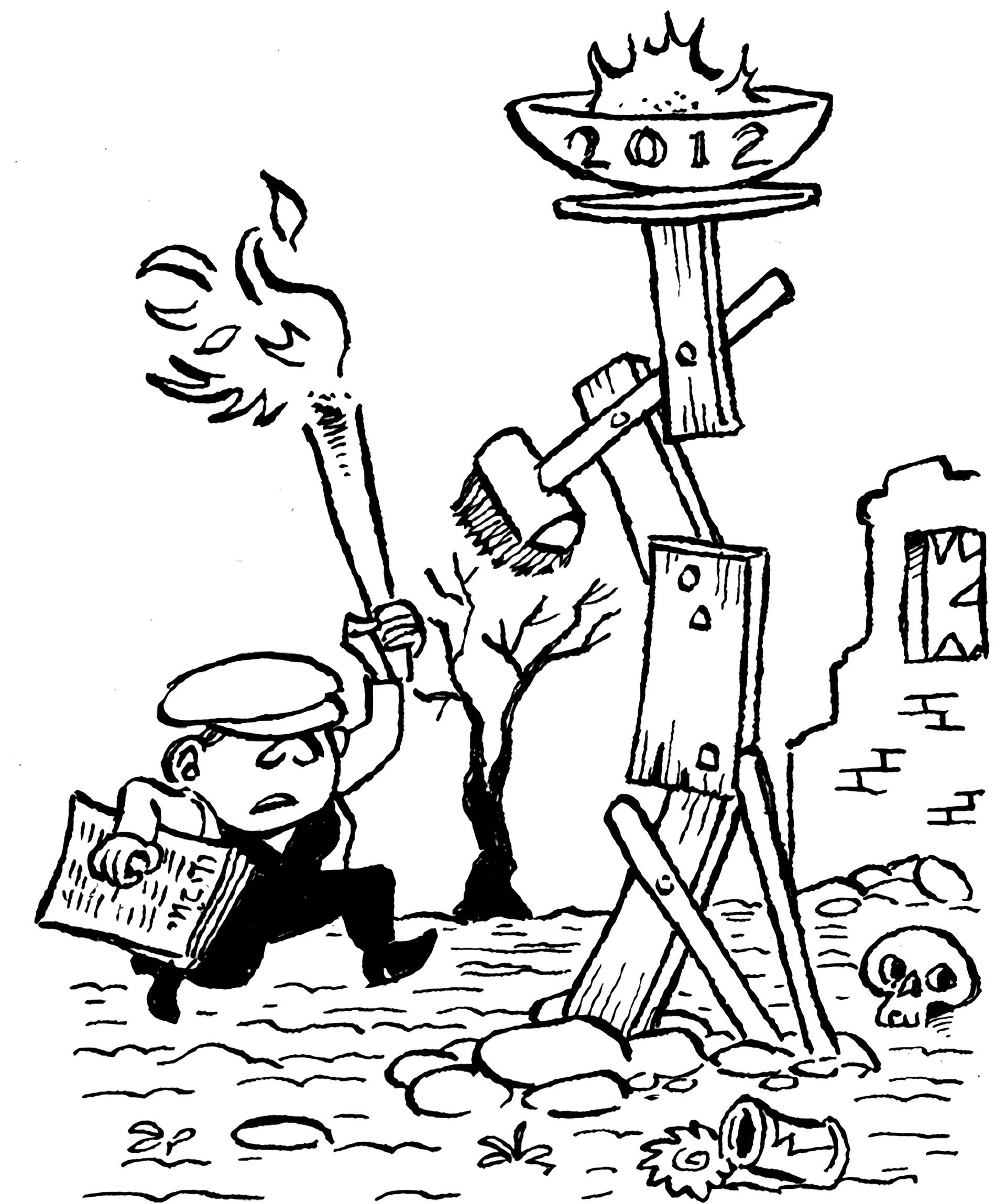

Last week, London’s mayor, Sadiq Khan, lit a ‘legacy flame’ at the Olympic Park in an attempt to reignite the fabled ‘spirit of 2012’ – that mythic year of national optimism and unity. The Conservative government is likewise hoping to preside over its own summer of love, with the Queen’s Platinum Jubilee and the Commonwealth Games echoing the celebrations of ten years before. For both sides of the political establishment, this anniversary is a chance to take a holiday from the nightmare of the present day.
If their memories were longer, they might think twice before invoking the spectre of 2012. According to a Western misinterpretation of an ancient Mayan prophecy, the world was supposed to end on the 21 December of that year, with Earth torn to bits by a mysterious celestial calamity. Armageddon never arrived, but the apocalyptic rumours were an eerily tight fit with the national temper. 2012 in the UK was a year of widening gyres and dark revelations.
In the aftermath of the 2008 crash, two particularly noxious stories pervaded the national consciousness. The first was the coalition government’s austerity programme, a suite of spending cuts supposedly intended to balance the state budget in the wake of the financial crisis. The second was a growing sense of suspicion and resentment towards our political and economic elites, fuelled by an increasingly squalid procession of scandals over bankers’ bonuses, MPs’ expenses and political lobbying. These narratives unfolded in harness, each new exposé making the next round of cuts seem yet more cruel.
In 2012, both situations came to a head: this was the year that austerity policies kicked into gear, with a series of landmark bills taking chunks out of the post-war welfare settlement. And it also marked the climax of the most pungent scandal afflicting British public life in the early 2010s – the News International phone-hacking affair. It is not impossible to imagine a universe in which this constellation of legislation and official corruption led to an apocalyptic reckoning for the establishment which brought it about. But, as you and I both know, things went the other way.
The Cameron government’s legislative ambitions centred around a trifecta of bills targeting key areas of state provision: the Welfare Reform Act, the Health and Social Care Act and the Legal Aid, Sentencing and Punishment of Offenders Act. Systematically, these three bills shifted enormous portions of the social contract – financial support, medical treatment and legal representation – away from the country’s most vulnerable, in a manner that is yet to see any form of reversal. The effects have been deleterious: punitive benefits sanctions driving death and deprivation; a debt-racked health service uncomfortably foisted into free-marketeering; and a two-speed legal system where the right of defence is only acquirable by those with the funds to support it.
All of this was backdropped by the news, announced in April, that the UK had slid into a double-dip recession. Meanwhile, the national debt continued to rise, hitting £1 trillion at the start of the year. What was the point of all this hardship if it wasn’t even achieving its self-declared econometric goals? The government strove to counter the perception that it was waging class war by appealing to a sense of national solidarity in a time of shared suffering, invoking the good old Blitz spirit. However, it was increasingly obvious that, in this case, the bombs were coming from inside the house.
Nothing crystallised this sentiment more perfectly than the phone-hacking scandal, a story precision-engineered to confirm everyone’s worst suspicions about our political and media elites. This miserable saga centred on the allegation that journalists at the Rupert Murdoch-owned tabloid News of the World had been hiring private investigators to illegally intercept the answerphone messages of celebrities and other persons of interest.
What may have begun as a question of press ethics and privacy violations became, at its heart, a story about the inner workings of the British establishment – not so much a case of conspiracies cooked up in smoke-filled rooms as Sunday suppers in the Cotswolds, free tickets to the health spa and an endless daisy chain of convivial backscratching. Why was the Met so reluctant to fully investigate the hacking allegations despite sitting on a mountain of evidence from previous cases? Well, it might have had something to do with the network of close relationships that existed between senior coppers, top politicians and News International executives. Remember: Tony Blair was godfather to Rupert Murdoch’s daughter. David Cameron and former NotW editor Rebekah Brooks were horse-riding buddies. In 2010, Cameron appointed Andy Coulson, another former NotW chief, as his director of communications. In 2011, Met Commissioner Paul Stephenson resigned his post, chiefly because of suggestions that his association with yet another former NotW editor, Neil Wallis, might have compromised his attitude to the hacking investigation.