Dear Readers,
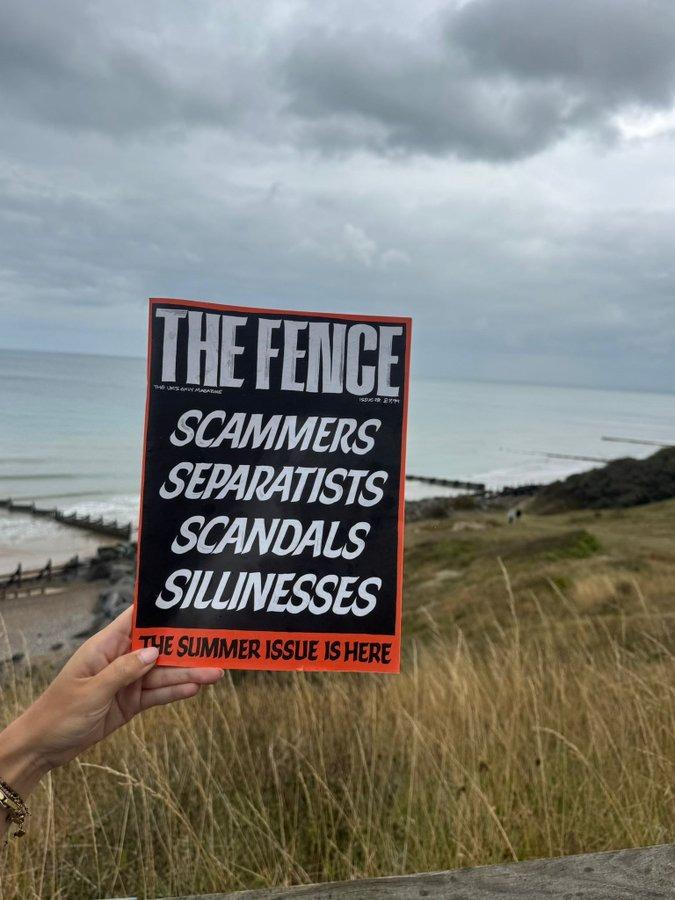
Good afternoon and welcome back to Off The Fence, a newsletter that’s amore. As various letters are dotted and crossed in our next (marvellous) issue, we continue to enjoy seeing Issue 28 jaunt around, from our coastline on the blustery beaches of Norfolk all the way to Australia’s, loitering conspicuously outside the Clocks at Flinders. It’s also been spotted in Soho (quelle surprise) and in the heart of the Angel. Please do continue to send (or tag us) in your snaps, we do love to see you reading out and about, and you get the fringe benefit of entering into our hotly contested race for a rather decadent bottle of Bolly. The competition is open for a week longer.
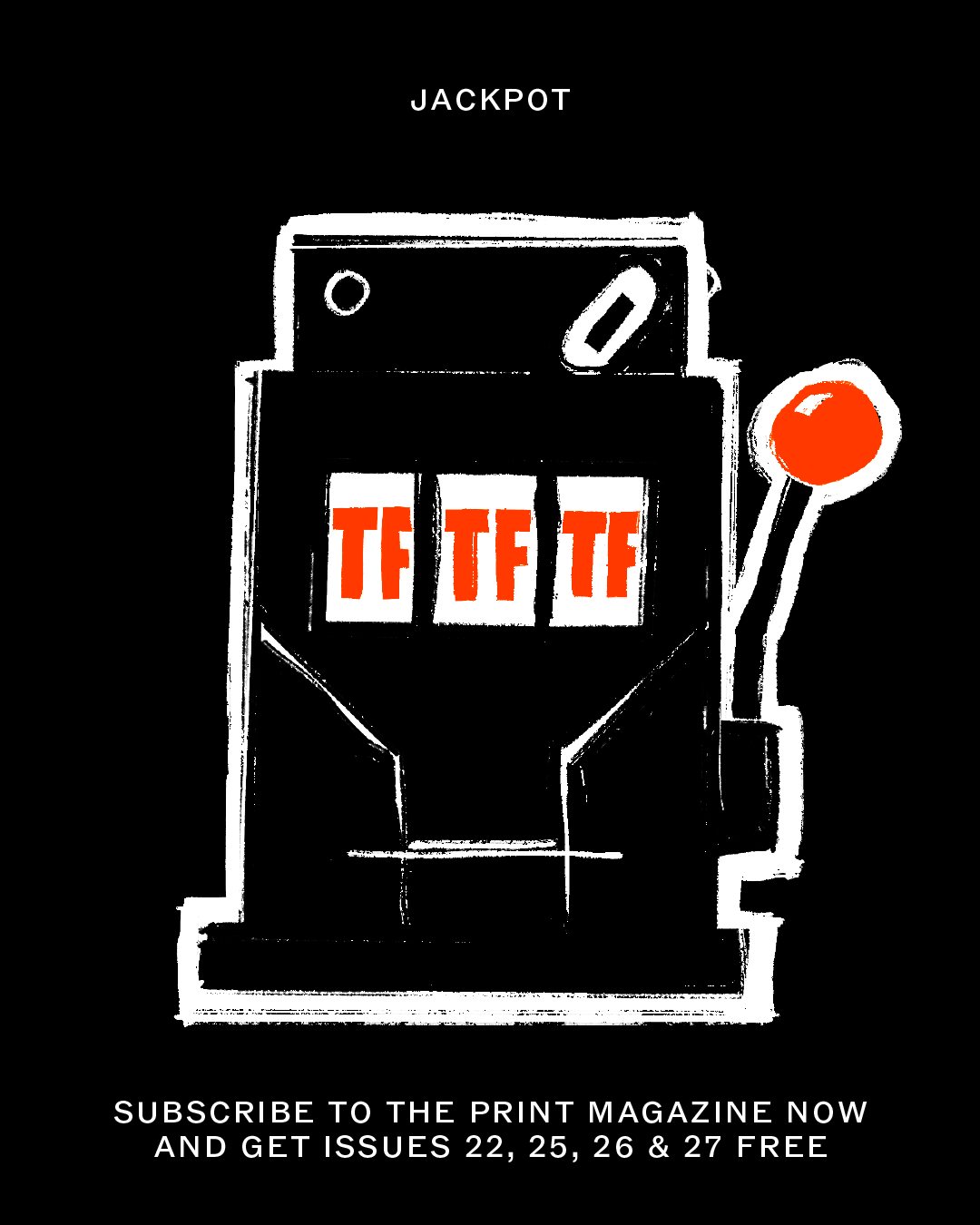
Speaking of deadlines, until midnight tonight we have a very special offer, and then it will expire, Cinderella-style. Everyone who subscribes to the print magazin will get Issue 22, 25, 26 and 27 for free on top of their subscription for the year. This applies to gift subs and also internationally, so scoop one up at the link below.
Today, we’ve got a dispatch from Madrid, courtesy of an old friend of the magazine, Francis Martin, who has been to a bar like no other.
A Night on the Tiles
Even by local standards, Una Grande Libre is an unusually patriotic drinking hole, with the awning and windows bedecked in the glaring red and yellow of the Spanish flag. But the image of a moustachioed face above a flamboyant fur collar betrays the establishment’s full identity: this is one of Spain’s few conspicuous Francoist bars, located just beyond the Madrid ring road, in a suburb with a large immigrant population. And the surprises don’t stop there.
Named after a Franco-era slogan proclaiming Spain ‘one, great and free’, the bar is also known as Casa Chen, after its owner, Chen Xiang Wei. Chen is diminutive, with a plasticine face that makes him hard to age, and an asymmetrical haircut strikingly similar to Adolf Hitler’s. He is also more than happy to talk with the two Brits who stumble into his establishment.
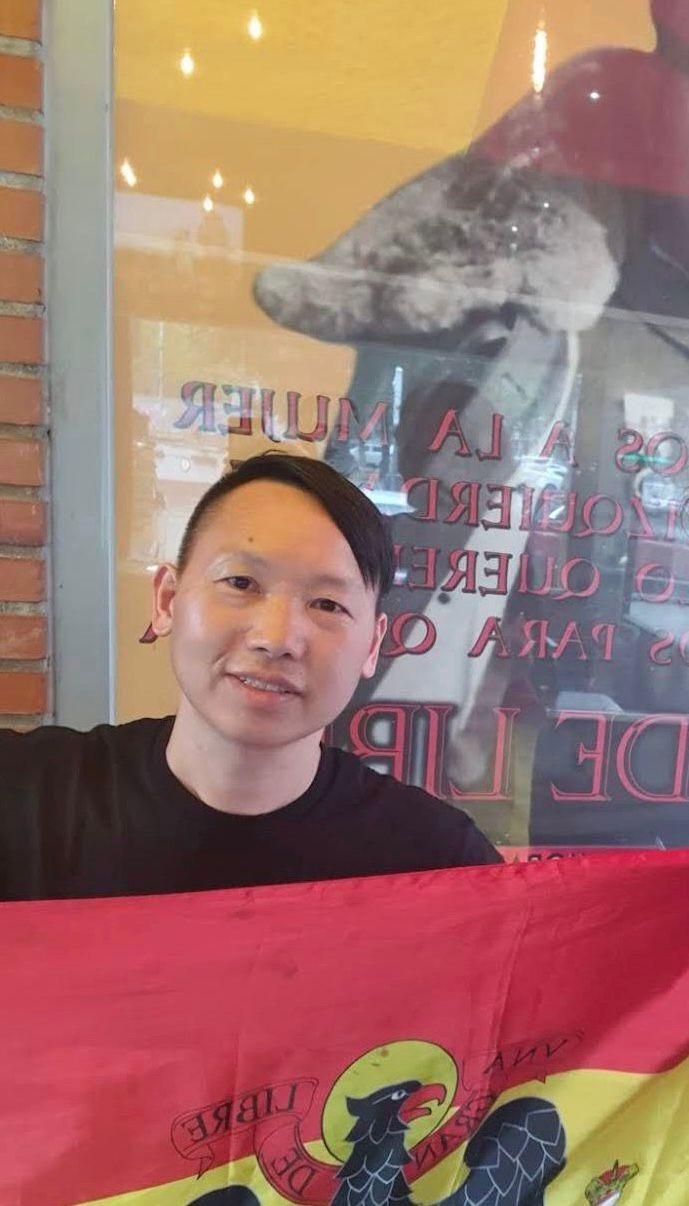
After moving to Spain almost 30 years ago, Chen at first ran a conventional outfit, but conversations with regulars inspired him to redecorate it in homage to Francisco Franco. When the landlord priced him out, he purchased the current premises, and runs it as a shrine to the man who believed himself ordained by God to rule the Spanish. There are rosary beads hanging from the bar, though Chen himself is not a Catholic.
He is, though, an unabashed Franco-phile, even naming his son after the generalissimo. A law passed in 2022 bans the promotion of Franco in spaces ‘with public access’, but Chen tells us he hasn’t had any problems. Perhaps part of the explanation comes when he points out the dozens of donated police caps, including from senior commanders, proudly displayed above the bar.
Clips of Chen’s exuberant Francoism have been going viral in Spain for years. His infamy owes much to the apparent cognitive dissonance of an immigrant supporting a far-right nationalist, as well as the eye-popping aesthetics of his bar, every inch of which is decorated with nationalistic tat, and innumerable pictures of the dictator (though few from his jowly old age).
There are images of Chen too: grinning next to Franco’s great-grandchildren, printed on commemorative coins dispensed by a machine in the corner, and emblazoned on bottles of olive oil. The bottles also carry his name and sobriquet, ‘El Chino Facha’, in an incongruent mishmash of faux Cyrillic and the font used by provincial Chinese takeaways.
Is he a fascist? He ducks the question with a spiel distinguishing ‘facha’ from ‘fascista’ (throwing in an unprompted distinction from Nazism for good measure). Sceptical, I ask a Spanish friend, and he tells me that ‘facha’ is used more like ‘commie’ – employed as a slur, but often with a certain level of irony.
At times, I can’t help thinking that Chen’s allegiances are reflective of naivety and an addiction to a minor level of fame. His love of Franco seems to be inspired, in large part, by opposition to the communism of his home country. This predisposition is bolstered by a certain nostalgia for a period through which he didn’t live, and in this he is not alone: a 2025 poll suggests that around one in five Spaniards consider the Franco years ‘bueno’or ‘muy bueno’, including people aged 18-24. The worst period of homicidal repression has now slipped out of living memory, and for many Franco’s legacy begins with the economic boom of the 60s.
The contradictions in Chen’s politics are not hard to find. Today’s politicians, he says, just follow a party line, never questioning their party leader. Chen also criticises Trump for cosying up to ‘dictators’, such as Putin and Xi. It is a curious statement to hear when our beers, and accompanying plate of rather good jamón, are resting on a table printed with an image of a man who ensured there were no free elections for four decades.
As we leave, Spanish teenagers of Chinese descent pose for a photograph in front of the bar, holding their fists to their chests in a caricature of a martial salute. They assure me that they don’t support Franco; for them, a trip to Casa Chenis more of an ironic rite of passage, to be posted on social media. When we leave, they haven’t yet decided whether they will go in to speak with Chen, but half an hour later we pass the bar again, and I see that they’re inside, having a night to remember – or, as some might have it, a night of forgetting.
You can follow Francis’ excellent Substack here.
Extra! Extra!
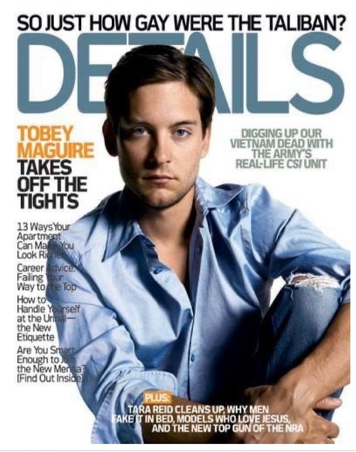
Not known to be totally humble at the best of times, we do tend to credit ourselves with coming up with some witty banners to adorn our print editions (see the quartet of s’s on our lovely summer issue) but recently our attention has been drawn to a long gone rival. Details magazine, a New York-based mag founded in the 80s and operating for around 30 years, started its life covering downtown club culture before moving on to a guise as a men’s fashion mag in the noughties – over the course of this, producing some of the most outrageously brilliant cover copy we’ve laid eyes on. Have you ever wondered how gay really were the Taliban? Or perhaps if Obama could make you better in bed? Well, thankfully, Details did too. Any subscribers that are also fans in possession of one of these fantastic covers, please let us know.
Hey There Good-Looking
We put Clive Martin’s rollicking investigation into the man behind all the noughties nightclubs you know and love in front of the pay wall. Clive chatted with Howard Spooner, whose venues include Embargo, Public, the Leopard Lounge, Crazy Larry’s, the Hammersmith Palais and the Clapham Grand (which he still owns outright) ‘were part of a hyper-luxe, pre-credit crunch club landscape that brought disparate and dangerous characters together to pop bottles and toast themselves silly’. Read on for the backstory. There is also some good gas on Prince Harry: ‘When we opened Public in Verbier in 2012, Harry was there for four or five days. One afternoon I came off the slopes with my two eldest children. I walked into the apartment – Guy Pelly had given him the keys – and he was lying there on the sofa, just in his boxer shorts, watching The Inbetweeners.’
Keep Left
Driving instructors continue to live up to their hallowed position as the most bombastic of all employed persons. It’s even a cliché, an old faithful at the chit-chat factory, to ask an interlocutor their best driving instructor stories. We’ve heard rumours of tear-flecked arguments concerning the moon landing. The emergency stop on the dual carriageway to get a look at a pretty girl walking by. An attempt at Biblical conversion. There was even a warning of decapitation for improper use of the seat belt. Now, though, driving instructors are not satisfied with terrorising us in the mortal realm, and have upped the ante by entering the digital one. There has been a spate of videos in the past few years of instructors taking videos of their lessons, and none so popular as Clearview Driving, which shows inane video after inane video of students messing up their parallel park. There’s even a narrative structure to some of it – you can follow a learner from first stall to getting their license in nine months. You have to see it to believe it.
Camp Matrix
This week our matrix of campness made a splash on Instagram. It is good to know how switched on our audience is to the issues that matter. Happily, all the engagement was positive and no one took issue with our empirical system of adjudication. Some commenters had thoughts on other figures they considered gaping holes in our assessment, but they were wrong. Still, we like to hear from the dissenters. Please write to us along the usual lines: editorial@the-fence.com.
In Case You Missed it
Sir Anthony Hopkins does geolocation.
Man renovates former sex dungeon.
Loyalty faltering in Massive Attack.
The food influencer who was a covert drug dealer.
And Finally
We have dredged up yet more adverts from the YouTube treasure chest, although this one is probably not going to hit the nostalgia-core notes of previous offerings, unless we have some secret centenarians in our midst. If so, welcome, and please do wave to us at editorial@the-fence.com.
In the 30s, the Post Office commissioned Len Lye to make a series of surreal short films capturing the surreal joy of the post office. The best-known one is probably Colour Box (1935), which was intended to showcase the Post Office’s cheap parcel service. It’s slightly mystifying, looking back, what the motivation behind hiring Lye – an abstract expressionist artist – was. The ‘advert’ is really a series of kaleidoscopic colours and shapes interspersed with large, mechanical script simply spelling out the name of the postal service. Over the top is rumba music.
To make these colourful jewels, Lye literally painted and etched his designs onto the filmstock. Technicolor had just been introduced for large studio movies, and along with it came other film breakthroughs. Lye was using something called Gasparcolor, which used a three-colour subtractive system. Basically, you use special filters to subtract certain colours from the spectrum of white light, which leaves super saturated shades visible – perfect for very trippy adverts.
He also did a couple that were black and white. In 1937 he actually briefly strayed from trying to sell things to people, and actually tried to give them a proper talking to. That’s right, an artist who debased his craft making adverts had some moral lessons to teach. In N. or NW., Lye makes a public service address on the importance of correctly addressing letters. It tells the story of a lovers’ tiff and the failure of letters to reach the other person. It was apparently so ‘extreme’ – the Post Office was particularly pearly-clutchy about a scene where a girl gets dressed and has a stroll – that it never really got shown in full. So, it’s still unclear what was so extreme about what sounds like would now pass as a very tame yarn.
The best of the entire series, however, is surely Rainbow Dance, where Lye got Rupert Doone – much-loved dancer, choreographer and collaborator with Cocteau – to shimmy across the screen, variously imitating walking, tennis and dance. He then upped the saturation of the black-and-white footage to form a silhouette, which was then replaced with colour screens, so that when the body moves, it leaves a trail of lots of different colours. It is hard to believe that this was an advert for the Post Office’s savings bank, ending with the winking catchphrase: ‘Pot of gold at the end of the rainbow’.
https://www.youtube.com/watch?v=AHN9IHGQxk8
Ta ra! That’s all for now. If you enjoyed this newsletter, then you’love the print magazine, and until midnight you’ll get four free ones if you sign up for a print sub. If something has gone wrong for you – in relation to the magazine – seek our therapeutic counsel at support@the-fence.com. During his only visit to New York in May 1946, Albert Camus visited the zoo 20 times.
All the best,
TF