One night, as I tossed in bed in the Frontline Club, massaged by the full-bodied rumble of the Bakerloo Line beneath me, I felt my blood rise with lust for adventure and formed an intention for a quest: one that would span the length and breadth of Britain, a quest of danger and excitement, a quest for those gender-fluid temples to fecundity – Britain’s horniest trees.
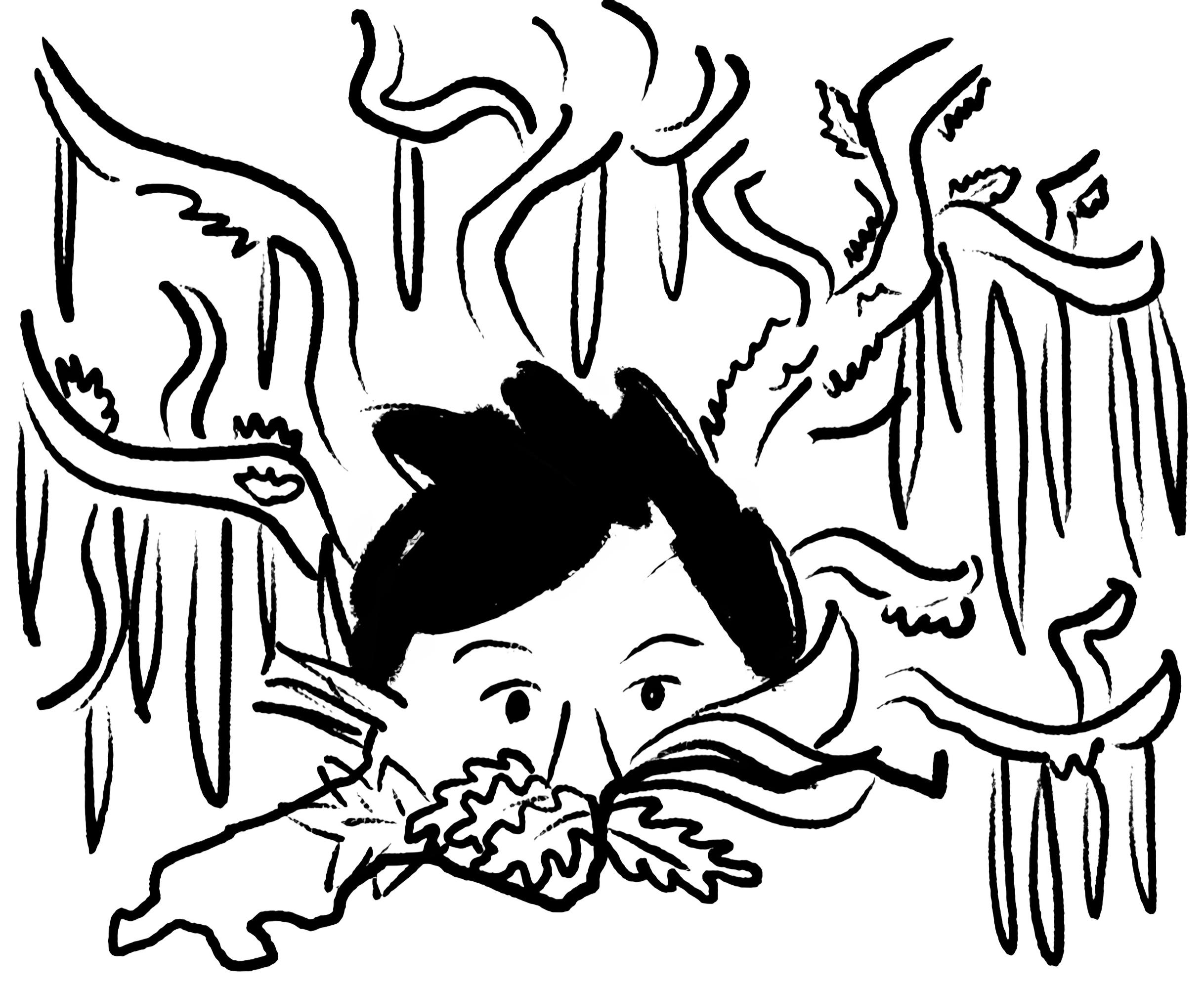
I decided to start with the hornbeams of Hadley Wood. The name refers to the hardness of the wood; the horn from the same root as horny, implying unsubtly hard, the beam a Middle English word for tree cognate with the German Baum. A short train journey from King’s Cross takes you to the heart of this almost rural idyll in Zone 6, and when I got out off the train at Hadley Wood I slipped through an irresistible hole in the fence, ending up ripped and bloodied and several suburban gardens later on Baker’s Hill, the wrong side of the tracks. Here were hornbeams as I had never seen them before; growing dark and close together, grey bark twisted and ancient, some with the hollow trunk of a tree long pollarded, some coppiced, an awe-inspiring tangle of forms and branches.
On one coppiced tree I was looking at, every twig rustled with a hanging bract, like a papery tail. Each of these would release 10 to 30 dry seeds, or samaras, and so the tree, possibly more than 400 years old, was producing as many as 3,000 potential offspring each year. More than a million potential transmissions of DNA over the course of a lifetime is not bad, casting even the horniest human polygamists (one thinks of Genghis Khan, and our former Prime Minister Boris Johnson) in the shade, whereas the better parallel – prolific women like Hecuba of Troy (19 living children pre-Achilles) and Edward Lear’s mother (21 children) – are almost virginal by comparison.
When it comes to length, there is no way that it can compete with a Chinese relative introduced recently to the UK; the monkey-tail hornbeam, carpinus fangiana. I’d seen a weak sapling in Devon, but the most spectacular example in the UK nestles among the hydrangeas of White House Farm, near Sevenoaks in Kent. There, in the garden of the legendary plantsman Maurice Foster, pendulous catkins cover a fine tree. I was looking at this libidinous monster last spring when I realised that my horniness calculator was completely off. The pink tongues of the female flowers were coming out of one set of papery catkins, but above them were the pale green catkins of the male flowers producing millions of grains of pollen – like so many trees, hornbeams are hermaphroditic, and have male and female flowers on the same plant. Humans can represent this full-bodied capacity for reproduction only in their gods, such as the Hindu Ardhanarishvara, ‘the half female Lord’, or the Phrygian Agdistis (envied to the point of castration by the other Gods) but most trees will or can do it in one form or another; sometimes self-pollinating, sometimes simply spreading the burden of motherhood across all members of the species.
Oaks have been central to the fetish of British concupiscence for millennia. Their power is to ally romance and the illusion of fidelity with prolific reproduction. Ignoring the strong claims of the Bear Oak of Penshurst Place (now superseded after 1,000 years by its self-seeded offspring) and the Marton Oak of Macclesfield (a conservative 1,100 years of a million quercus petraea gametes strewn a hundred miles across England and Wales), I went to search for romance in the form of a 1,000-year-old oak at Alfoxton Manor in Somerset, which is most popularly known as the house of William and Dorothy Wordsworth at the time of their deep collaboration with Samuel Taylor Coleridge.
I walked up the drive to find 20 people in a Buddhist meditation workshop and slunk off through the deer park, following my iPhone like a divining rod to the coordinates of the Alfoxton Oak. Luckily, it stood out among the other trees. It has a vast and bulbous trunk with a huge bolling 15 feet above the ground – a sign that it was pollarded until perhaps 400 years ago. Titillated by a small Buddha which the current wardens of the tree had placed in a deep roll of the trunk, my mind went to Christabel, widely considered to be one of Coleridge’s worst poems. The poem describes a fair lady, Geraldine (to rhyme with ‘fine’), who appears out of the Alfoxton Oak tree to Christabel, a beautiful maiden who is praying hornily at midnight for her absent fiancé. This is the moment that Christabel realises something is coming out of the tree:
It moaned as near, as near can be,
But what it is she cannot tell. –
On the other side it seems to be,
Of the huge, broad-breasted, old oak tree.
It turns out to be Geraldine, a person with strange habits and a suitably vague disfigurement. The implicit sexual relationship that develops between the two women obsessed Byron and Percy Bysshe Shelley and inspired Edgar Allan Poe, Sheridan Le Fanu and, most bizarrely, Emmeline Pankhurst, who named her daughter Christabel after this shining example of female emancipation.
I think the tree itself manifests better evidence of female agency than the poem. Majestic oaks are often known as the King of the Forest, but for those who care about scientific accuracy (and we know readers of The Fence are sticklers for truth), it would be better termed the Queen of Abortions. Oaks thrive because they adapt to conditions rather than specialising, and that means they need the highest possible genetic variation. To do this, they abort five out of six of their fertilised ovules, producing acorns preferentially from the most unusual genetic information, normally the pollen which has blown for miles from a distant tree. A quick look through the microscope at the developing acorns of the Alfoxton Oak drives this point home; the stalkless acorns show pits of abortive ovules. In a bad year, acorns, too, will be aborted at a very early stage, and the ground will be covered with small brown nodules. The few saplings growing around the base of the Alfoxton show the result of this in real time: different leaf shapes, different modes of growing and different times of coming into leaf all allow oaks to survive the changing climate and changing weather.