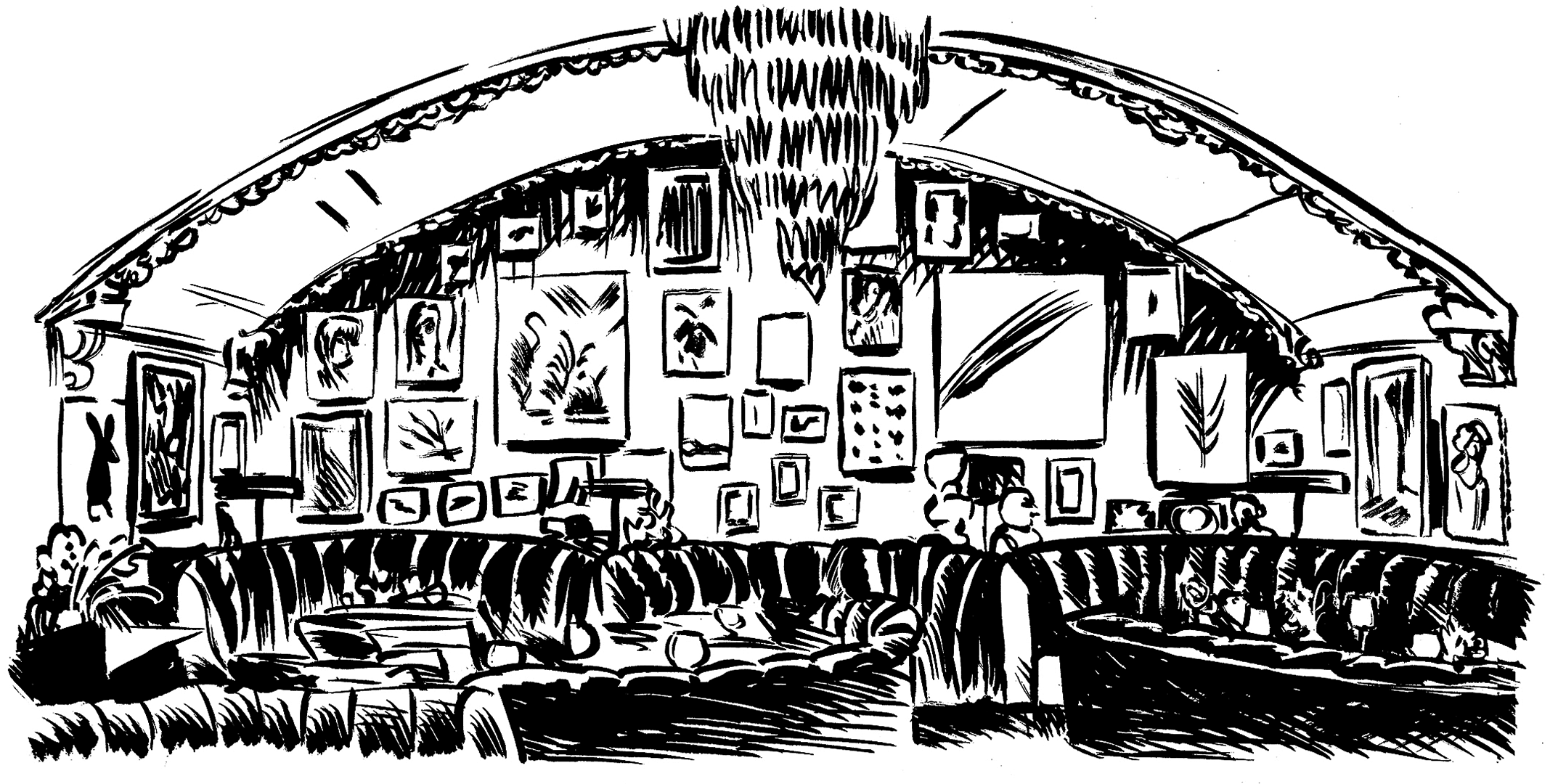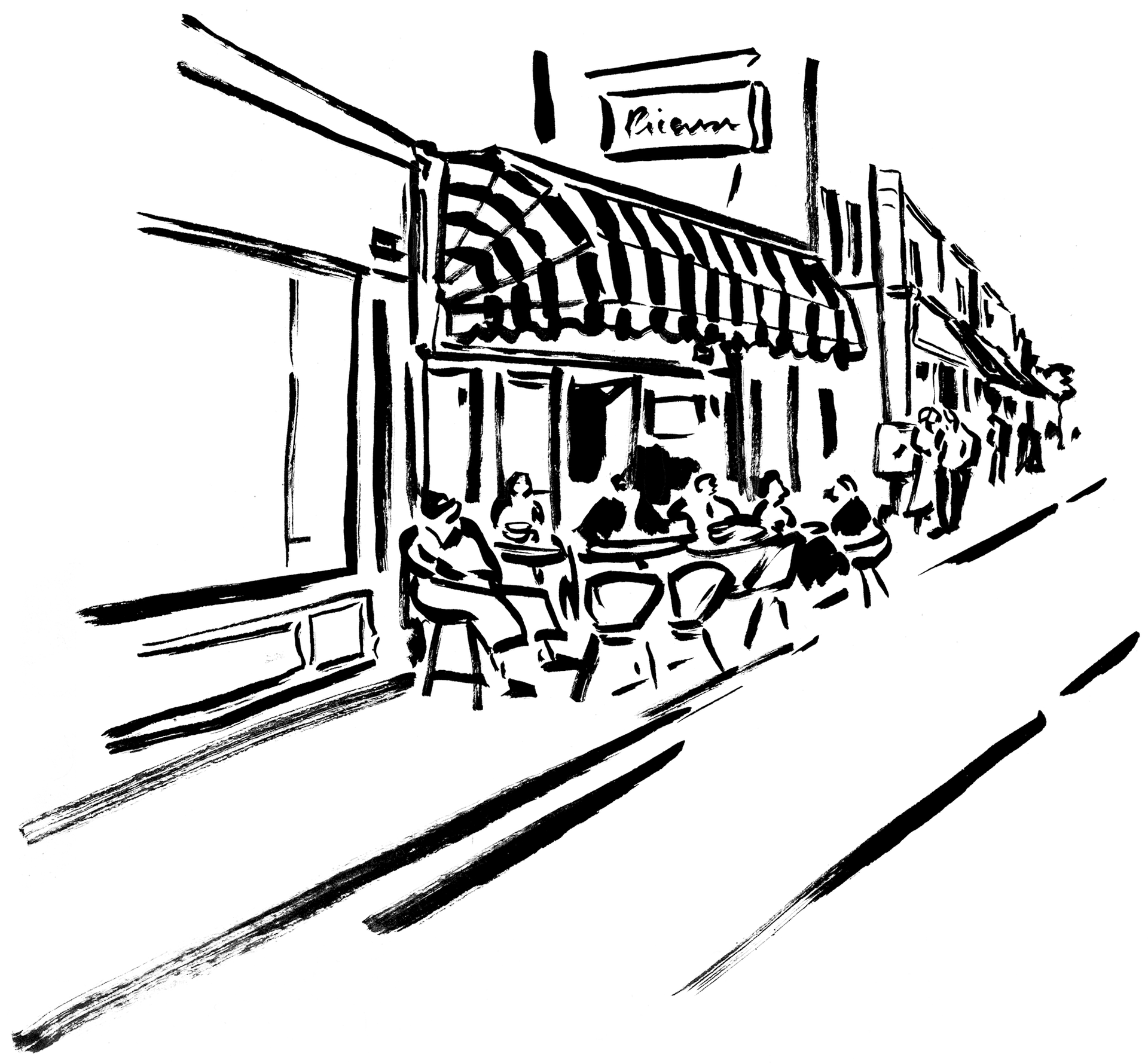
Venturing to the King’s Road in 2025 is to enjoy the kind of ambience one might experience from a 3D render of Godalming High Street. But this lacuna of good taste was once a heady stretch of transgression. Getting off the number 19 bus at any stop, at any time from the early 1960s to the late 1990s, was to enter ‘where it was at’. The King’s Road was the place to strut, to see and to be seen. And at number 127 on the almost two-mile-long road was a pit-stop for the kids with rizz: the Picasso, an Italian café with a neon sign and a green-and-white striped awning.
Before mobile phones, the Picasso was like a homing device: if you wanted to find someone, you checked in the Picasso. Were it not for its location, it might not have become the institution it came to be regarded; as it was, opening in 1962 halfway down the King’s Road, the Picasso was one of the burning spits on the pavement that marked the site of ‘Swinging London’.
The Picasso was an unassuming café, part of a group called Dinos, and was opened without hype or ceremony by a man called Alberto Barbieri. It served simple food and good coffee, and wouldn’t change its decor for the 50 years it existed. Against this fixed backdrop mods, swingers, punks and the last of the beatniks sipped cappuccinos, yet as these scenes emerged, disbanded and evolved, the café remained a constant.
One of the go-to shops on the King’s Road then was John Michael’s, a pioneering menswear store. When the photographer Richard Young started working there as a junior in 1964, it was his job to get everyone coffee and sandwiches from the Picasso. He remained a patron for the next 48 years. ‘Good coffee, no pretensions, no reservations, no waiting or being seated,’ Young says, ‘and I loved the staff because they were always miserable and not at all forthcoming.’
Around this time, being near Antiquarius, the Picasso was the place where local antique dealers met, dealers including Julian Lloyd’s mother. Lloyd’s first encounter with the Picasso came when he was just 14 years old. He recalls being alarmed when a distinguished woman who dealt in scientific instruments informed him of ‘the erotic possibilities of Pond’s Cold Cream’ over lunch.
By 1967, Lloyd was becoming the photographer of the 60s demimonde. ‘The hippies on the King’s Road weren’t your everyday hippie with a bell around the neck,’ Lloyd says. Of its varied clientele, he particularly remembers the presence of one set. This crew included writer Anthony Haden-Guest, and the real-life ‘Jumpin’ Jack Flash’, film consultant David Litvinoff, who, when aggravated, would shout things between mouthfuls like, ‘Who are you telling my cock tastes salty!’
The condition of Litvinoff’s penis tended not to be of much concern to the Beautiful People, who were typically in another dimension. ‘Men with buccaneer boots and phosphorescent faces waved from the Picasso café, looking like they took LSD with their cornflakes,’ writes Richard Neville, founder of underground magazine Oz, in his memoir Hippie Hippie Shake. By all reports, many did. My mother, a model, actress and general Zelig-like feature of the 60s and 70s, remembers the Picasso back then as ‘the Deux Magots of the underground’. Her friend, who had a 9-to-5 at Island Records, associates it less romantically, and perhaps more realistically, with ‘shirkers’.
Reported sightings in the Picasso around this time included Jack Nicholson and Anjelica Huston (on different occasions). Martin Amis would also ‘mince in in skintight velvets and grimy silk scarves’. In his memoir, Experience, he recalled it was a place where he would try to pick up girls in states of hash-induced paranoia, but was often thwarted by its apparent population of statuesque men. As he put it: