Dear Readers,
Good afternoon, and welcome to Off The Fence, a newsletter that’s arriving on a Friday, which is unconventional. But here we are.
We are not following other publications in leaving Twitter, there’s still a lot of great value to be had there, but we will be posting more on Bluesky, as lots of you seem to be enjoying things there. Do follow us here.
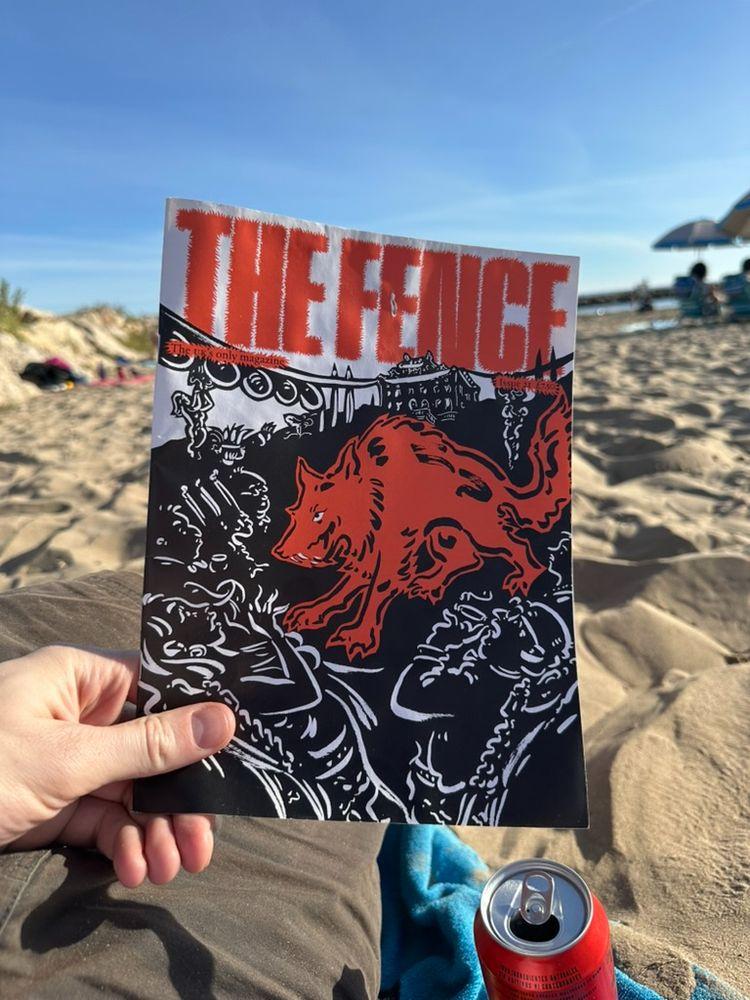
Issue 21 has been snapped by readers in a number of places of political intrigue. Here it is in Bucharest; now at the Oxford Union; fomenting riots on a Barcelona beach and enjoying a sundowner in Namibia.
Remember, all you need to do is send us a photo of Issue 21 out and about and you could win a bottle of Bollinger Champagne. You can send it to editorial@the-fence.com or you can tag us at one of our social media accounts.
The new website continues to look gorgeous, much as it did on Tuesday. We’re supplying a beautiful print magazine that is matched with a top-tier digital vehicle and we have this silly mail-out too. And all at a much cheaper price than our peers: do sign up today.
Right, we’ve got some reheated foodie drama, but first, an interview with a legendary writer, who spoke with our own Róisín Lanigan.
The Crazy Prices
Patrick Radden Keefe’s first reporting trip to Belfast was in 2014. Over the course of the following decade, he travelled back and forth countless times, meticulously researching the political and historical landscape of the city. Seven of those trips were for his book, the Orwell Prize-winning Say Nothing, which was released five years ago. Speaking to The Fence, Radden Keefe describes the book, which came with a hundred pages of endnotes, as ‘scrupulously factual’.
Say Nothing’s FX adaptation, released this week, uses more dramatic license in telling the story of the ‘Disappeared’, the beginning and end of The Troubles and also of Dolours and Marian Price, sisters who were among the first women to join the IRA. Jumping back and forth in time, we join the Prices and other figures of the conflict, notably Gerry Adams and Brendan ‘The Dark’ Hughes. It wrestles with the aftermath of violence, the impossibility of truly reckoning with the end of a war that was never recognised as a war. ‘This series is its own thing, and different from the book in a lot of ways, as it should be,’ says Radden Keefe. ‘A completely faithful adaptation would be unwatchable, and I think that viewers understand that when they're, they’re watching a drama. It’s not a documentary.’
In text and on screen, Say Nothing tells the story of Jean McConville, a mother of ten from Divis Flats and the most well-known figure of the victims of The Troubles who were abducted and killed by the IRA in the 1970s and 1980s, whose bodies were not recovered. McConville’s children recall her being taken from their home shortly before Christmas 1972, the deadliest single year of the 30-year conflict.
Growing up in west Belfast, close to where McConville was taken, she was almost a mythical figure throughout my childhood. Derelict houses were pointed to as ‘where they took Jean’ in an almost Boogeyman-like fashion.
‘When you examine any armed conflict, the focus should rightly be on the victims, and in the series, the first people you meet are Jean McConville and her children,’ Radden Keefe says. ‘From the early days of the writer's room, when we were still conceiving how the book would translate into a drama, Josh Zetumer, the lead writer and showrunner, always said that this was a story about the allure of radical politics, but also about the costs of those politics.’
But the truth, as Radden Keefe acknowledges, is that despite the Golem-like quality of her story, little is really known about what Jean McConville was like as a person. There is only one, grainy, black-and-white photo of McConville, pictured with her children. In modern-day Belfast, only one tower remains from Divis, once intended to be the largest social housing project in Western Europe. ‘I spent several years gathering every bit of information I could about Divis, seeking out old photos and reminiscences, talking to sources who lived there or spent time there,’ he says.

Michael Lennox, himself a Belfast native who directed every episode of Derry Girls, was a producer on Say Nothing, and directed four episodes of the show. Radden Keefe travelled to Belfast several times with Lennox, meeting with the McConville family and hearing their concerns about seeing their story resurrected for new eyes all over again. There’s a great local attention to detail across every episode, every scene – the show’s cast is predominantly from west Belfast, including Anthony Boyle (who plays Brendan Hughes) and Lola Petticrew, who went to the same Falls Road school as Dolours Price, St Dominic’s.
Of course, thanks to having relatively little true info about her life, in the book, there is no definitive answer on whether Jean McConville was – as the IRA have always claimed – an informant, or, to use the terminology we’re more familiar with in Belfast, a ‘tout’. In 2006 the Northern Ireland police ombudsman said they didn’t believe she was, and recommended the British government break protocol and confirm their findings. The government didn’t. Radden Keefe’s book leaves the answer open to interpretation. The show leans closer towards the belief of the Ombudsman, and of McConville’s children, that their mother wasn’t a tout.
But when it comes to telling a story, one that is this cruel and horrifying and confusing, the decades-long endless debate over whether McConville was an informant ceases to be useful. ‘Even if we were to stipulate that she was, would that change the fundamental moral calculus at play?’ Radden Keefe says. ‘Would it somehow mitigate the awful culpability of those who murdered and disappeared her, orphaning ten children? I don't think that it would.’
It goes without saying that Say Nothing is the most exciting television event of the year. You can watch it – and you absolutely should watch it – on Disney. The reviews are glowing.
Expanding the Portfolio
There’s a fascinating story emerging on Berwick Street, where the traders at the famous market were alerted to plans to switch off water taps at either end of the street.
The market is reassuringly austere, with a fruit ‘n’ veg stall and lots of traders catering to the local community and younger office workers. We go there for delicious iced coffees from Soho Dairy and falafel wraps. The market doesn’t particularly cater to more well-heeled visitors, and it takes up valuable real estate in the middle of the road.
Why would the council try to shut such a valuable local market? Who would be encouraging them to do that? Questions, questions, questions.
The relationship between Soho’s landlords, locals and businesses grows ever more fraught, as Francisco Garcia reports – do read it if you’re interested in London’s most iconic neighbourhood.
Panem et Circenses
Given that Hugh Corcoran’s Instagram have now become the subject of international coverage – and we’re not joking, either – it makes sense to check out some more bizarro posting, and it’s thanks to a reader of taste and distinction for alerting us to this epistle from Dovile Dryzite, who is married to Juergen Teller, a German who enjoys being photographed naked (google ‘Juergen Teller Charlotte Rampling piano’ if you’re feeling brave).
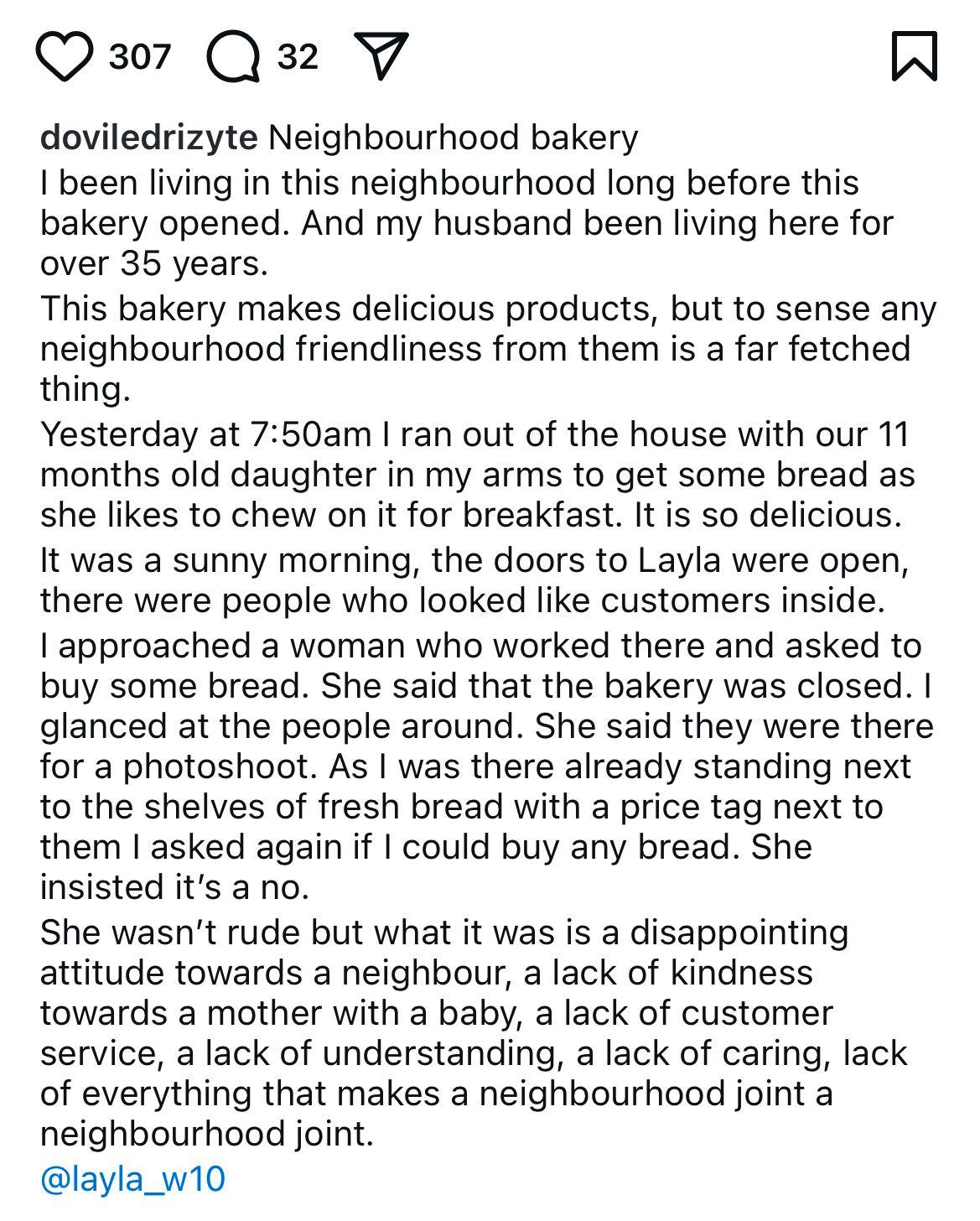
Dryzite, for whatever reason, seems to have appointed herself as the Mayoress of Notting Hill, and obviously doesn’t think there’s bowing and scraping at Layla when she deigns to visit.
We will just add that Layla is an absolutely wonderful local bakery, and if you’re ever out west, you should gorge yourself on their banana tahini loaf. Yum yum.
Exile on Greek Street
Now for some rather disturbing news. Russian dissident editor and restaurateur, Alexei Zimin, has been found dead in a hotel room in Belgrade. Zimin was an outspoken critic of the Russian annexation of Crimea, and had fled to London, where he opened a restaurant in Soho called Zima. Tragedy tinged with glamour? It’s another slice of ‘London noir’, and if you haven’t read Clive Martin’s immediate classic on the genre, then now is your chance.
The Serbian capital has been flooded with Russians since the start of the Ukraine invasion. But the incomers and the locals have started rubbing each other up the wrong way, as Camilla Bell-Davies reported in Issue 20. Two very good features there, if you don’t mind us saying so.
In Case You Missed It
‘People find me quite controversial’: Sirin Kale interviews Molly-Mae. The! Molly! Mae!
A masterpiece of reportage and analysis from James Meek on Ukraine’s battle fatigue.
Ladies and gentlemen, this is Mambo Number Five: James Marriott convincingly argues that cultural energy has moved over to the right.
A fantastic profile of Matt Gaetz from Dexter Filkins in the New Yorker.
Another great piece about Frank Auerbach, this time from Michael Prodger.
And Finally
This coming fortnight till the end of the month is the perfect time to visit London’s leading attractions. On a recent visit to the Tower of London for a staff member, there was no queue to visit the Crown Jewels.
The Tower of London: such a bloody history; so strangely intact. Far too much of a living, breathing organism to be just for the tourists. There are still 150 people living within the Tower’s walls, and there is an operational pub that our pints correspondent dreams of visiting (if any of you could make this happen, we would be forever thankful).
https://www.youtube.com/watch?v=GIdzbsgKvzo
The community at the Tower is captured in this charming BBC documentary from 1985, made by John Pitman, and which enjoys a level of access that just wouldn’t be granted today. Pitman has a lot of fun at the expense of the head of the armouries – and you should too. Watch it here.
That’s it for this week, and we’ll be back on Tuesday. As you will see, there are a number of exciting treats on the shop page. We’ll be talking about them in greater detail then.
If you enjoyed yourself, do buy something there, or you can smash that ‘like’ button below which just makes us feel good about ourselves. If you’d like to talk to the editor about an order or any other technical issues, please email support@the-fence.com and you will be attended to promptly. Until the next time.
All the best,
TF