Dear Readers,
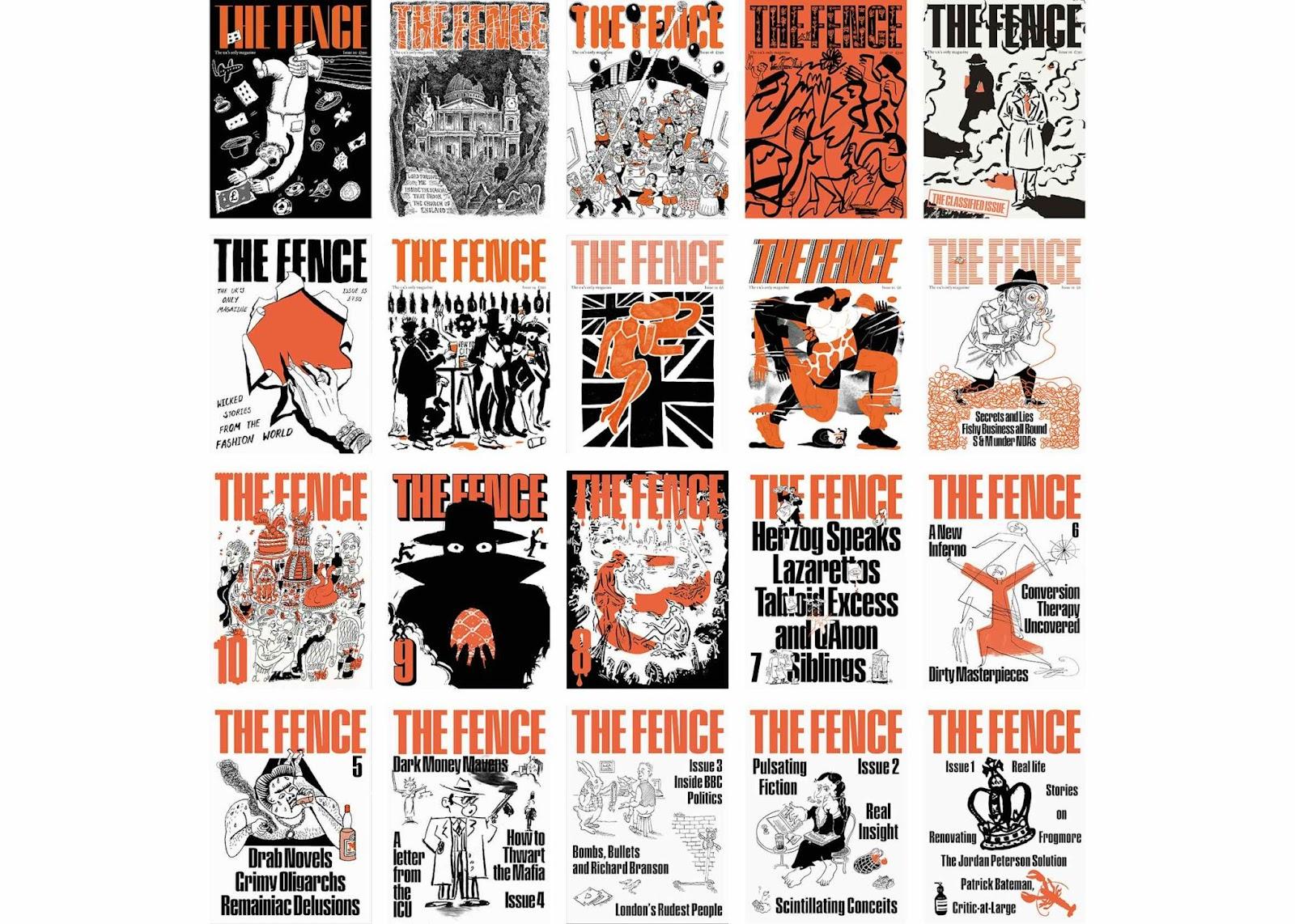
Good afternoon, and welcome to Off The Fence, a newsletter that people enjoy. There was excitement among the high-functioning portion of our readership when our editor appeared on the Today programme at 7.40 in the morning to talk about the resurgence of print media with Bella Robathan and Emma Barnett. Is there a resurgence in print magazines? Well, there’s certainly a renewed interest in the medium, which makes us very happy indeed.
Younger readers are discovering the possibilities of ink-stained pages and the oldsters are remembering what it’s all about. And The Fence is here to provide a bridge between the two – largely because two of our editorial staff are now middle-aged.
Issue 23 lands next week, so if you’re an existing subscriber, please make sure your details are correct on your account on the website. If you haven’t yet signed up, then an opportunity presents itself: subscribe today and receive Issue 22 this week and Issue 23 the week after. Two pieces of post in less than seven days from a quarterly magazine: life really doesn’t get better than that.
On our new mail-out, Capital Letter, our pints correspondent Jimmy McIntosh – the Richard Brody of pubs – has helped us choose London’s 25 Best Boozers, in what we regard as a definitive and unimprovable list. Do join us there, we’re having lots of fun.
Let’s get it going. This week, we’ve got a tribute to a bohemian couple, some words about Alex James, but first, let’s talk about a man very much in the news.
What’s the Matter with Gazza?
The tax campaigner Gary Stevenson is having a moment. His book, The Trading Game, is at the top of the charts for the eighth successive week. He’s got over a million subscribers to his YouTube channel and he’s the toast of Question Time.
While it’s heartening to see someone bang on about wealth inequality on primetime TV, he’s still repeating the claim that he was ‘the best trader in the world’, despite this vaulting braggadocio being debunked by the Financial Times (according to his colleagues, he wasn’t even the best performing trader at Citibank).
As we detailed in a previous newsletter, Stevenson intimated that he received a seven-figure advance for his book, and that ‘it was the biggest advance that Penguin ever paid out’.
Regardless, the team at Penguin do have his back. In the acknowledgements for the advance proof of his book, Stevenson nobly tips his hat to ‘all the girls who should really have names’.
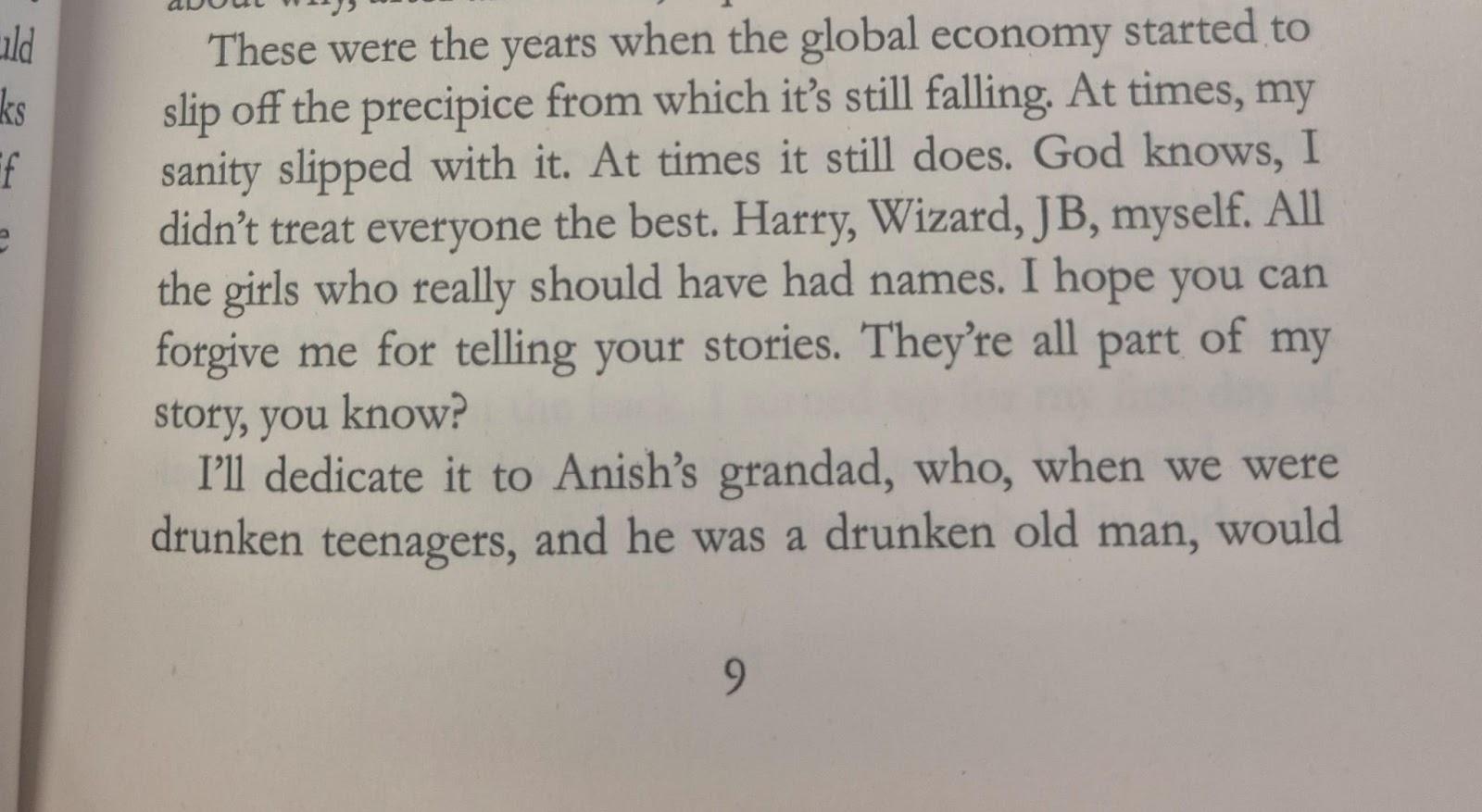
This was then amended, in the final version, to ‘all the people who really should have names’. A solid editorial intervention.
Let Me Never Be Put to Shame
Given that he’s issuing forgiveness to serial child abusers, it’s worth asking once more: is Justin Welby the worst Archbishop of Canterbury since Thomas ‘Firestarter’ Arundel? It’s a serious question, and one that Cormac Kehoe and Miles Ellingham address at length in this outstanding profile we published earlier this year. It’ll be fascinating to observe whether Welby will be able to maintain a role in public life – he’s certainly on manoeuvres to do so.
The Outsider’s Insider
Graydon Carter’s wonderfully juicy memoir, When The Going Was Good, has been blurbed, excerpted and screenshotted on both sides of the Atlantic – and has even copped a little pushback from various quarters. If, like us, you’re in the print game, then the book operates as a 50-year social history of the medium, and it’s worth reading the whole book to get the full narrative (this review by Chris Vognar really gets it).
Is the ‘golden age of magazines’ over? Well, there are still lots of great magazines – the New Yorker is pretty good, and there are lots of writers making serious bank, but not from staff jobs at magazines. You only need to look at the healthy state of the publishing industry to see what is possible. Right now, print media needs fresh editors and financial backers, but more importantly, it needs a business visionary to address distribution. The audience is still there, and it is waiting.
The Brexit Sex Dungeon
Alex James still has great hair for a 56-year-old man, but his coolness has been in retreat for years, from wanging on about cheese at great length, co-creating a line of sparkling wine called Britpop Brut, claiming he spent £1 million on champagne and cocaine in his heyday, to befriending David Cameron and Jeremy Clarkson in the ‘Chipping Norton set’.

Alas, we have just learned that the bassist for Blur is a member of 5 Hertford Street, the Mayfair club where Nadine Dorries wrote her most recent novel, and whose clientele may well put you in mind of one of Blur’s more consistent earworms. We couldn’t possibly comment.
Spice World
The terror began, unsurprisingly, in Broadway Market. At the tail end of the street, a stall popped up, unassuming at first, but quickly snaked with queues of mullet-having, Claddagh-wearing, GAA-supporting Irish. Emerald Eats sold chicken fillet rolls and spice bags, and the crowds ate it up. As soon as London had a taste for the spice bag though, they became insatiable. Now, in 2025, spice bags are ubiquitous across the city, but particularly in the London-Irish enclaves of north and east London.
In Finsbury Park, you can get a spice bag in the Twelve Pins for £7.50 (£12 sharing). South-east of the river you can head to Paddy Wok in Deptford, which opened on St Patrick’s Day. Scaldy's, sold out of Feeney's Irish pub in the city, calls itself the capital's ‘spice bag specialist’. When does the glorification of this culinary uisce beatha end? When does it start to become appropriation? When does Devonshire-saturation-point hit?
What began as a taste of home away from home has become, much like Guinness and the Mary Wallopers, turned into an nth degree microtrend by well-meaning but nonetheless Irish-fetishising Londoners. By the very people who love splitting the G and talking about having a great-aunt still living in Kildare. By people who earnestly patronise The Swan in Stockwell, well into their mid-30s. And it must end, before authentic spice bag culture is lost to us forever.
Keeping Things Honest
On average, an independent magazine now costs £15, and as Emma Barnett very kindly mentioned to millions of listeners last week, The Fence is only £7.50, an almost insultingly low sum, and much cheaper than our peers and the online-only publications who are rebranding newsletters as ‘newspapers’ and ‘magazines’.
It is a real pleasure to see so many of you joining us. A subscription, delivered to your door, starts at just £29.99 for the year. Do join the merry throng below, or buy a magazine, a tote bag or one of those beautiful maps.
Father Time
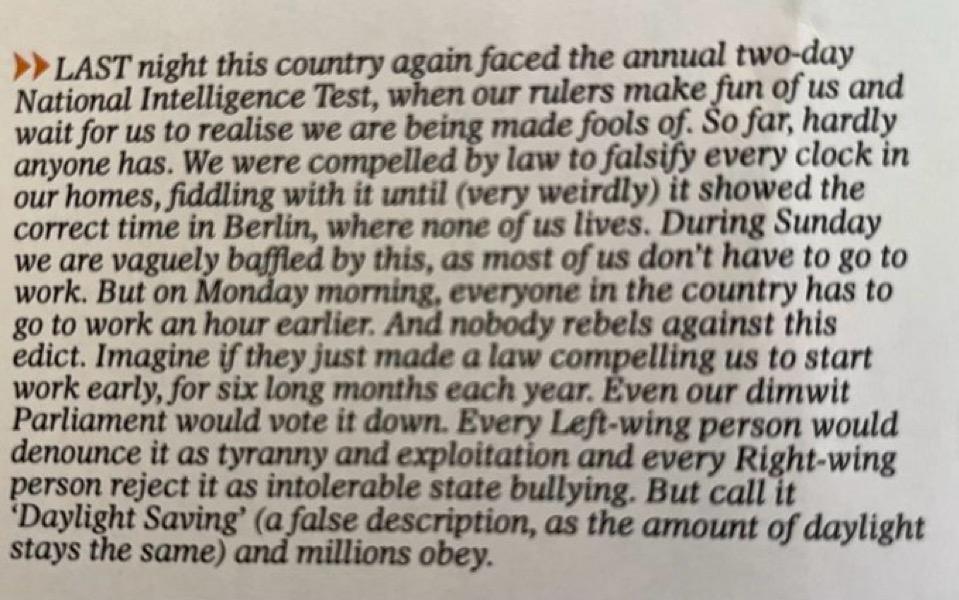
In last week’s edition of this very newsletter, we told you to keep an eye out for Peter Hitchens’ bi-annual jeremiad against the iniquities of Daylight Savings Time or, as he all too memorably refers to it, ‘Kaiser Bill’s clock-meddling folly’.
As an obedient sort, we trust you did just that, but in case you were not glued to his column this weekend, it gives us great pleasure to report that our man in Oxfordshire lived up to his billing, penning a blurb that was, even by his mighty standards, a truly swivel-eyed rejoinder to the nefarious time lords.
We’d like to take this opportunity to salute the indefatigable Hitch. Truly, the last thing in Britain that you can set your watch by.
In Case You Missed It
Leo Robson: father of three, debut novelist and master of short-form video content.
Mark Seddon remembers The Gay Hussar, the ‘Hungarian’ restaurant on Greek Street that served as the ‘left’s cafeteria’ for the latter part of the 20th century – the story about Frank Longford will rock your world.
A great London Noir story from the Dark Luxury newsletter. The police are raiding luxury counterfeit goods stores in Camden, only for them to be restocked just a day later. Conrad Quilty-Harper investigates.
Sian Norris on the sorry life and pathetic death of the Bibby Stockholm, the UK government’s prison barge.
WIRED’s Will Knight on Forth, the programming language for the apocalypse.
And Finally
Diana Melly, the author and novelist who died earlier this year, was best known as the wife of George, the roué Liverpudlian jazzman fly-fisher who wrote perhaps the best book on what was first known as ‘pop culture’.
George died in 2007 of vascular dementia and lung cancer, and his final days are beautifully captured in this documentary, which also acts as a portrait of his wife, and their marriage together. We all face the imminence of death in different ways, but not all of us take to the stage with a full brass band:
https://www.youtube.com/watch?v=WrN1Wkulh8E
That’s that for this week, if you enjoyed it, do drop a ‘like’ just below, or better still, buy something from the webstore here. Please remember that the width of Australia from east to west is greater than the diameter of the moon. For now, enjoy the sunshine. Spring is sprung and all is well in the world. Stay cool, remain hydrated, and we look forward to joining you again next Tuesday.
All the best,
TF