The Quiet Revival

Gen-Zs are gathered in their Masses in Soho.

Mass began at 6 pm on a Friday. The church was the double-barrelled Our Lady of the Assumption and St Gregory. Located in Soho, it is the oldest Catholic church in England. Yet the congregation for the service aren’t pensioners. Those genuflecting and filling the pews are all in their 20s. 

The chaps wear their Sunday Best: suit, tie and, completing an unofficial uniform, a Barbour jacket. A solitary young woman in the front pew wears a black mantilla veil. Rosary beads are fondled, candles are lit and silence falls. The organ begins the entrance hymn to Our Lady: ‘For Mary, mother of our Lord, / God’s holy name be praised…’ 

Ironically,  you may have heard of this phenomenon: The Quiet Revival. The young are returning in legion to the church. Converts, reverts, the curious and the once damned. Specifically, Gen-Z Catholics may soon help the Roman Catholic Church to surpass the Church of England in active attendance for the first time since King Henry VIII’s bigamous impulses created the latter in 1534. 

The Sign of the Cross delivered, Father Christian de Lisle begins the Penitential Act: ‘Confiteor Deo omnipotenti et vobis…’ What is it about Catholicism? The Latin, the incense, transubstantiation. Evelyn Waugh once summed it up as ‘the Alice-in-Wonderland side of religion’. In fact, Waugh attended the very church we are gathered in this evening. 

Those of us that were raised Catholic may remember the aching legs during Holy Communion, the confession box, and the dreaded Easter Mass that dragged on for three hours with Father So-And-So’s homily. (Need I say I’m lapsed?) But now, from Silicon Valley to Soho, Catholicism is drawing in new generations in pursuit of the sacred. Martin Luther rolls in his grave. 

The Eucharist this evening is being administered old style. Rows of young devotees kneel before the altar and the Body of Christ is placed upon each stuck-out tongue (yes, old style). Those kneeling are members of The Challoner Club. It is a private member’s social club for Roman Catholics in London. Founded in 1949, and closed in 1997, this year it has had a Lazarian resurrection. 

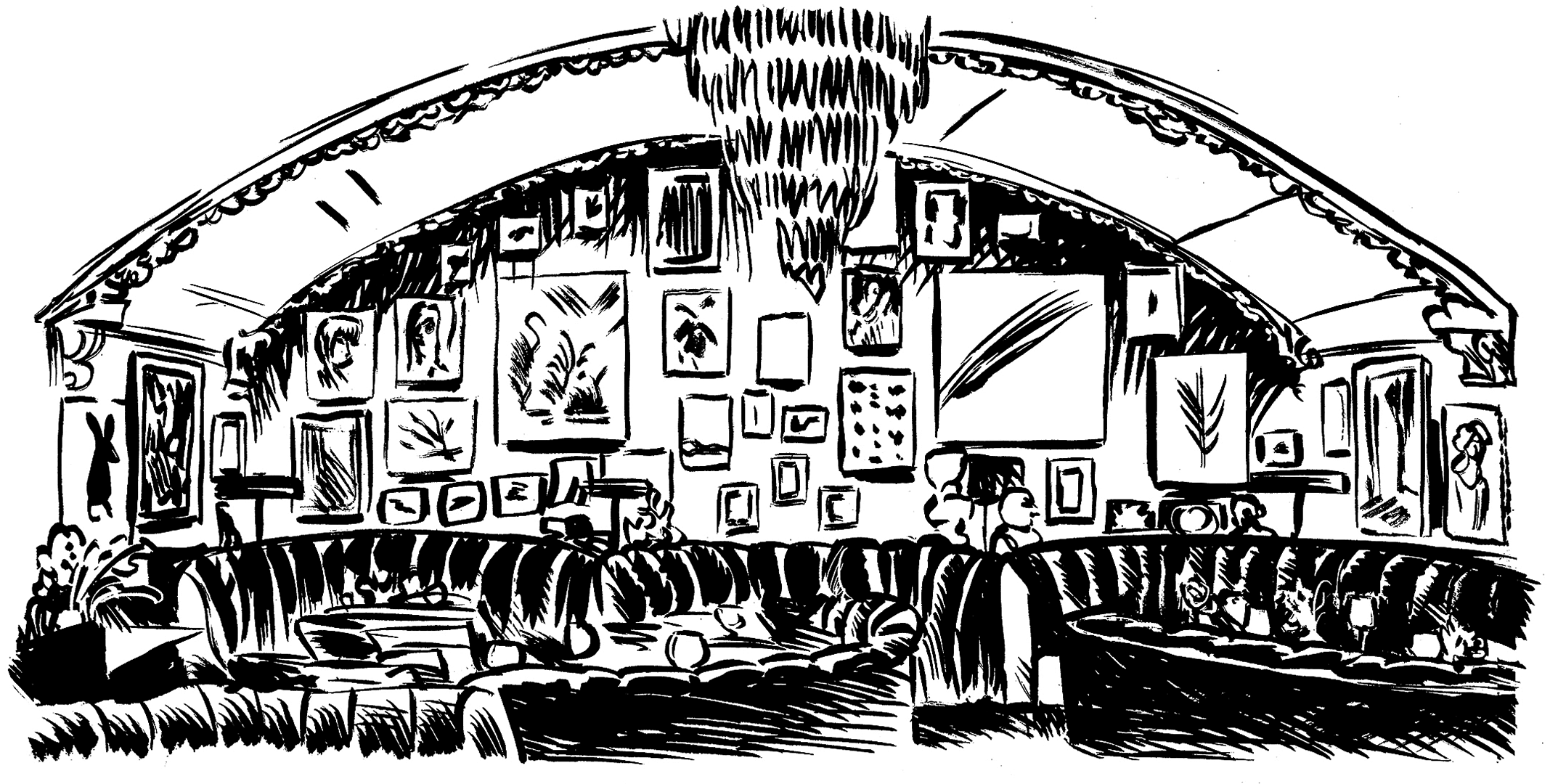
There’s a post-Mass reception at the Oxford and Cambridge Club. Guests are allowed a Holy Trinity of three glasses of wine each. Down a quiet corridor, the chairman of the club, Calder Claydon, tells me membership is nearing 80 – enough to safely pack out a Sunday service. 

Claydon converted to Catholicism aged 14. Why go on to revive a club? ‘I noticed there was a distinct lack of Catholicism in clubland. There are clubs for everything – different nationalities, different political beliefs – but there wasn’t anything of that kind for Roman Catholics.’ 
Despite the genteel air of the club and our surroundings, Claydon sees it as challenging a history of anti-papism among high society. ‘Catholics have been traditionally, post-Reformation, excluded from these circles’, he explains. But that has now changed with The Challoner’s revival: ‘It goes to show that, not only are we now welcome in these zones, but quite right we should be! We are not here to subvert, and we are not here to cause issues, as some Reformation figures might think.’ 

Still, The Challoner Club bears a passing resemblance to Brideshead Revisited. Whilst none of the Flytes have taken up membership yet, Lord Petre, descended from a long-line of English Catholic barons, is an honorary member of the club. Viscount Monckton is also affiliated. A monseigneur attends the reception in his cassock. ‘But I don’t think we have to rely on these people’, Claydon counters. ‘We’re not here to be a hub of people who are aristocrats. We are here to be a hub of people in clubland who are Catholic… and if some of them happen to be aristocrats, the more the merrier. It doesn’t mean we’d exclude a chap for not having a title.’ 

Catholicism in contemporary Britain appeals because it is ancient, sacred, baroque. At the same time, it’s popping up all over social media (have a glance at ‘Catholic Tok’, if you dare).  The sacred and profane are always two sides of the same coin. Nevertheless, this coterie of young Catholics repeatedly assert their traditionalist credentials.  

Outside the club, I spot the young woman who was sporting the black veil in the front pew. She attends confession weekly, and this is apparently common among young converts to Rome. The Tridentine (Latin) Mass also appears popular among the club. This has been a source of contention since the reforms of Vatican II in the 1960s which began to see Latin partially replaced by the vernacular as the language of the liturgy. ‘I would like the Old Rite’, she tells me, ‘but unfortunately it is being cracked down upon by the hierarchy. I think that priests and the faithful should have the liberty to say whichever Mass they feel brings them closer to Christ.’  

There’s one spot, The London Oratory, which is still doing the 1962 missal (‘Latin Mass’) on Sundays, but you’ve got to get up at 8 am for that. Forgive me, I ask, why is Latin Mass restricted again?

Ah, of course, Pope Francis’s apostolic letter, Traditionis custodes. Different Popes, to various extents, have either encouraged or restricted the traditional Latin Mass throughout modern papal history.  

Thus, Vatican politics rears its holy head. The young woman who wore the black veil continues: ‘The Church has dealt with many Popes. Some were complete heretics – the Borgias come to mind. Some have been saints, especially recently. I’m a personal fan of Pope Benedict. It’s early on in Leo’s career as a Pope – we’ll see. Francis certainly…. Well, I’m sure you’ve read and can see for yourself what people think about him.’   

Early marriage is also making a comeback. Another member aged 22 – who converted to Catholicism having perused Aquinas’s Five Ways in his teens – has already tied the knot. ‘We’d been going out for a while and wanted to move to London. And you can’t ask someone to move to London and then say, ‘Ah, but I can break up with you at any time!’ I wanted a sacred bond, and that bond is marriage.’ He knows of other Catholics in their 20s who have also taken this decision. 

Contrition, the Rosary, Mass at 6 pm on a Friday. What may be drawing our young zealous brethren to these practices in contemporary London? ‘There’s one important thing’, a proselyte tells me, ‘it’s not tradition, it’s not dogma, that’s converting people. It’s social media.’ He later warns: ‘Young people, if they read Catholic theology, they need to be rooted. They need to have that iron in them. Unfortunately, in my opinion, I don’t think young people have that iron in them.’ 

During the service, the church’s glass entrance doors are eternally swinging open due to the steady flow of latecomers. The drunken revelries of Soho can be heard intermittently. A young man in front of me, who has a fine baritone voice for hymns and rosary beads draped around his right hand like a bandage, keeps turning back each time the door opens. Large startled eyes. Father raises the Eucharistic bread. The congregation repeat, ‘Domine, non sum dignus, ut intres sub tectum meum…’ – the doors open once again – ‘sed tantum dic verbo, et sanabitur anima mea.’ And then there is silence. 

You've reached the end. Boo!

Don't panic. You can get full digital access for as little as £24.99 per year.

Get Offer

Register for free to continue reading.

Or get full access for as little as £24.99 per year.

Register Subscribe

Already a member? Sign In