This writer is British and Bangladeshi. Somehow, she is also neither. She looks to the nation, and keeps score.
In Bangladesh, where I was born, they call me ‘Bideshi’. Foreigner. My closest relatives say it, not with contempt or disgust, but affectionately, with a curious sense of awe. They coo ‘Bideshi’ despite my flat, Bengali nose; my round, Bengali face; and my immeasurable tolerance for spicy food. They are protective of me and my western sensibilities, unsuited to their tap water or their climate. Although I speak Bangla fluently, over there I’m illiterate. I never learned to read or write the complicated script. At home, other Brits hear my smooth, lilting English, and are shocked to find out that I was born at Holy Family Hospital, in Dhaka. Some look betrayed and my cheeks burn with guilt, as if I’ve deceived them.
We moved to England when I was three years old. The pages of my Bangladeshi passport have become so gummy that I have to prise them apart with a nail file. Inside, there is a handwritten note of my height, 80cm, and a photograph of me looking terrified in my favourite dress. Other relatives had settled long before us. In the sixties, my eldest uncle had relocated to be a GP in Southgate, London. Another arrived in the seventies to go on to work as an electrical engineer at a glass factory in West Yorkshire, subjecting residents of Castleford to perhaps the first brown face they would ever see. My father had flown out a few years earlier to make the necessary arrangements for uprooting our lives – and this long stretch apart would mean that when we reunited, I would ultimately fail to recognise him. Before we’d left, my mother had palmed the walls of her childhood home and wept. She tells me I was mercifully quiet during the 13-hour flight. I’d fisted one hand in the silken pleats of her sari, and with the other I sucked on my fingers, tasting them for salt. I have, of course, virtually no memory of this journey, nor of my life prior to it. Landing for that first time in Heathrow in 2001, I was twice-born.
I grew up in a relatively diverse part of the country, where other, higher-ranking members of the diaspora had choice words for people like me. ‘Freshie’, as in, fresh off the boat. ‘Yardie’, co-opted from Jamaican Patois, was an ethnic person from a nondescript ‘backyard’. Certain missteps guaranteed you a ‘Fresh’ label: accented or mispronounced English, being spotted in public wearing Desi clothes, or, in my case, committing the cardinal sin of being born elsewhere. I quickly learned to keep this shortcoming a secret. When I first enrolled in nursery, the teacher asked my mother to accompany me for a week because I couldn’t speak a lick of English. Afterwards, I spent an inordinate amount of time sharpening my Home Counties accent and reading novel after novel until I’d caught up with my peers, then surpassed them (at which point I was at risk of being dubbed a ‘Coconut’, instead). Still, I was perpetually afraid of slipping up, which felt tantamount to being caught and arrested in a sting operation.
‘Freshie’ existed, mainly, to distinguish the birthright-havers from their have-not parents or grandparents. To distance them, I suppose, from the utter indignity of emigrating; of traversing continents in search of a better or safer or more prosperous future. This singularly self-sacrificing act, when undergone by brown or black people, seemed to reek of desperation. And many second and third generation immigrants – who, paradoxically, aren’t immigrants at all – did not want others to catch a whiff of that stink on them.
I, for one, have always resented British-born Asians. Their sense of identity appeared to come so easily and unthinkingly. I imagined that when confronted by racists to ‘go back to where you came from!’, they’d simply, smugly, quip that they were born in Tooting or Tower Hamlets. And what would I say, if similarly attacked? I had no such response up my sleeve.
Second-gens and beyond have a superior kind of citizenship to mine: implied, non-negotiable. Whereas I have silently weighed up my Englishness for years, tallying up arbitrary points on a rolling mental scorecard:
- Not born on British soil, -20pts.
- When eating spicy food, has never said ‘ooh, this has got a kick’, -9pts.
- Has bad teeth, +2pts.
- Has backpacked across South East Asia +8pts (but not during a gap year -2pts.)
- Studied at Oxford and still attempts to steer any conversation towards this fact whenever feasible, +1pt.
- Has a white, middle-class fiancé, +10pts.
- Has a tattoo in an eastern script they cannot read, +2pts.
- Has never texted a radio show to ‘keep the tunes coming’, -2pts.
Although, there is much that has afforded me a smoother ride than other South Asian migrants. Sarah is, of course, a white-girl name. Sarahs are blondes or mousy brunettes with tiny, pink nipples and imperceptible arm hair. I have noticed that after telephone or email correspondence with me, people expect to meet a skinnier, paler Sarah. I have often felt like an interloper in their midst. But if my name makes me tolerable; the white, middle class fiancé ascends me into the ranks of the palatable. It is possible to draw a straight line, aesthetically, from my obsession with brown-girl-white-boyfriend Joe in Bend It Like Beckham to my own brown-girl-white-boyfriend, Sam. The same sharp cheekbones, the same strong nose, the same ruinous jaw. Sam has, unwittingly and uncomfortably, lent me a huge amount of cultural currency. White people smile at us on public transport and on Big Walks. During our trips to villages or rural towns, they are genial; reassured, I assume, by my proximity to whiteness. This can be more infuriating than pleasing. I worry that they’ll liken me to a Priti Patel or a Suella Braverman: a sycophantic, delusional brown woman who has seemingly acid-washed her background on the off chance that the Sahib will overlook her melanin and see her, foremost, as British. In these moments, I feel a desire to clarify our dynamic – Sam has learned to read, write and speak Bangla so as to communicate freely with his future mother-in-law. I say this smiling. It is my turn to be smug.
Still, these plus points have done little to actually insulate me from racism. I have a hazy memory from a party at my ex-boyfriend’s university house share. He and his all-white friends had convinced themselves that they occupied an alternate, post-racial reality wherein the casual, downright giddy use of slurs and racist rhetoric was permitted because they were – very heroically – attempting to take ‘the power’ out of these words. We were playing some sort of drinking game, during which one of his friends made a joke about our preferred form of foreplay: colonial, obviously, master and slave. I had laughed along, or maybe I had even agreed emphatically. It is hard to know for sure. I have long repressed this shameful memory, folded it down again and again into a tiny, thick square in the hope that it might get lost. Yet, I remember their expectant gazes on me, vividly, urging me to be a good sport.
Most recently, I was at a pub in Doncaster where Sam’s band was playing upstairs as part of their Music Venues Trust tour. An old man swaying on his feet yelled over the snooker table at me, ‘Do you like Biryani? Curry, too?’ I stopped short at this, completely bewildered. Sam responded angrily, ‘What did you say?’ and when the man grumbled that he wasn’t in fact talking to him, he told him to ‘Fuck off, then’. Later, Sam had the man removed from the premises by a security guard who seemed glad to manhandle him. I was shaken. The others blanched. I found myself wishing that he’d just called me a Paki instead. At least, then, I could rest assured that the twisting pang in my gut was not an overreaction. At least, then, I would have something tangibly awful to point to when I burst into tears that night in our Travelodge room.
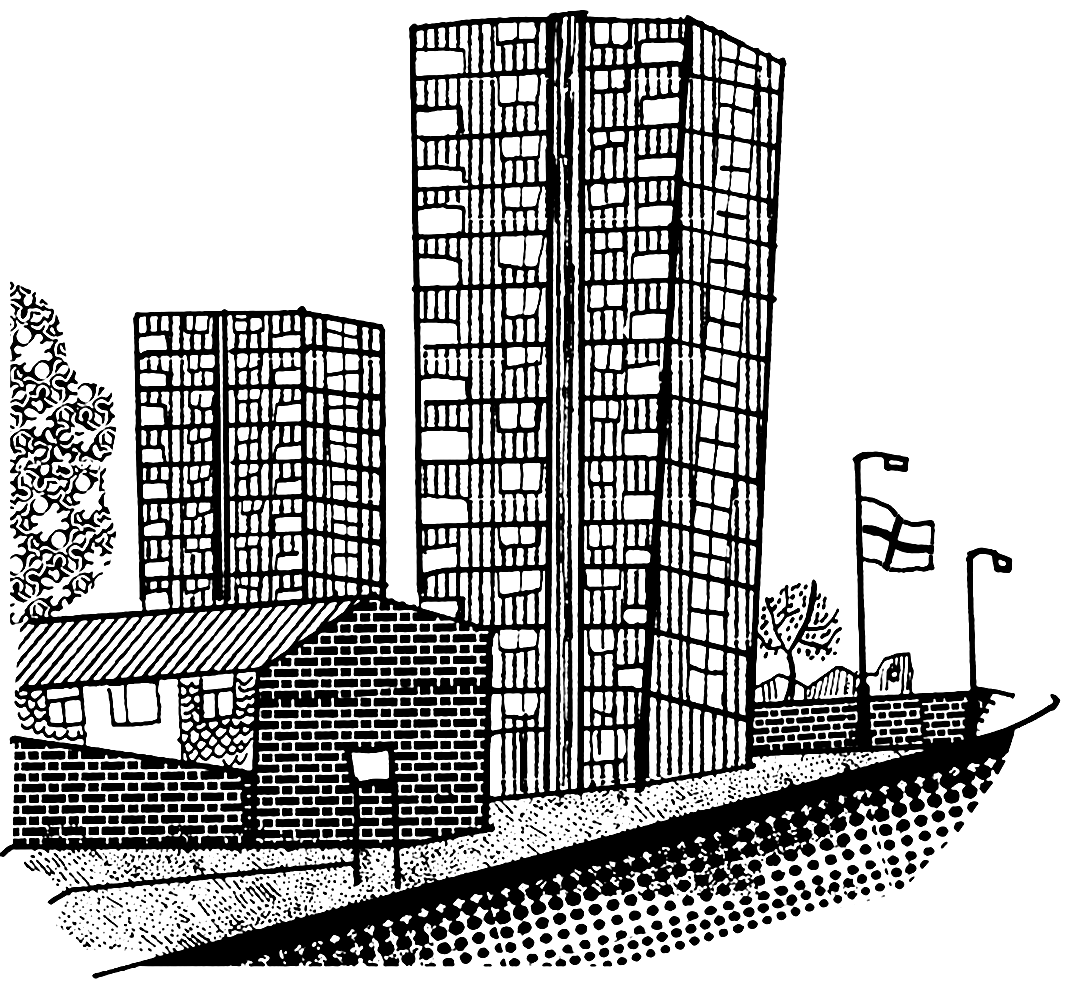
In the months since, I have been preoccupied with a certain kind of sonder. Watching other brown people on trains and in cafés, in corner shops and at the post office, walking past flags hoisted onto lampposts or graffitied onto roundabouts – imagining their own unique, knotty constitution, and understanding for the first time that, while citizenship can be awarded, a sense of belonging can only come from within. There are, possibly, as many ways to be British Asian as there are British Asians. And while I no longer feel a need to prove my Englishness to others, I will continue keeping score, largely because it reminds me of how my country has shaped my sense of self. Racking up points with no medal or trophy to show for it, probably +2pts. Ending an earnest thought with a self-deprecating joke, that’s got to be +5pts at least.