
Dear Readers,
Good afternoon and welcome to Capital Letter. This is our fifth outing, and we’re having a truly wonderful time. Last time out, we detailed the 25 best pubs in London. Now, as the sun beats down, we’ve got an array of tips for the weekend and beyond. There’s a wonderful sense of promise in the air, the streets are electric with possibility – there are so many things to do.
At present, this newsletter is fortnightly, and then it will be weekly, and behind the paywall. Thank you to everyone who has become a paid subscriber in the last week, it allows us to become more ambitious with what we do here. Do join the merry throng.
If there’s somewhere you think we should cover, then please do get in touch at editorial@the-fence.com. We’re also keen to hear from people who’d like to write for us, too.
On the docket for today, we’ve got the campest church in London, our first theatre review but we begin with a dispatch from a must-see show in south London.
Stunting in the Bando
UK drill music might be London’s most exciting cultural export of the last decade. Titillating, terrifying, ingenious, glamorous, its leading artist, Digga D, was arrested while livestreaming in Lincolnshire last summer. Is that how every scene dies?
Caught Lacking. OJ. Wetting. Any Elizabethan playwright would have marvelled at drill’s linguistic dexterity, but most Londoners never bore witness to the shivvings and cheffings that it chronicles.
It is, self-evidently, a transgressive form, one that the liberal media doesn’t know what to do with. Following the moral panic that accompanied its emergence, we’ve failed to take stock of its extraordinary cultural significance. Now, with music videos being wiped from the internet for their violent content; and with rappers being jailed in droves, an exhibition just south of MI6 headquarters lies as an elegy. With Anti-Blackness Is Bad, Even The Parts That We Like, the artist RIP Germain canonises and commemorates something that’s slipping into the ether, even in the digital era.
At the ground floor of Cabinet, a modernist pavilion of a gallery in Vauxhall Pleasure Gardens, the show is barren. Through a grate in the floor, a commotion in the basement is barely visible and audible: red and blue flashing lights, shouting voices and undulating basslines. Downstairs is dark, morgue-cold and smells of bleach. Here is 101 hour psycho (2024–25), a video installation that looks like a casket that looks like a flipped police wagon. In a nod to Ghanaian fantasy coffins, it hinges open to reveal a claustrophobic cubby hole, to which you are invited, not compelled, to lie within. A screen only six inches from your face autoplays footage from RIP Germain’s four-day-straight drill archive. You are locked in.
Of a visit, you might see a music video, phone footage of a beating, stabbing or face-slashing or a Channel 4 roundtable. Enduring this while lying on your back in a dark, confined space is, it goes without saying, deeply uncomfortable. At best, it’s a dystopian doom scroll. At worst, it feels like being trapped in a cell, if only in an art gallery.
The footage drives home the fact that drill, for its protagonists, is real life. RIP Germain says that’s why we love it. In the Guardian, he told Eddy Frankel that ‘people nowadays are starved of culture, so anything that seems like the real deal they gravitate towards.’ But it’s also why it’s dying. Last month, Conservative MP Ben Obese-Jecty stood up in Parliament to lament ‘The celebration of criminality via musicians,’ in a speech that took specific aim at drill breakout star Headie One.
As much as we think we like rule-breaking, it’s too much for us when done properly. RIP Germain lays drill to rest alongside acid house and punk as a cultural movement whose attendant public outrage hampered its longevity. Then again, all scenes, all movements, are doomed to die their death. At least some scenes are allowed to write their chronicles.
Anti-Blackness Is Bad, Even The Parts That We Like runs until 10 May at Cabinet.
Hugh Corcoran: An Apology (of sorts)
Our newsletter sibling, Off The Fence, ran a review of Yellow Bittern chef Hugh Corcoran’s cuisine last year. It was – and still is – the most popular mail-out we’ve ever published. One small thing, though: our critic, Joe Bishop, didn’t visit Corcoran’s current bolthole on the Caledonian Road, but his previous pop-up in Vauxhall. Last Friday, in a bid to update our records, a member of the editorial team made the trip to the Bittern, and was pleasantly surprised by the quality of the fare. The soft soda bread was wonderfully fresh, while the rabbit pie, which was shared, was chewy and nurturing.
London lags behind every other European capital in its appreciation of natural wine, with Jay Rayner’s puerile name-calling emblematic of a generation of critics who seemingly have no interest in testing their palate and expanding their knowledge. The all-natural selection at the Bittern comes without a written list, and the wine is obviously Corcoran’s leading passion. You tell him what sort of thing you’re interested in drinking and he provides four options. Our table of four had a sharp white Burgundy and a crunchy Ardéche, marked up twice above retail value. Both bottles were outstanding.
As it’s a cash-only business, the door is locked, and you have to be buzzed in by a member of staff, which does make you feel like you’re on a stage set, given the tightness of the room, watching your fellow guests come and go. The clientele is very much the type of diner you would encounter at Café Deco, St. JOHN or the RCA summer party.
So, an agreeably eccentric business, operating with confidence and brio, the sort of place of which there should be more of in London: that much we can say. One may find it hard to forget those Instagram posts, now temporarily lost to the ether. Unnecessarily provocative, certainly, but we can hardly say they didn’t do the job because, well, here we are.
It is, of course, a luxury to be able to set your working hours, especially in this economy and digital age. The Yellow Bittern is famously open at weekday lunchtimes only. Surrounding the restaurant, at the tail end of the Cally, sit a number of eateries – like the excellent Thai restaurant, Supawan – which do not have the benefit of legacy media coverage. These, like most such places in London, can only earn a crust by being open seven days a week. It’s tempting to wonder what they think of it all.
Giving it the Horn
Theatre in London was, for at least half a decade, both bloated and undercooked. There are five-star shows all over town, and we’re sure you’ve read about them elsewhere. We’re going to Islington, though, to watch something challenging.
The Almeida’s recent production of Ionescu’s absurdist play Rhinoceros has come in for what the luvvies refer to in hushed tones as, ‘mixed reviews’. Half of the press are enamoured with it as ‘brilliantly mischievous’, but for the rest it’s ‘excruciating’. What’s strange is that much of the criticism for the production seems to blame the production for being what is – absurd. Critics have lambasted the play – in which residents of a provincial French town turn into Rhinoceroses – for lacking a ‘sense of pervading menace and fear’, being obsessed with ‘maximalist metatheatre’, or for not being fully committed to getting us ‘caught up in the story’... as if this were not rather the point of the theatre of the absurd.
The production is ridiculous in the best way: there is live foley, a cat-watermelon and a camp little grey rhino onesie, tail included. But it is also full of startling images. At the curtain call, the production makes its audience question whether they should even applaud as the protagonist continues to belt out his plea for humanity – they follow the convention even when doing so drowns out the hero on stage.
Another reason for the critical displeasure is that this production is more nuanced in its approach to the text. Usually, a straightforward narrative about how totalitarianism is bad, a message the liberal theatre masses crave like a masochist craves the whip, this production isn’t willing to be like other Rhinos. It asks wider questions about what it means to communicate or belong to a group, and when it does get on to the topic of groupthink, it dares to ask a weirder, darker question: wouldn’t it be nice to be a Rhinoceros?
Even where the production is not perfect, it is a shame to see it branded with harsh reviews because – like it or not – Rhinoceros represents a (cough, cough) dying breed within British theatre at the moment. More and more, the scripts read like TV, the actors are wearing mics, and projection floods across the stages of the land (if this appeals, see Punch at the Young Vic, Steve Coogan’s Dr Strangelove (now in cinemas!), or anything at all in the West End). For anyone who prefers theatre to a ‘theatrical event’, this is the play to see. It is a genuine rarity: a live wire experiment, happening in real time, in a real room, full of real people.
Rhinoceros is at the Almeida Theatre till 26 April.
New To The Parish
Which is the most soulless part of London? It’s a hotly contested title. A strong claim must be made for Regent Street. Supposed to be the great thoroughfare at the heart of Regency London, it’s now very hard to discern, amidst its faceless chains, any heart at all. However, a mere hop, skip and jump from greying late capitalism is an absolute gem of a church, which might just lift your spirits if you have the misfortune to find yourself nearby. Margaret Street is one of the small side streets that lead off into the mazes of Bloomsbury. Towards its end, there is a sudden explosion of patterned Victorian brickwork and an ornate iron gateway into a small courtyard. At the back of this rises a vast gothic edifice. This is All Saints, Margaret Street.
If the exterior of the church is unexpected then the interior is even more so. It’s like an extended high Victorian acid trip. The place oozes camp. Every surface is an orgy of gold gilt and gothic tracery. Spend time on each wall, every pattern and careful calligraphed letter. Other churches which we recommend as part of this occasional series have specific memorials, artwork or sculpture which we will endeavour to point you towards. Not so at All Saints, the attraction is the whole. With the possible exception of the interior of the House of Lords, there is literally no space in London quite like this. It makes much of the V&A look like it came from the IKEA catalogue. It wasn’t always the extravaganza which you see in front of you now; the Margaret Street Chapel began life in the late 18th Century as a non-Conformist preaching box, plain in exterior and interior. It passed through various, increasingly bonkers, sects until it ended up as a private chapel within the Church of England in the early 19th Century.
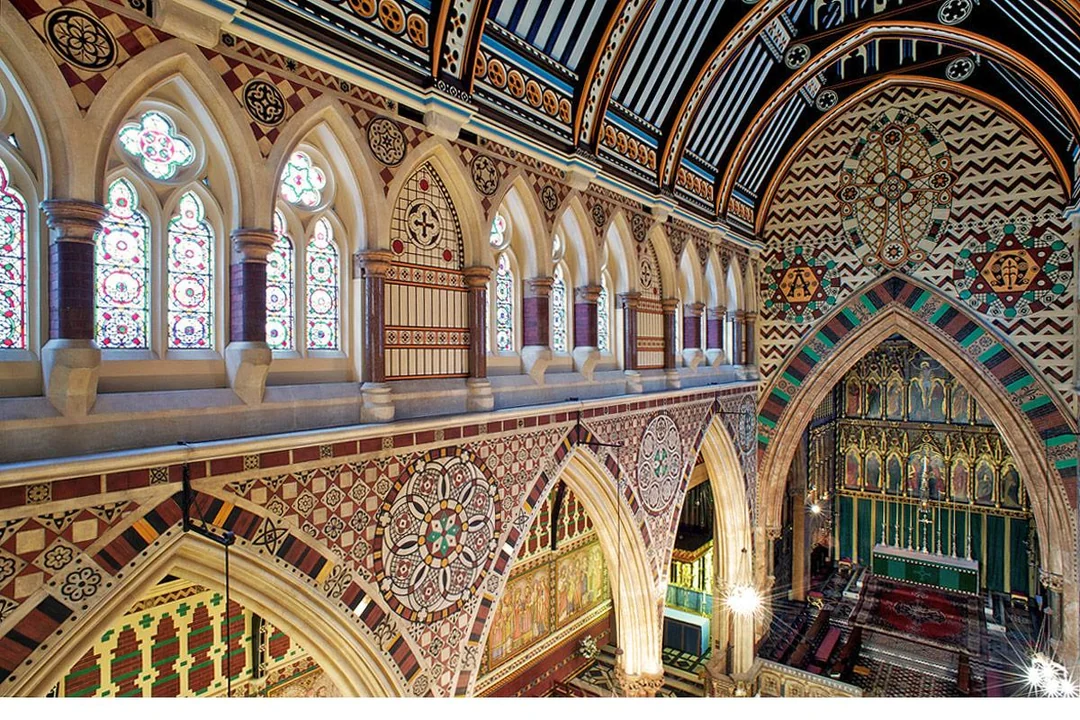
It was a suitably dull enough building to become something of a test case for the Victorians. Successive vicars in the 19th Century dragged All Saints further and further into the world of the Oxford Movement and the era’s high church revival. Alongside this came a rediscovery of gothic architecture. The old All Saints was knocked down in 1849, and the current masterpiece began, the work of the then relatively unknown architect William Butterfield. The church can make a pretty strong claim to be the single building that kicked off the high gothic revival in Britain, leading to the construction of iconic London landmarks like St Pancras and Tower Bridge later on in the century.
The liturgy of All Saints more than lives up to its architectural promise. Known as a hotbed of spiky camp Anglo-Catholicism: gin, lace and acidic tongues. There are services near constantly, though if you do visit during one of its off hours, then you’ll notice that the smell of incense still lingers in the air. The services are incredibly ornate, with world-class music. Don’t expect hymns, though: they’re all a little too Protestant for Margaret Street, and so there is only one per service (if that) and even that is sung very quietly while sitting down.
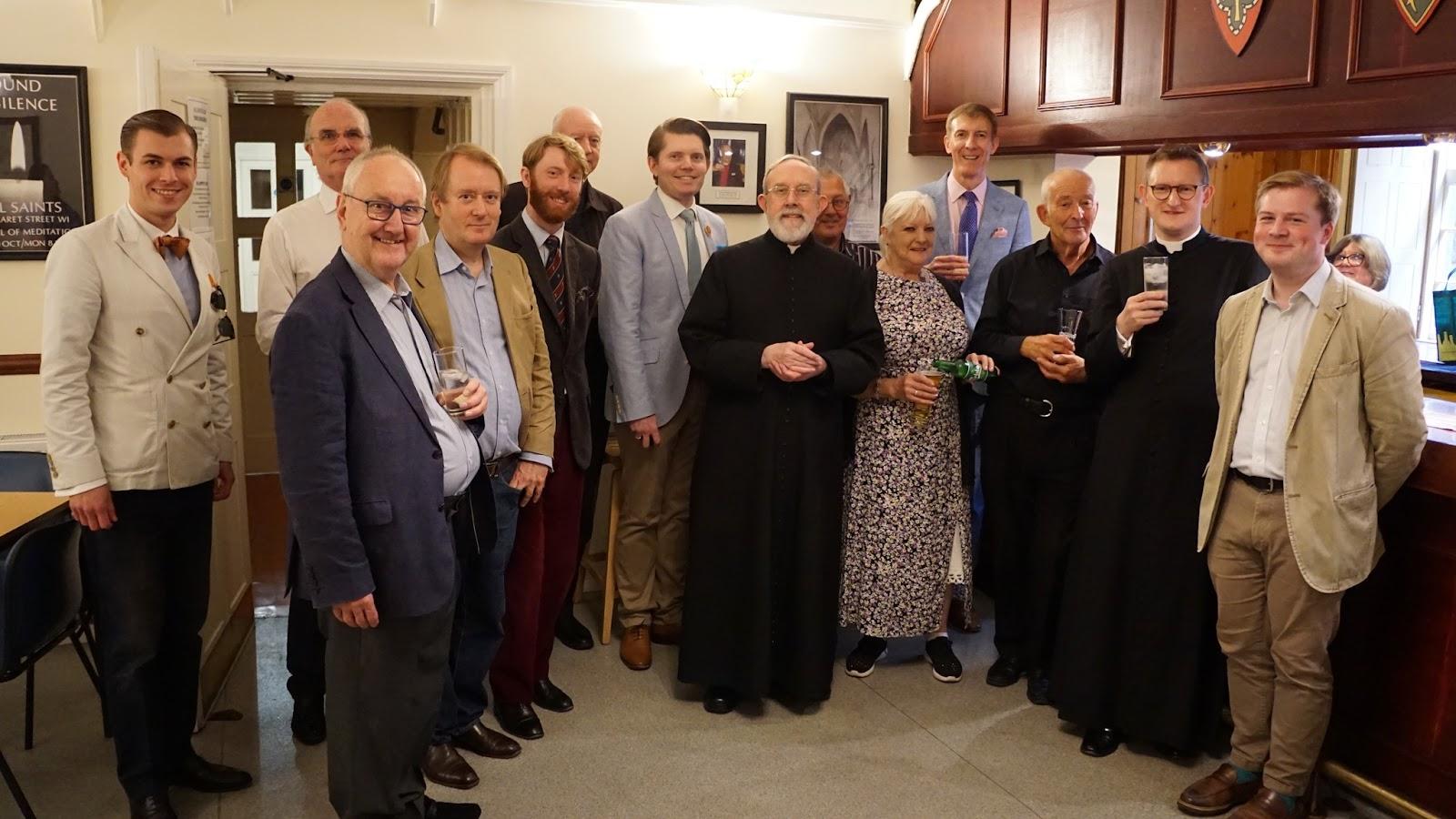
The eccentricity doesn’t stop in the services. The parish lunches take place at Le Beaujolais on Litchfield Street – the extensive cheese trolley providing quite the contrast to the world of trestle tables and limp sausage rolls that you might associate with a church meal. There is even a bar underneath the church where, after a Sunday service and on purchasing ‘membership’ for a couple of pounds, you can get what is undoubtedly the most generously poured and reasonably priced gin and tonic in central London.
We do hope you enjoyed yourself here, and do let us know how you got in the comments, and do become a paid subscriber if you had a particularly good time. We’ll join you again in a fortnight. Have a lovely weekend.
All the best,
TF